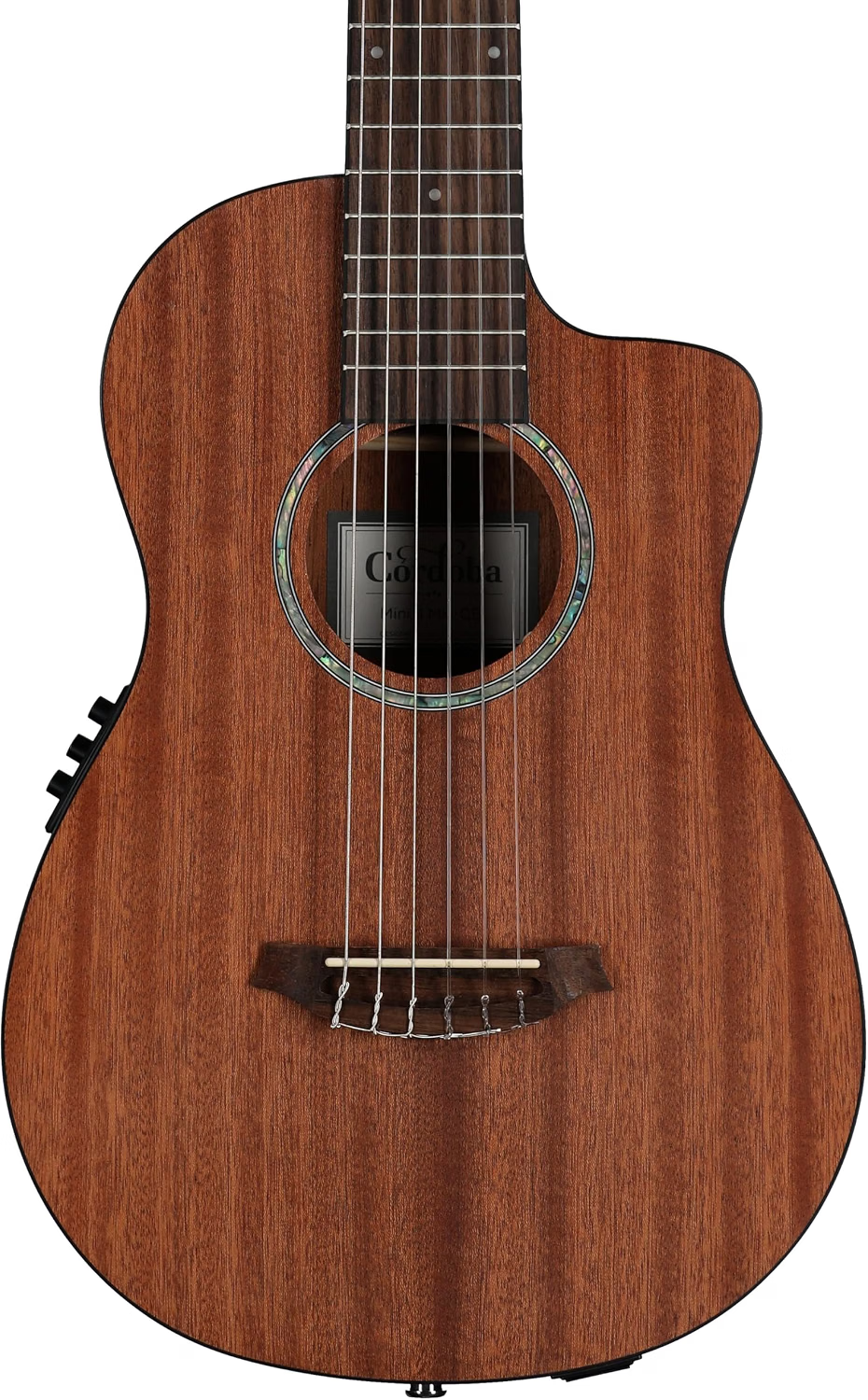
Córdoba Mini II MH-CE Acoustic-Electric Guitar
As an Amazon Associate I earn from qualifying purchases.
The Córdoba Mini II MH-CE answers a practical question for anyone who takes a guitar away from home: can you pack something smaller and still play the songs you know in their usual keys? Its six nylon strings tune to standard E, so the chords on your song sheet still work when you sit down with another guitarist. What changes is the distance between your fingers, the amount of body resting against you and the sound available before you plug in.
What You Should Know Before Buying
A shorter neck changes some chords more than others. The Mini II MH-CE has a 580 mm scale, measured from nut to saddle. That puts the frets closer together than on a typical full-size classical guitar. An open C chord asks a little less of the stretch between your first and third fingers. Move up the neck, though, and the same spacing gives three fingertips less room to form an A shape. If possible, judge the fit with a chord you find cramped as well as one you find a stretch.
The neck is also worth considering in its own right. Córdoba specifies a 48 mm nut with 39 mm between the outer strings at that end. A small body doesn’t necessarily mean a narrow neck, especially for somebody coming from an electric guitar. Think about the last chord of a song you actually play. If you like to let an open string ring beside a fretted note, the space across the neck matters just as much as the shorter reach along it.
Standard tuning is a real advantage if you play with other people. The Mini II uses E–A–D–G–B–E, low to high. Play an open G shape and the pianist beside you can play a G chord. That detail is easy to overlook when comparing compact six-string instruments by appearance. The Yamaha GL1 Guitalele uses a higher tuning, so familiar shapes sound in a different key. Either arrangement can suit a solo player, but they make quite different companions for a singer following a chord chart.
The small mahogany body brings its own compromise. At its widest point it measures 11¼ inches, and its depth at the lower bout is about 3⅓ inches. That leaves less guitar under your picking arm when you settle into a chair. It also sets a reasonable expectation for the acoustic sound. Individual notes can work well for practice and accompaniment, but somebody buying for deep, room-filling bass should listen to the Mini unplugged before choosing it. Turning up an amplifier later will help an audience hear you. It won’t change what comes back to you acoustically in a quiet room.
The electronics are useful if you have something to plug into. The MH-CE has an undersaddle piezo pickup and a Córdoba MG102 preamp with volume, bass, treble and a tuner. For a small performance, that means you can connect to a suitable amplifier or PA and adjust the level from the guitar. The two tone controls give you a straightforward way to soften a bright amplified sound or trim excess bass. The preamp also adds a battery to keep track of, something to check before taking it out for a rehearsal.
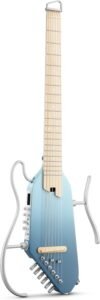
There’s a distinction here for anyone buying a travel guitar for hotel practice. The Córdoba is an acoustic instrument, so people nearby will hear the strings and body whether it is plugged in or not. If your main requirement is to practice through headphones after someone else has gone to bed, the Donner HUSH-I PRO Travel Guitar takes a different approach. Decide whether you want a guitar you can hear naturally without equipment or one designed around private practice.
Who Should Probably Avoid This Product?
If you are preparing classical pieces for a performance on a full-size guitar, the Mini may be a frustrating main practice instrument. Your notes and fingerings transfer, but the distances your hand learns are different. That matters in a passage where you shift several frets without looking. A smaller instrument for keeping a piece fresh on holiday makes sense. Spending weeks refining those shifts on one neck before performing on another is a different proposition.
Travelers should also measure their actual storage space. The Mini is about 34⅜ inches long before you add a case or gig bag. Its body takes up less room across a car seat, but the neck stays attached. If the awkward measurement is the length of a suitcase or storage compartment, compare that figure with the available space first. The Journey Instruments OF882C Travel Guitar illustrates why some traveling players choose a removable neck even when they want a larger instrument once they arrive.
Who Will Benefit Most?
A singer who likes nylon strings and moves between home practice and a small amplified setup has a good reason to choose the MH-CE. You can work out a song on the sofa, take the same guitar to rehearsal and keep the arrangement in the singer’s chosen key. The built-in tuner is particularly handy there: you can check the guitar you are holding without unpacking another accessory.
The cutaway makes sense for players who move beyond first-position chords. If you like to finish a verse with a short melody higher up the neck, it gives your fretting hand more room where the neck meets the body. For players deciding how much that matters alongside body size and acoustic projection, the SwapStrings acoustic guitar guides include several body styles worth comparing.
The strongest reason to own the Mini II MH-CE is having a smaller guitar you can bring to the places where you actually play. It can sit beside a chair for ten minutes of fingerpicking, fit around the rest of the luggage on a weekend away and plug in when a friend brings a microphone. If those are familiar situations and the neck gives your fingers enough room, its compact dimensions serve a purpose every time you pick it up.
As an Amazon Associate I earn from qualifying purchases.
Opens Amazon (paid link)