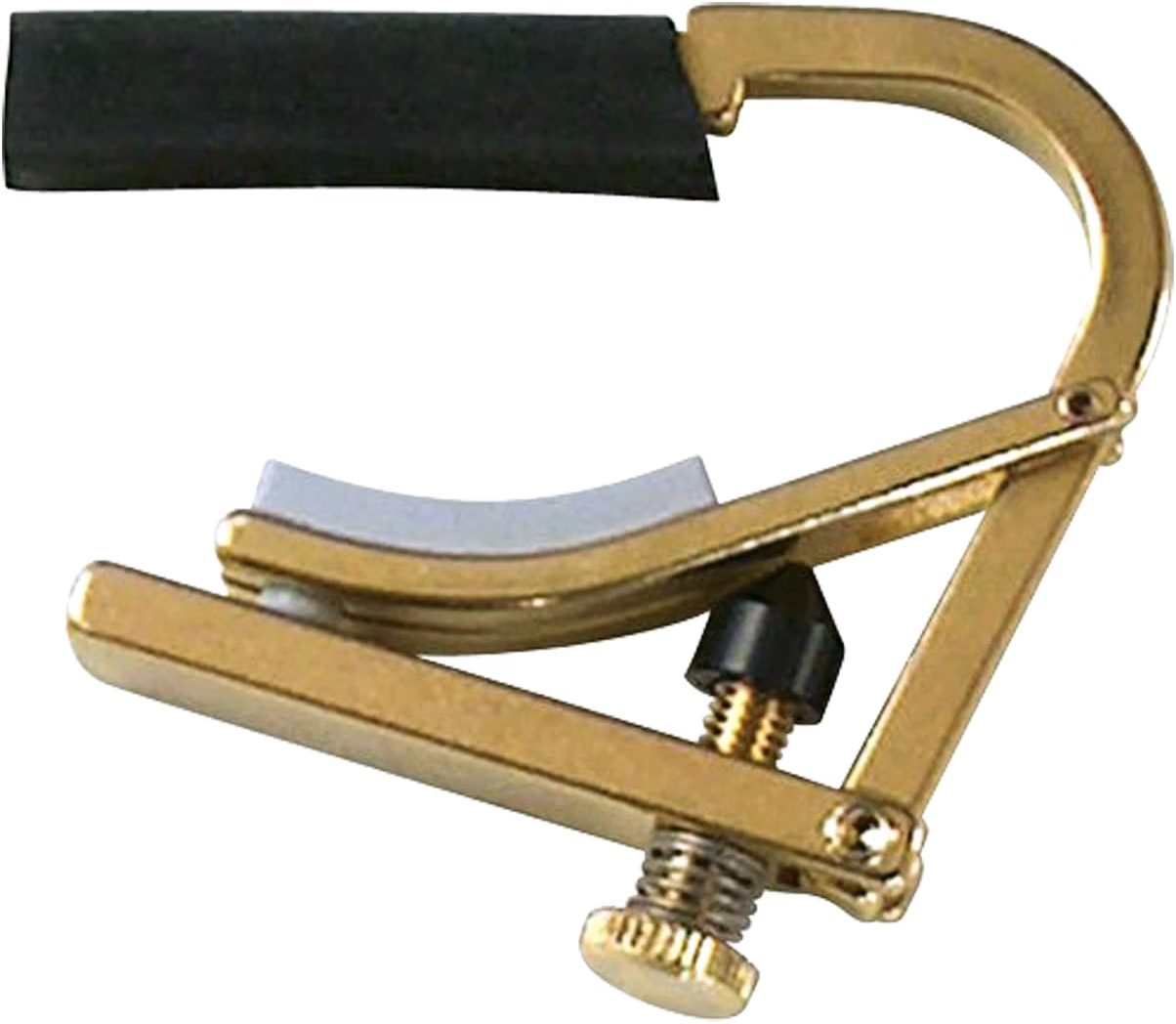
Shubb C8B Drop-D Partial Capo
As an Amazon Associate I earn from qualifying purchases.
A low bass note can give an acoustic arrangement more depth, especially when it keeps ringing beneath a melody. The brass Shubb C8B Drop-D Partial Capo gives you that option while leaving the guitar in standard tuning. Put it at the second fret so it holds down five strings and leaves the low E open. The top five strings rise by a whole step, and the sixth string stays where it was.
That gives you a useful sound for open chords and fingerpicking. It also changes which notes are available when you move away from those open shapes. Before buying, think of a song you’d like to use it on. The question is whether you want an open bass note under the chords or need the sixth string to behave like it does in actual Drop D.
What You Should Know Before Buying
The open bass note is E, and the sixth string still frets normally
At the second fret, the capo creates the same spacing between open notes as Drop D, a whole step higher. A D shape played relative to the capo sounds as E, and the open low E gives you the root beneath it. If you usually sing a particular song in D, that change in pitch matters. Try singing it in E before counting on the capo for that arrangement.
In true Drop D, you lower the sixth string from E to D. Every fretted note on that string moves down with it. With the C8B in place, a note you fret on the sixth string still has its standard-tuning pitch. If a riff moves along the bottom strings using the same fret across strings six and five, the usual Drop-D fingering won’t carry over. Retuning is the straightforward option for that kind of part.
The five-string fit needs a little care
Shubb designed this partial capo for a six-string steel-string guitar. Position it from the bass side so the bar clears the low E and reaches across the other five strings. Pick each string separately after closing it. If the low E sounds dull or rattles, check whether the capo is touching it. If the high E buzzes, check whether the pad is covering it securely.
Neck shape and string spacing affect how easily you can get a clean fit. Take extra care if your main instrument is a wide-neck nylon-string model like the Godin Multiac Nylon Encore. The C8B is made for six-string steel-string geometry. Check compatibility with your particular neck before ordering if that’s the guitar you intend to use.
You may need to reset the pressure when moving it
The lever closes the capo, and the screw sets how firmly it grips. Start with just enough pressure for the five covered strings to ring cleanly. If you squeeze them harder than necessary, they can pull sharp. Position the pad close behind the fret, listen for buzz and adjust a little at a time. The aim is to have the notes ring without forcing the lever shut.
A neck can get thicker as you move up it, so a screw setting that works at the second fret may need attention elsewhere. If a string buzzes with or without the capo, check the guitar before adding more pressure. SwapStrings’ MusicNomad string action gauge article explains how to measure string height if you’re also trying to understand a setup issue.
A set still needs time for a tuning check
A pressure-adjustable capo can be quick to fit after you’ve found a good setting, but allow a moment to check the result before the song starts. Tune the guitar first. After fitting the capo, play the open low E and check the five clamped strings individually. If those notes are sharp, try easing the pressure or repositioning the pad before touching the tuning keys.
Players with a tuner already in their setup, such as the Peterson StroboStomp HD, can include that check in their usual routine. If you’ll use the capo for a single song in a set, rehearse putting it on and taking it off between the songs on either side. That tells you how easily it fits into the time you actually have.
Who Should Probably Avoid This Product?
Pass on the C8B if you want the low D itself or regularly play riffs that depend on the sixth string being tuned down. The partial capo is at its strongest when the bass note stays open. If you fret that string often and expect your Drop-D shapes to transfer across the neck, you’ll spend more time working around the capo than enjoying the sound it adds.
It’s also a poor fit as your only capo if you mostly need to move whole songs into different singing keys. A conventional six-string capo raises all the strings together so familiar chord shapes keep their usual relationships. The C8B deliberately leaves one string out, which is useful for some arrangements and can give you an unwanted bass note in others.
Who Will Benefit Most?
The C8B suits acoustic players who like the sound of an open bass note under fingerpicked chords. Start with a D shape above the capo and let the low E ring. Then change the notes on the treble strings while keeping the bass steady. That’s a simple way to hear what you’d gain from the partial capo before building a whole song around it.
It can also work for songwriters who want to try that voicing during a session and return to standard tuning as soon as the capo comes off. If you’re putting together a small set of accessories for acoustic playing, the Guitar Gear category covers tuners and setup tools that can help you get those details right.
Try the C8B on a slow passage where there’s room to hear the bass sustain. If that open E gives the melody more depth and the raised key suits the song, you’ve found a good reason to keep this little capo in the case.
As an Amazon Associate I earn from qualifying purchases.
Opens Amazon (paid link)