BOSS RC-5 Loop Station Looper Pedal
As an Amazon Associate I earn from qualifying purchases.
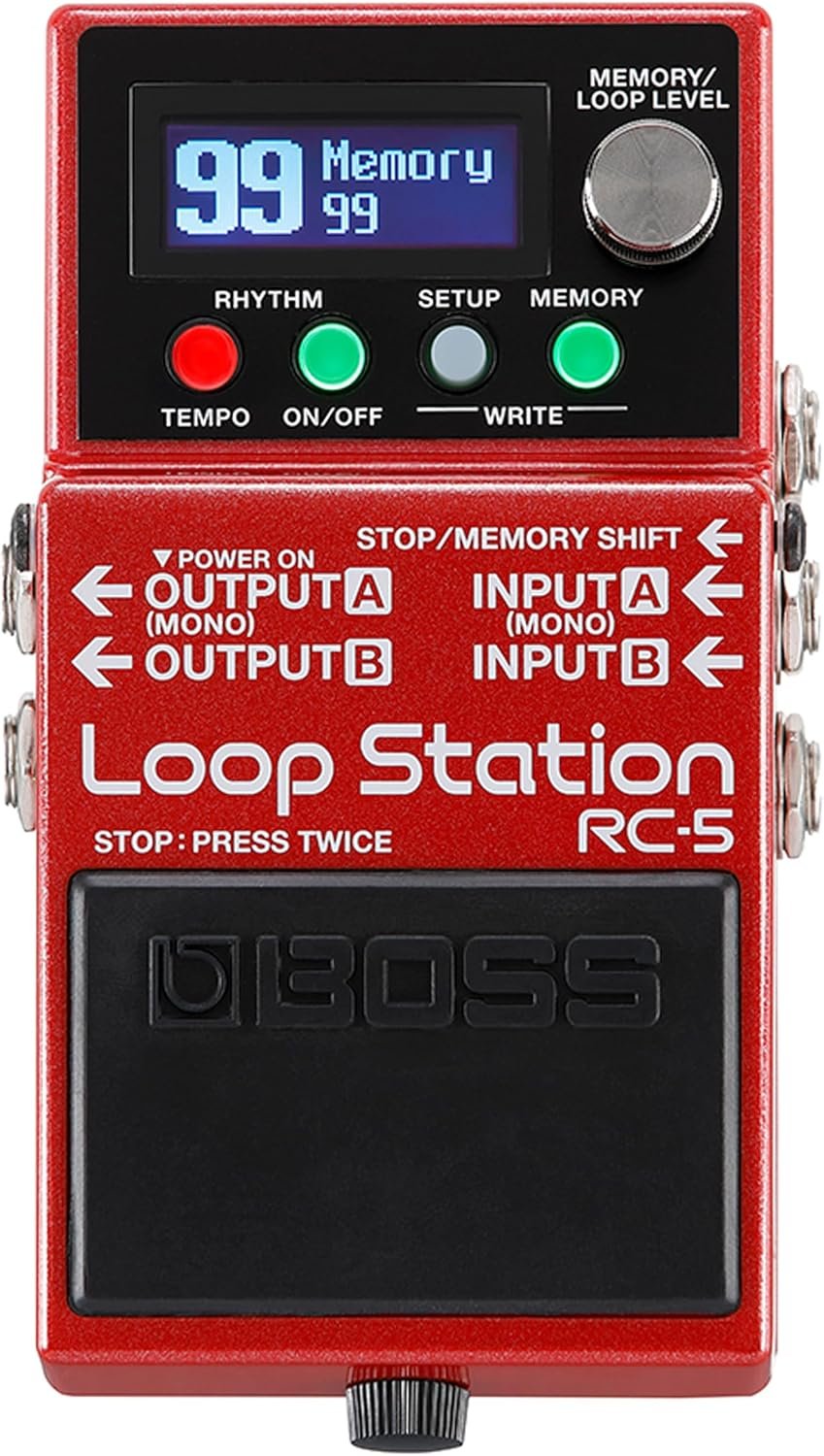
The BOSS RC-5 Loop Station is built for guitarists who want looping to become a genuinely useful part of their playing rather than a novelty they try once and forget. Its compact pedal format keeps the floor space sensible, while the deeper recording, rhythm and memory functions give it enough flexibility for practising, songwriting and building layered guitar parts. It feels particularly well suited to players who want room to experiment without moving to a much larger multi-switch looper.
Why it works in a guitarist’s setup
The RC-5 works because it adds a lot of creative possibility without demanding much pedalboard space. It has the familiar compact BOSS footprint, so it can sit alongside overdrives, modulation and delay pedals rather than forcing you to redesign the whole board around a large looping unit.
For practice, the appeal is straightforward. You can record a chord progression, loop it and then work on lead lines, timing or improvisation over your own playing. That makes a practice session feel more musical than simply running through scales, because you are reacting to harmony and rhythm in real time.
It also makes sense for songwriting. A riff, progression or melodic idea can be captured quickly and layered with another part while the idea is still fresh. The built-in rhythm functions add another useful dimension, giving you something to play against when you do not want to set up a drum machine or computer.
The 99 phrase memories are particularly useful for guitarists who want to keep ideas rather than treating every loop as temporary. That gives the RC-5 a little more long-term value than a very basic looper, especially if you regularly practise, write or build arrangements on your own.
What it feels like to use
The RC-5 has that familiar compact BOSS feel: small, solid and purposeful rather than delicate. It does not take up much room underfoot, and the large pedal surface makes it easy to hit while you are concentrating on playing rather than staring down at the floor.
In use, the single-pedal layout keeps the basic looping process approachable. Recording a part, playing it back and adding another layer can become quite natural once the footswitch timing settles into muscle memory. That matters because a looper should disappear into the playing rather than make every phrase feel like a technical exercise.
The display is another useful touch. It gives you a clearer sense of what the pedal is doing than the tiny indicator lights found on very simple loopers, especially when you begin moving between saved phrases or using some of the deeper functions.
There is also a nice balance between simplicity and depth. You can treat the RC-5 as a straightforward practice looper and barely touch the more advanced controls, or spend time exploring rhythm patterns, stored loops and connectivity as your needs grow.
The trade-off is that the deeper functions do take some learning. This is not quite as immediate as a bare-bones one-knob looper, but the extra control is precisely what makes it more useful over the long term.
The drawbacks
The RC-5 is compact, but that compactness comes with a few compromises. The biggest is that one footswitch has to handle several jobs, so stopping, overdubbing and clearing a loop takes a little practice. Once the controls become familiar it is manageable, but players who want separate dedicated switches may eventually prefer adding an external footswitch or moving to a larger looper.
The menu system also has more depth than the simple exterior suggests. That is useful in the long run, but it means the RC-5 is not quite the sort of pedal you unpack and fully understand in five minutes. Guitarists who only want the most basic record-and-repeat function may find some of its features unnecessary.
The screen is clear for a pedal this size, although it is still small. If you are changing memories or settings while standing, you may find yourself leaning down to check what is happening rather than making adjustments entirely by feel.
It is also worth remembering that looping exposes timing mistakes very quickly. That is not really a flaw in the pedal, but it can make the first few sessions feel less smooth than expected. Your first recorded chord progression may reveal tiny timing inconsistencies that were easy to ignore before. The positive side is that this makes the RC-5 a surprisingly effective practice tool.
Finally, this is probably more looper than a guitarist needs if the sole aim is to record a short rhythm part and play over it occasionally. Its real value appears when you intend to use the phrase memories, rhythm section and deeper looping functions regularly.
Who it suits best
The RC-5 makes the most sense for guitarists who practise alone but want their sessions to feel more like playing with another musician. Being able to create your own rhythm part and immediately play over it is useful for developing phrasing, timing and improvisation without needing to turn on a computer or load up recording software.
It also suits songwriters who tend to build ideas in layers. A chord sequence can become a bass-like part, a melody or a second guitar line within minutes, which makes it easier to hear whether an idea actually has potential rather than simply imagining how the extra parts might sound.
More experienced players should appreciate the deeper functions too. The phrase memories, rhythm options and extra connectivity give the RC-5 room to grow into more elaborate practice or performance setups instead of feeling limited after a few weeks.
Beginners can certainly use it, but there is a small learning curve. If someone wants the simplest possible first looper, a more basic pedal may feel easier initially. For a guitarist who expects looping to become a regular part of practice, writing or performance, however, the RC-5 offers considerably more headroom.
Is it worth the pedalboard space?
For a guitarist who genuinely wants to use looping for practice, writing or performance, the RC-5 earns its place surprisingly well. The physical footprint is small, the pedal feels solid underfoot, and the feature set is deep enough that it is unlikely to feel limiting too quickly.
What makes it especially useful is that it can stay simple when you want it to. You do not have to use every rhythm option, memory location or connection from day one. It can begin as a straightforward looper for practising over chord progressions, then become more capable as you start saving ideas, building arrangements and using it in a more structured way.
The main question is whether you will actually use those extra functions. If all you want is the occasional basic loop, there are simpler options. But for players who like the idea of one compact pedal handling practice, songwriting and more serious looping work, the RC-5 feels like a sensible long-term choice rather than something you will outgrow quickly.
Take a closer look