Fender Telepath Wireless System
As an Amazon Associate I earn from qualifying purchases.
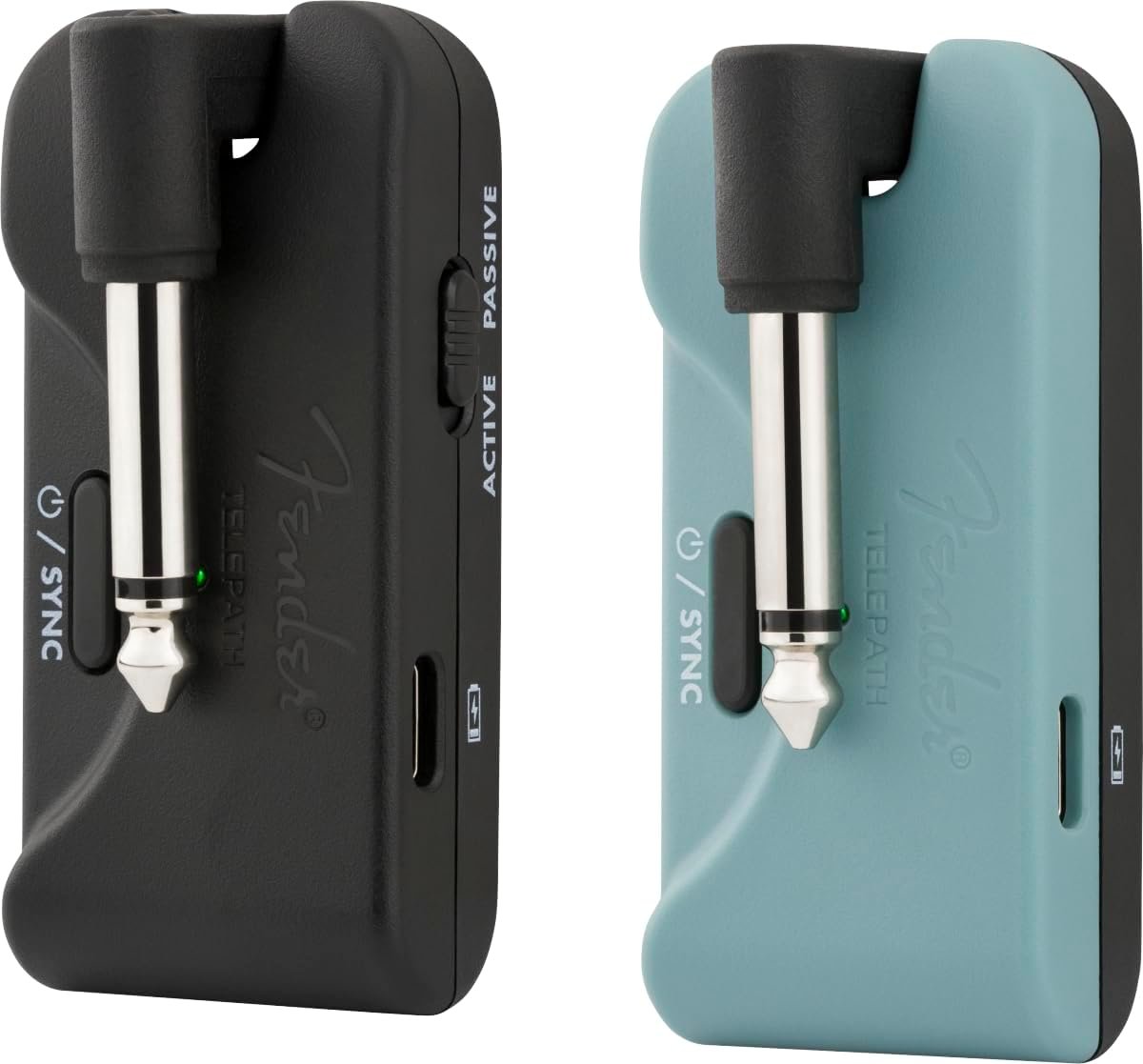
The Fender Telepath Wireless System is designed for guitarists and bass players who want to remove the instrument cable without turning their setup into something complicated.
Instead of running a conventional lead from the guitar to an amplifier, pedalboard or other compatible input, the system uses a compact transmitter and receiver pair operating on the 5.8 GHz wireless band.
That immediately changes the playing experience. There is no cable trailing across the floor, no lead wrapping itself around a microphone stand and no need to stay within a few metres of the amplifier simply because that is where the cable ends.
For home practice, rehearsals and smaller performance spaces, that freedom can be genuinely useful rather than merely convenient.
Why wireless can make a real difference
A guitar cable is wonderfully simple.
Plug one end into the instrument, plug the other into the amplifier and start playing.
The problem is that the cable also becomes part of the room.
It lies across the floor, twists as you move and can end up underneath pedals, chair legs or other equipment.
Anyone who has played standing up for any length of time will recognise the familiar routine of stepping over the cable or occasionally pulling it around with a foot.
A wireless system removes that physical connection.
The Fender Telepath allows you to walk away from the amplifier, turn around freely and move around the room without dragging a cable behind you.
That may not matter to someone who sits beside a small practice amplifier.
For a player who rehearses standing up or performs on a stage, it is a much more noticeable improvement.
What it feels like to use
The appeal of a compact wireless system is that there should not be much to think about once everything is connected.
One unit connects to the guitar or bass.
The other connects to the amplifier, pedalboard or other input.
Once the pair is communicating correctly, the physical cable between those two points disappears.
That is really the whole point.
Wireless guitar equipment works best when you stop noticing it.
You should be thinking about the instrument rather than whether the signal is travelling through copper cable or radio.
The Fender units are small enough that they do not turn the guitar into something cumbersome, and there is no separate belt pack with another short cable running to the instrument.
For everyday use, that makes the system feel considerably simpler than some traditional professional wireless arrangements.
5.8 GHz wireless operation
The Telepath operates in the 5.8 GHz range.
For guitarists, the technical number itself matters less than the reason Fender has chosen it.
Wireless equipment has to share radio space with all sorts of other electronic devices.
A system designed specifically for instruments needs a stable connection with sufficiently low delay that playing still feels immediate.
Fender states a latency of around 4 milliseconds.
That is extremely short in practical terms.
There is always technically some delay when an analogue guitar signal is converted, transmitted digitally and reconstructed at the other end, but the aim is for that delay to be small enough that the guitarist does not feel disconnected from the sound.
For normal playing, 4 ms is intended to keep the response feeling natural.
The stated 70-foot range
Fender gives the Telepath a stated operating range of around 70 feet.
For most home, rehearsal-room and smaller-stage situations, that is considerably farther than a conventional guitar cable would normally allow.
It does not mean you need to stand seventy feet from the amplifier.
The useful part is having enough working range that normal movement does not constantly push the wireless connection to its limit.
You can walk around a rehearsal room, move across a stage or stand away from the amplifier while adjusting something without first unplugging the guitar.
Wireless range should always be regarded as an approximate maximum rather than an absolute guarantee, though.
Walls, electronic equipment, radio interference and the physical layout of a building can all affect real-world wireless performance.
Useful for checking your sound from across the room
One surprisingly practical use for wireless guitar equipment is being able to hear the amplifier from a different position.
When you stand directly beside an amplifier, particularly a guitar combo, you do not necessarily hear exactly what someone several metres away hears.
With a wireless system, you can walk across the room while playing.
That makes it easier to judge volume, tone and how the amplifier fills the space.
For rehearsals, it also lets you hear the balance of the entire group from different positions rather than remaining fixed beside your own amplifier.
That alone can be a useful reason for owning a wireless system even if you have no intention of running around a stage.
A cleaner rehearsal space
Removing one cable does not sound like a major change.
In a room already containing several instruments, amplifiers, microphone stands, pedalboards and mains cables, however, every lead removed from the floor helps.
The guitar lead is particularly troublesome because it moves with the player.
A cable that starts neatly positioned can gradually work its way across the room as the guitarist changes position.
Wireless does not eliminate every cable in the setup.
Your pedalboard and amplifier still need connections.
But removing the moving cable between player and equipment can make the immediate playing area noticeably tidier.
Useful with a pedalboard
Wireless does not mean abandoning pedals.
The receiver can become the starting point of the normal signal chain.
Instead of the guitar cable entering the first pedal, the wireless receiver supplies the guitar signal.
Everything after that can remain exactly as it was.
For players with an established pedalboard, that is important.
A wireless system should not force you to rebuild the rest of the rig.
It simply replaces one particular cable — the long one between the instrument and the first part of the amplification chain.
Guitar and bass use
The Telepath is designed for both guitar and bass.
That makes it useful in households or studios where more than one type of instrument is being used.
The basic requirement is the same: transmit the instrument signal reliably without introducing a delay that makes playing feel unnatural.
Bass players can benefit from wireless freedom just as much as guitarists, especially when playing standing up or moving around during rehearsals.
The absence of a long cable can also be welcome with heavier bass instruments, where there is already enough weight hanging from the strap without constantly feeling a cable pulling from one side.
The compact design
One advantage of this type of wireless system is how little extra equipment it requires.
There is no rack unit.
There is no large receiver box sitting on the amplifier.
There is no belt pack clipped to the guitarist.
The transmitter and receiver are both compact enough to remain part of a small guitar setup.
That makes the Telepath particularly suited to musicians who want wireless convenience without building a professional touring rig.
It can live alongside picks, strings and other accessories rather than requiring another dedicated equipment case.
Rechargeable convenience
A compact wireless system inevitably depends on battery power.
That is one of the fundamental differences between wireless and a normal cable.
The advantage of a rechargeable system is that you are not continually buying disposable batteries.
Charge the units, use them and recharge them when necessary.
For someone who keeps their musical equipment organised, that can become an easy routine.
For somebody who routinely discovers that every rechargeable device in the house is flat just before leaving, it requires a little more discipline.
That brings us to one of the biggest compromises of wireless guitar equipment.
The drawbacks
The Fender Telepath Wireless System solves the problem of the trailing guitar cable, but it also replaces that extremely simple cable with electronics.
That exchange brings genuine advantages, but there are several disadvantages worth considering.
A cable never needs charging
This is probably the most obvious drawback.
A conventional guitar cable does not have a battery.
You can leave it in a case for six months, take it out and — assuming nothing has been damaged — plug it in and use it.
Wireless equipment cannot offer that kind of simplicity.
The Telepath needs power.
If the batteries have been allowed to run flat before a rehearsal or performance, the wireless convenience disappears until the units are charged again.
For regular users this is easily managed, but it becomes another item on the pre-gig checklist.
Guitar tuned.
Pedalboard powered.
Spare strings packed.
Wireless charged.
That is not difficult, but it is something a cable never asks you to think about.
I would still carry a normal guitar cable
Even if the Telepath became my normal way of playing, I would still keep a conventional cable in the guitar case.
Wireless systems involve more components.
There is the transmitter, receiver, internal batteries and radio connection.
Any one of those can create a problem that does not exist with a straightforward piece of cable.
A spare lead is therefore an inexpensive backup.
If something refuses to connect five minutes before playing, plug the cable in and carry on.
That is much better than trying to troubleshoot wireless electronics while everybody else is waiting.
Wireless range is not the same in every building
The quoted 70-foot range is useful, but wireless range should never be treated as a guaranteed circle around the receiver.
Real rooms are messy environments.
Walls, metal structures, electronic devices and other wireless equipment can influence radio performance.
A system that works flawlessly across a large open rehearsal room may behave differently in a crowded venue full of electronic equipment.
For normal guitar use that may never become a problem.
It is still worth understanding that wireless specifications are measured under particular conditions and real-life environments vary.
5.8 GHz does not mean interference is impossible
Moving to the 5.8 GHz band can help avoid some congestion associated with other commonly used wireless frequencies, but no consumer wireless band is completely empty.
Wi-Fi and other devices also use wireless spectrum.
The Telepath therefore should not be thought of as somehow immune to every possible radio problem.
In most normal situations it should simply work.
For a professional performance where failure would be particularly troublesome, testing the system in the actual venue before relying on it would be sensible.
4 ms is still technically latency
Fender quotes approximately 4 milliseconds of latency.
For most players, that is extremely small and should feel essentially immediate.
But it is still worth understanding what is happening.
Digital wireless systems need time to convert and transmit the signal.
A player who is unusually sensitive to latency, particularly when other digital equipment is also in the signal chain, may prefer the absolute simplicity of a cable.
Digital modelling amplifiers, effects processors, audio interfaces and recording software can all add their own small delays.
Individually they may be insignificant.
Stack enough digital processes together and latency can become more noticeable.
For ordinary amplifier use, this is unlikely to be a major concern, but it is still one of the technical differences between wireless and a direct analogue cable.
The transmitter adds something to the guitar
The Telepath is compact, but it still plugs into the instrument.
That means there is a small physical device hanging from the output jack rather than a flexible cable.
On many guitars this will be perfectly comfortable.
On others, jack placement can make a difference.
A Strat-style recessed socket, Telecaster side jack, Les Paul edge-mounted jack and some bass designs all position the connection differently.
The unit needs enough clearance to sit securely without pressing awkwardly against the guitar body or controls.
Players with unusual jack positions should pay particular attention to this.
Guitar shape can affect physical fit
The phrase “works with guitar and bass” describes the electronic compatibility, not necessarily every possible physical shape.
Some instruments have output sockets positioned inside recessed areas or very close to the body.
Others angle the jack in a way that can make rigid plug-in wireless transmitters awkward.
A normal cable has a flexible lead immediately after the plug, which makes it extremely forgiving.
A compact transmitter is more rigid.
If your instrument has an unusual output socket, checking the physical fit beforehand is worthwhile.
Active electronics deserve checking
Bass guitars and some electric guitars use active pickups or onboard electronics.
Wireless systems and active instruments usually coexist perfectly well, but particular jack wiring arrangements can occasionally behave differently with some plug-in transmitters.
Anyone using an unusual active instrument should check compatibility rather than assuming every electronic configuration behaves identically.
Again, a conventional cable remains the simplest reference point.
It adds another digital stage to the signal path
Some guitarists are completely comfortable with digital equipment.
Others deliberately keep the path from guitar to amplifier as simple as possible.
The Telepath converts and transmits the signal digitally.
For most musicians the convenience will matter far more than the philosophical question of whether the signal travels down copper wire.
Nevertheless, players who have spent significant money building a completely analogue rig may simply prefer to keep a physical cable.
That is not necessarily because the wireless system sounds poor.
It is because simplicity can itself be part of the appeal of a traditional guitar setup.
Two small devices are easier to misplace than one cable
This is an unglamorous drawback but a real one.
A guitar cable is fairly difficult to lose.
It is several metres long and normally coiled somewhere obvious.
The Telepath consists of two compact pieces.
Leave one attached to an amplifier at a rehearsal room and put the other in the guitar case, and you no longer have a functioning system.
It is worth developing the habit of keeping the transmitter and receiver together whenever they are packed away.
Charging becomes part of storage
Rechargeable devices benefit from being treated properly between uses.
Throwing the Telepath into a case with no thought about its charge state is not the best approach if it may be needed unexpectedly.
For occasional players, this can be more annoying than for musicians who use the system every week.
If you only pick up the electric guitar once every few months, a cable may actually be more convenient because it is always ready.
Wireless freedom can introduce new bad habits
A cable naturally limits how far you can move.
Wireless removes that restriction.
That sounds entirely positive until somebody walks farther than expected, turns around a corner or moves outside the reliable operating area.
Wireless does not mean unlimited range.
It simply provides much more freedom within a defined area.
For stage use, knowing the practical limits of the system before performing is sensible.
A wireless system cannot improve the rest of the rig
The Telepath can remove the guitar cable, but it cannot fix noise created elsewhere.
A poorly grounded amplifier, noisy pedal power supply or problematic patch lead remains problematic.
It is easy to blame a new wireless system whenever noise appears, but the complete signal chain still needs sensible troubleshooting.
Likewise, a good wireless connection will not transform a poor amplifier or badly set-up pedalboard.
It solves one specific problem: the physical cable between the player and the rest of the equipment.
The convenience may be unnecessary for some players
Not everybody needs wireless.
If you normally sit two metres from a practice amplifier at home, a good cable is incredibly difficult to improve upon.
It costs nothing to charge, has virtually no setup procedure and provides a dependable physical connection.
Wireless begins to make more sense when you stand, move, rehearse with other people or perform.
Buying technology simply because it exists is rarely worthwhile.
The Telepath is most useful when the cable is actually getting in the way.
Who it suits best
The Fender Telepath Wireless System makes most sense for guitarists and bass players who regularly play standing up and want greater freedom of movement.
It suits rehearsals particularly well.
Removing the instrument cable makes it easier to move around the room, walk over to another musician or step away from the amplifier to hear the overall sound.
It can also work well for smaller live performances where a full professional wireless rig would be unnecessary.
Players already using compact pedalboards may appreciate the equally compact nature of the Telepath.
It is less compelling for somebody who plays almost entirely while sitting beside a home practice amplifier.
For that player, a quality guitar cable remains wonderfully effective.
Is it worth replacing the guitar cable?
The Fender Telepath Wireless System is not really trying to make the guitar sound more exciting.
Its purpose is much simpler.
It removes the cable that physically connects the player to the rest of the rig.
With 5.8 GHz wireless operation, a stated range of around 70 feet and approximately 4 ms latency, it is designed to make that transition without turning the guitar setup into something complicated.
The main advantages are freedom of movement, a tidier playing area and the convenience of a compact transmitter and receiver rather than a larger traditional wireless system.
The compromises are equally straightforward.
It needs charging. Wireless conditions can vary. The transmitter must physically suit the guitar’s jack position, and there are more electronic components involved than there are in a simple cable.
I would therefore keep a conventional guitar lead in the case regardless.
But for a guitarist who regularly finds the instrument cable wrapped around their feet, caught under equipment or simply limiting where they can stand, the Telepath offers a practical reason to go wireless rather than technology for technology’s sake.
For more useful accessories, cases, cables and everyday equipment, explore our Guitar Gear guides on SwapStrings.
As an Amazon Associate I earn from qualifying purchases.