Strymon Flint V2 Tremolo & Reverb Pedal
As an Amazon Associate I earn from qualifying purchases.
The Strymon Flint V2 Tremolo & Reverb Pedal brings two of the most recognisable guitar effects together in one beautifully understated unit. Combining vintage-inspired tremolo with three distinctive reverb types, it offers guitarists a practical way to introduce movement, depth and atmosphere without covering their pedalboard with separate effects.
Inspired by the sounds of classic guitar amplifiers and studio equipment, the Flint V2 offers three tremolo modes based on historic circuits, alongside spring, plate and hall reverbs.
Its black anodised aluminium enclosure, cream-coloured controls and separate footswitches give it a traditional appearance, while MIDI functionality, stereo connections and USB-C support bring the design firmly into modern pedalboard territory.
The attraction is not the sheer number of effects. Instead, the Flint V2 concentrates on two musical essentials, offering enough control to move from subtle vintage warmth to spacious, atmospheric guitar textures.
For musicians who appreciate carefully chosen equipment rather than an endless collection of features, that focused approach is particularly appealing.
Why It Works on a Guitar Pedalboard
Tremolo and reverb have shared a long history in guitar amplification.
Classic American amplifiers frequently included both effects, allowing guitarists to combine gently pulsing volume changes with the natural impression of space.
The combination became associated with surf music, blues, country, early rock and atmospheric instrumental playing.
The Strymon Flint V2 takes inspiration from those sounds while providing greater control than many traditional amplifier circuits.
Tremolo adds rhythmic movement by changing the level or tonal character of the guitar signal.
Reverb introduces reflections and decay, making a note sound as though it occupies a larger acoustic environment.
Used together, the effects can create everything from a lightly animated clean sound to long, slowly developing ambient passages.
Having both in one pedal also saves space and reduces the number of cables and power connections required.
The dedicated footswitches mean either effect can be used independently, so players do not need to engage reverb simply to access tremolo.
That makes the Flint practical for straightforward pedalboards as well as more elaborate arrangements.
What It Feels Like to Use
The Flint V2 has a compact, solid appearance that suits Strymon’s reputation for carefully designed guitar equipment.
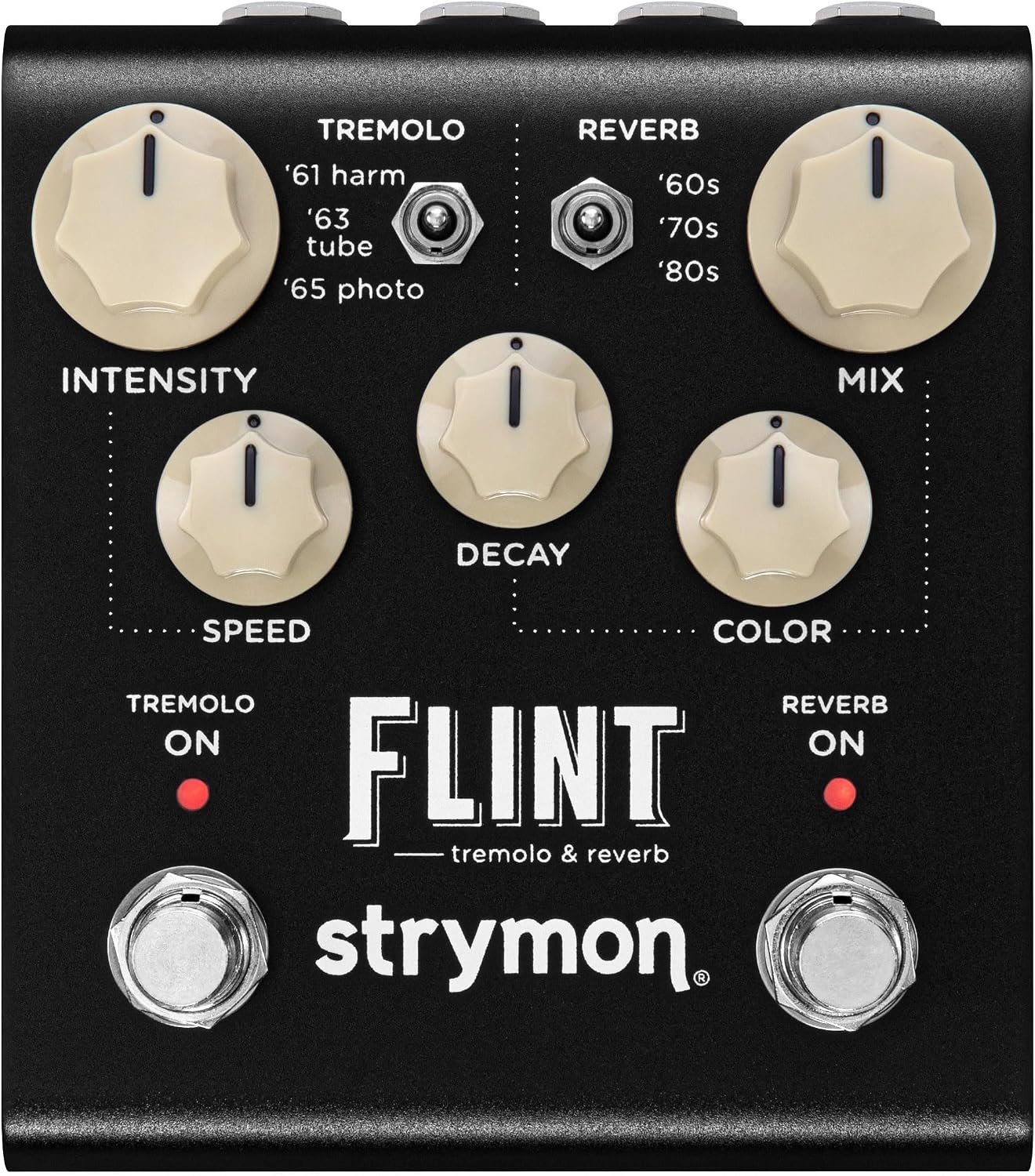
Its black anodised aluminium enclosure measures approximately 4 inches wide and 4.5 inches deep, with a height of around 2.4 inches.
The metal housing gives the pedal a substantial character without the excessive weight of a much larger multi-effects processor.
Cream-coloured control knobs contrast neatly against the black surface, making the layout easy to understand at a glance.
The tremolo section provides Speed and Intensity controls, alongside a switch for choosing the effect type.
On the reverb side, Decay, Color and Mix allow the player to adjust the length, brightness and prominence of the reverberation.
The two footswitches are clearly separated.
One activates tremolo, while the other controls reverb.
The layout avoids the need for a large display or complicated menu navigation during ordinary playing.
For guitarists accustomed to traditional stompboxes, it should feel familiar.
The more advanced functions are available when required, but the basic controls remain accessible.
Three Distinctive Tremolo Sounds
The Flint V2 includes three tremolo algorithms inspired by historic amplifier designs.
Each produces a different sense of movement, giving guitarists more choice than a conventional single-mode tremolo pedal.
’61 Harmonic Tremolo
The ’61 Harmonic setting recreates the character of an unusual early-1960s amplifier circuit.
Rather than relying only on conventional volume changes, harmonic tremolo alternates the emphasis between different frequency ranges.
This produces a gentle, swirling movement with some similarities to a subtle phaser.
It is particularly interesting for clean guitar passages, slow chord progressions and atmospheric playing.
’63 Tube Tremolo
The ’63 Tube mode draws inspiration from power-tube bias tremolo.
Its movement has a rounded, pulsing character associated with vintage valve amplifiers.
For blues, roots music and traditional rock, this setting offers a useful alternative to sharper, more pronounced modulation.
It can sit quietly beneath a performance without overwhelming the underlying guitar sound.
’65 Photocell Tremolo
The ’65 Photocell setting produces a more defined volume modulation inspired by classic optical tremolo circuits.
Its pronounced pulse works well for rhythmic guitar parts where the tremolo needs to be clearly audible.
This makes it useful for surf-inspired playing, vintage instrumental music and arrangements that depend on a consistent rhythmic effect.
The three modes offer genuine differences in character rather than simply changing the speed of one basic tremolo sound.
Spring, Plate and Hall Reverb
The Flint V2’s reverb section provides three algorithms inspired by different periods of amplifier and studio history.
’60s Spring Reverb
The spring setting recreates the lively character of traditional amplifier spring tanks.
It provides the bright, slightly splashy response associated with vintage guitar amplification.
This is particularly suitable for surf music, country picking, blues and clean electric guitar sounds.
’70s Plate Reverb
The plate setting draws inspiration from classic studio reverb techniques.
Its smooth, dense reflections can add depth to sustained chords and melodic passages without the more obvious spring character.
For guitarists wanting a refined ambient effect that remains useful in everyday playing, plate reverb provides an attractive middle ground.
’80s Hall Reverb
The hall setting is designed around the spacious character of vintage digital rack reverbs.
Longer decay settings can create wide, atmospheric textures that continue developing after the guitar note has been played.
This makes it particularly interesting for ambient music, slower arrangements and expressive lead playing.
The Decay, Color and Mix controls allow each reverb to be adjusted without navigating through complicated editing screens.
Modern Stereo and MIDI Connectivity
Although the Flint V2 looks like a traditional effects pedal, its connectivity is considerably more advanced.
Stereo input and output support allows it to become part of a wider stereo guitar arrangement.
The input uses a TRS connection, with a rear-panel switch allowing the player to select mono or stereo operation. A suitable adapter cable is required for stereo input from two conventional mono outputs.
Two output connections provide stereo operation when connected to appropriate equipment.
This can be useful when running two amplifiers, recording stereo effects or building an atmospheric pedalboard.
The Flint V2 also supports MIDI control through its EXP/MIDI connection or USB-C port.
Up to 300 preset locations can be accessed through MIDI, giving musicians a way to organise more elaborate performances.
MIDI clock synchronisation also allows tremolo speed to follow compatible external equipment.
These features are particularly useful for guitarists already using MIDI controllers, programmable switching systems or computer-based performance arrangements.
For ordinary playing, however, none of this additional equipment is essential.
The Flint remains fully usable as a conventional tremolo and reverb pedal.
Additional Tone Shaping
The Flint V2 includes several secondary controls that extend its sound-shaping possibilities.
One particularly useful option is changing the order of the two effects.
Running tremolo before reverb allows the reverberation to continue developing around the modulated guitar signal.
Reversing that order changes how the tremolo interacts with the reverberated sound.
The difference can be particularly interesting when using long reverb decays.
Adjustable reverb pre-delay provides another way to separate the original guitar note from the beginning of the reverb effect.
Strymon also includes independent boost and cut adjustments for the tremolo and reverb sections.
These can help balance perceived volume when changing between different sounds.
An expression pedal can provide continuous control over selected parameters, although compatible external equipment is required.
These features make the Flint more flexible than its straightforward top-panel appearance initially suggests.
A Useful Companion for Classic Amplifier Sounds
The Flint V2 makes particular sense for guitarists using amplifiers that lack built-in tremolo or reverb.
Rather than changing an otherwise satisfying amplifier, adding the Flint introduces those sounds through a familiar pedalboard connection.
It can also complement modern amplifier-modelling equipment.
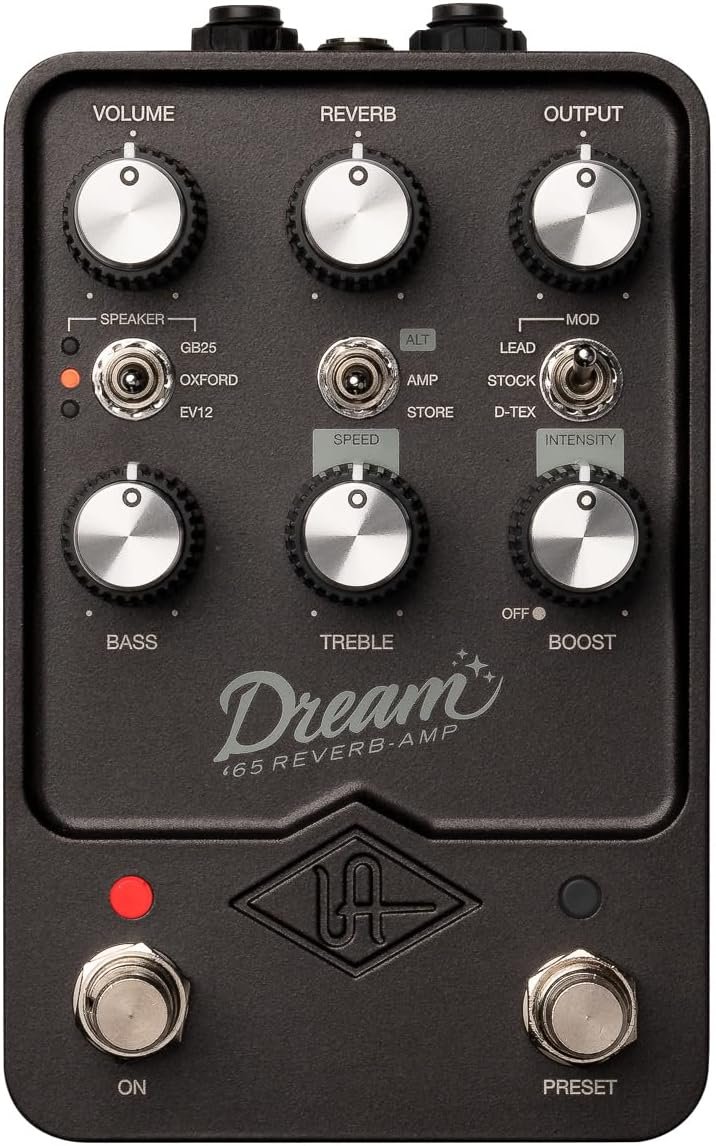
For example, our Universal Audio UAFX Dream ’65 Reverb Amplifier article explores a pedal that recreates classic American amplifier character, including spring reverb and vibrato.
The Flint takes a different approach by concentrating specifically on tremolo and reverb, allowing those effects to be combined with a broader variety of existing amplifier sounds.
For recording musicians, the stereo connections and detailed control can also support more elaborate signal chains.
The choice depends on whether the player needs amplifier simulation or simply wants dedicated, flexible ambience and modulation.
The Drawbacks
The Strymon Flint V2 is a carefully designed effects pedal, but its focused approach and advanced functions create several important limitations.
These deserve consideration before deciding whether it is the best choice for a particular guitar setup.
It Only Provides Two Categories of Effects
The most obvious limitation is that the Flint concentrates exclusively on tremolo and reverb.
Although each section offers three different sounds, the pedal does not include distortion, overdrive, chorus, delay or conventional pitch effects.
Guitarists wanting several types of modulation or a complete effects collection will need additional equipment.
That can mean more pedalboard space, more cabling and additional power connections.
For players who mainly want a versatile selection of sounds without building a collection of separate pedals, a multi-effects processor may be more practical.
Our BOSS ME-90 Multi-Effects Pedal article explores a broader approach, combining amplifier modelling and numerous effects in one floor unit.
The Flint makes more sense when tremolo and reverb are particularly important parts of the player’s sound.
No Power Supply Is Included
The Flint V2 requires a regulated 9V DC centre-negative supply capable of delivering at least 300mA.
Strymon does not include a power adapter with the pedal.
This is an additional consideration for buyers who do not already have a suitable pedalboard power supply.
It is important not to assume that any available adapter will work.
Incorrect voltage, polarity or insufficient current capacity can cause operating problems or damage the equipment.
The pedal also does not provide ordinary battery operation.
For a permanent pedalboard, a suitable isolated power connection is generally the more convenient arrangement.
Advanced Presets Need External Control
The advertised 300 MIDI preset locations sound particularly generous, but they require suitable MIDI equipment to access and manage.
The Flint does not have 300 dedicated onboard buttons or a large preset-selection display.
Players wanting to recall numerous sounds during a performance may need a compatible MIDI controller and additional cables.
That increases the overall complexity of the setup.
For someone who normally uses just one or two favourite combinations, this may not matter.
However, musicians expecting extensive instant preset switching directly from the pedal should understand how its control system works before purchasing.
Secondary Functions Are Less Immediate
The Flint’s main controls are straightforward, but some useful features are accessed through secondary operating functions.
These include effect order, pre-delay and individual boost or cut adjustments.
Changing these parameters is not as immediate as turning a dedicated control knob.
A player may need to consult the operating instructions while becoming familiar with the different combinations.
This is an understandable compromise in a compact pedal, but it means the Flint is not entirely free from hidden settings.
For guitarists who prefer every adjustment to have its own physical control, the secondary system may feel less convenient.
Stereo Operation Requires Extra Attention
Although the Flint supports stereo input and output, its input arrangement uses a single TRS jack.
Players connecting two conventional mono outputs into the pedal need an appropriate adapter cable.
The rear-panel mono/stereo switch must also be configured correctly.
This is less immediately obvious than a pedal with completely separate left and right input sockets.
Stereo setups can also involve additional cables, amplifiers or recording channels.
For guitarists using one conventional amplifier, the stereo features may remain largely unused.
The flexibility is welcome, but it is not necessarily valuable to every player.
No Dedicated Tap-Tempo Footswitch
The Flint has separate footswitches for activating tremolo and reverb, but no third dedicated tap-tempo switch on its front panel.
The tremolo speed can be adjusted using the Speed knob or synchronised through compatible external control arrangements.
For guitarists who frequently change tremolo speed between songs, an external footswitch or MIDI controller may provide a more convenient solution.
This introduces additional equipment when compared with pedals featuring a dedicated tap-tempo switch.
Players who prefer setting a fixed tremolo speed and leaving it alone are less likely to find this restrictive.
It Cannot Replace a Full Guitar Amplifier
The Flint V2 processes an existing audio signal, but it does not include amplifier modelling, a speaker cabinet simulator or a power amplifier.
It cannot function as a complete independent guitar amplification system.
Players still need a suitable amplifier, recording setup or other appropriate equipment.
This is particularly important for musicians developing compact, amplifier-free live rigs.
The Flint can contribute excellent tremolo and reverb sounds to such a setup, but another device must provide the amplifier and cabinet processing where required.
Its purpose is dedicated effects rather than complete guitar amplification.
Vintage-Inspired Sounds Have Their Own Character
The Flint’s effects are deliberately inspired by traditional amplifier and studio equipment.
That is one of its strengths, but it also defines the available range of sounds.
Guitarists wanting highly experimental modulation, unusual rhythmic sequences or complex modern reverb algorithms may find the selection relatively restrained.
The three tremolo types and three reverbs provide considerable musical flexibility, but they remain focused on recognisable vintage-derived effects.
The Flint is particularly convincing as a specialist instrument for classic modulation and ambience.
It is less suitable for musicians whose main interest is extreme sound design or constantly changing experimental textures.
Digital Processing Will Not Appeal to Everyone
Although the Flint recreates effects associated with historic analogue equipment, the processing itself is digital.
Strymon uses high-quality conversion and advanced DSP algorithms to recreate the behaviour of the original circuits.
That provides consistency and flexible control.
However, some guitarists specifically want a physical spring tank, traditional valve tremolo circuit or entirely analogue signal processing.
For those players, the Flint may not provide the particular ownership experience they are seeking.
The pedal is better understood as a modern recreation of vintage effects rather than a replacement for every characteristic of the original hardware.
A Focused Pedal Requires a Clear Purpose
Perhaps the most important buying consideration is whether tremolo and reverb play a significant role in the guitarist’s music.
Someone who uses those effects occasionally may find that their amplifier or existing multi-effects unit already provides everything necessary.
The Flint offers a more dedicated approach, with carefully developed algorithms and substantial control.
That specialisation is attractive when these sounds form an important part of the player’s style.
However, a musician who rarely engages tremolo or prefers completely dry guitar tones may not make enough use of its capabilities.
It deserves pedalboard space when its particular strengths will be used regularly.
Who It Suits Best
The Strymon Flint V2 is particularly well suited to guitarists who appreciate traditional amplifier-style tremolo and reverb.
Blues, country, surf, indie and ambient players may find its six effect types especially useful.
It also makes sense for musicians with an otherwise straightforward amplifier setup who want additional movement and depth without changing their core guitar sound.
Recording guitarists can benefit from the stereo connections, adjustable reverb characteristics and external control options.
Players already using MIDI-controlled pedalboards may appreciate the ability to store and recall a large collection of settings.
However, guitarists wanting extensive distortion, delay, pitch processing or amplifier modelling should consider whether a broader processor would be a better fit.
The Flint is most rewarding when its two core effects are central to the way the player makes music.
Is the Strymon Flint V2 Worth the Pedalboard Space?
The Strymon Flint V2 brings together two classic guitar effects in a compact, thoughtfully constructed pedal.
Its three tremolo modes cover noticeably different styles of movement, while the spring, plate and hall reverbs provide useful options for everything from vintage clean playing to spacious modern arrangements.
The dedicated controls make everyday operation approachable, and the addition of MIDI, stereo connectivity and secondary tone-shaping functions gives the pedal considerable flexibility.
Its limitations are clear. It focuses on only two effects, requires a separate power supply and needs additional equipment to make full use of its advanced preset capabilities.
Nevertheless, for guitarists who genuinely value expressive tremolo and carefully shaped reverb, the Flint V2 offers a convincing combination of traditional musical character and modern functionality.
It is not designed to do everything. Instead, it concentrates on two effects that have remained essential parts of guitar music for decades.
Explore more carefully selected stompboxes, processors and sound-shaping equipment in our Effects & Pedals collection.
As an Amazon Associate I earn from qualifying purchases.