Universal Audio UAFX Dream ’65 Reverb Amplifier
As an Amazon Associate I earn from qualifying purchases.
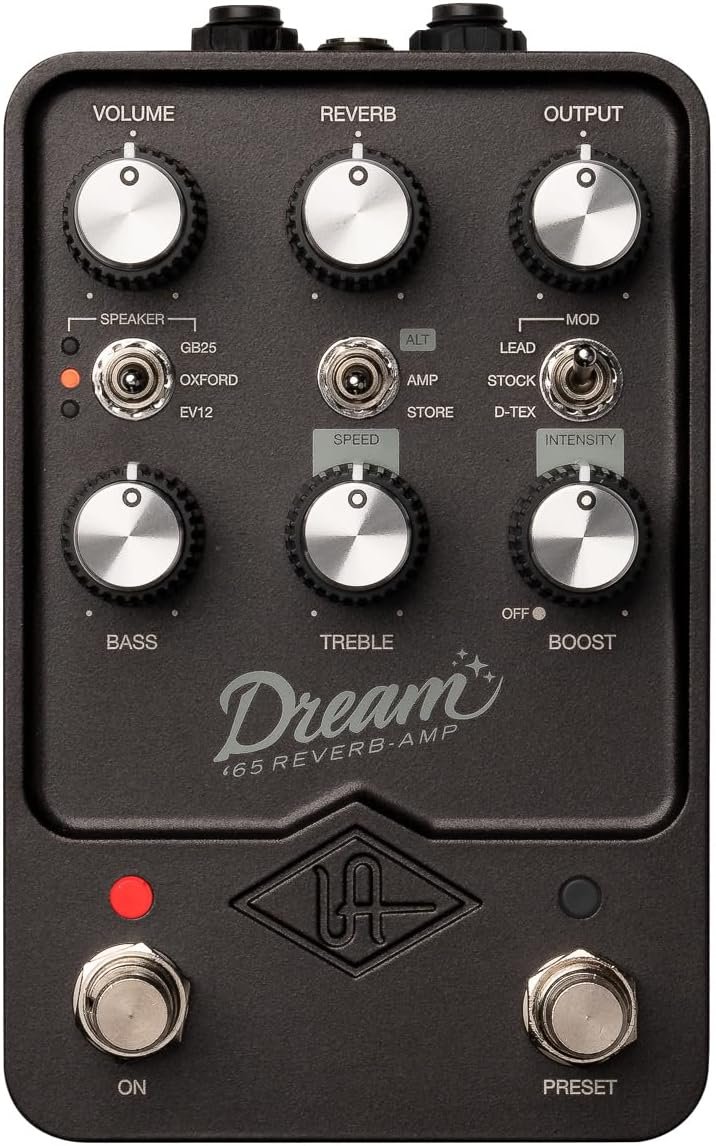
The Universal Audio UAFX Dream ’65 Reverb Amplifier puts the character of a classic mid-1960s American tube combo into a pedal that can sit on a normal guitar pedalboard.
Rather than simply adding an overdrive or EQ curve to an existing amplifier, Dream ’65 is designed as a complete amp-and-speaker solution. It can provide clean tones, natural-sounding breakup, spring reverb and vibrato while also modelling the speaker, microphone and room portion of a recorded guitar sound.
That makes it useful in several different setups. It can run directly into recording equipment or a suitable live sound system, form the centre of an ampless pedalboard, or have its cabinet and microphone modelling bypassed when used in front of a conventional guitar amplifier.
Why it works on a guitar pedalboard
Dream ’65 is focused on one particular family of amplifier tones rather than trying to reproduce dozens of unrelated amps.
Universal Audio based it around the character of a mid-’60s American tube combo, including the clean response, breakup, spring reverb and vibrato associated with that style of amplifier. Its dual-engine processing also handles the speaker cabinet, microphone and room modelling derived from Universal Audio’s OX technology.
That narrower focus can make the pedal easier to approach than a large multi-effects processor.
Across the top are familiar amplifier-style controls, so a guitarist accustomed to setting an ordinary combo amplifier should quickly understand the basic idea. Volume determines how hard the virtual amplifier is being driven, while separate output control allows the overall signal level to be adjusted afterwards.
This means increasing the Volume control is not merely making the pedal louder. As it is turned up, the model moves from cleaner tones towards greater compression and overdrive, much as the original amplifier circuit would.
For somebody building a compact rig, that gives Dream ’65 the potential to replace a much larger piece of equipment rather than simply becoming another effect placed in front of it.
What it feels like to use
Physically, Dream ’65 is larger and more substantial than the smallest single-foot-switch pedals, but it is still compact enough for a conventional pedalboard.
Universal Audio lists it at approximately 3.62 inches wide, 5.55 inches deep and 2.56 inches high, with an unboxed weight of around 1.24 lb.
The two footswitches allow the pedal to work more like a small floor-mounted amplifier control system than a basic on/off stompbox.
In its standard Live and Preset arrangement, Live mode follows the positions of the physical controls, while Preset mode recalls a stored sound. The current UAFX Control system expands this further, allowing up to four onboard presets plus Live Mode with updated footswitch configurations.
That is useful on stage because you can prepare sounds rather than having to bend down and recreate knob positions between songs.
There is still an appealing amount of direct control on the pedal itself. You do not need to reach for a phone simply to adjust the basic amplifier tone, reverb or output level.
The app is there when deeper configuration is wanted rather than replacing all of the physical controls.
Classic amp character without carrying the amplifier
The attraction of Dream ’65 is the way several parts of a traditional recorded guitar setup are combined.
The amp modelling supplies the basic clean and driven response. There is tube-style spring reverb and vibrato modelling, while selectable speaker, cabinet and microphone combinations change the character of the final sound.
Universal Audio also includes amplifier modifications and boost options, giving the pedal more range than a completely fixed reproduction of one vintage amplifier.
There are two modified amp settings alongside a clean-boost option, allowing the basic American-style foundation to move into stronger drive and altered response without adding another pedal in front.
That makes Dream ’65 particularly interesting for players who spend much of their time around clean, edge-of-breakup and moderately driven guitar tones.
Spring reverb is also an important part of the design rather than an unrelated digital reverb added afterwards. Universal Audio modelled the spring reverb and vibrato from the amplifier that formed the basis of the Dream ’65 model.
For surf, blues, country, soul, indie, classic rock and many cleaner guitar styles, that combination gives the pedal a clear musical identity.
Useful for recording and live playing
Dream ’65 makes particular sense for guitarists who record at home.
Instead of setting up an amplifier, speaker cabinet and microphone every time inspiration strikes, the pedal can provide an already miked amp-style signal for an audio interface.
It has two quarter-inch inputs and two quarter-inch outputs, supporting stereo connections as well as four-cable configurations. The cabinet and microphone simulation can also be disabled when the pedal is being used with a real guitar amplifier.
For recording late at night or working in a room where a real tube amplifier cannot be turned up properly, this can be considerably more practical.
The same principle can be useful live.
A guitarist building an ampless rig can send the Dream ’65 output onwards to suitable stage or front-of-house equipment without taking a traditional combo amplifier to the venue. Universal Audio specifically positions the pedal for both direct stage use and recording into a DAW.
It can also work as a backup option for players who normally use an amplifier but would rather have something on the pedalboard that can provide a complete amp sound if needed.
Presets, app control and MIDI
The UAFX Control app adds another layer without changing the basic character of the pedal.
It can be used to customise settings, manage presets, access additional speaker options and configure footswitch behaviour. Universal Audio currently supports improved Bluetooth operation as well as hardwired connectivity for the updated control system.
Dream ’65 also supports MIDI over USB with current UAFX firmware.
That allows compatible MIDI equipment to call up presets and control parameters, which is useful for more sophisticated pedalboards where several devices need to change together. Universal Audio’s current UAFX MIDI system supports program changes and control changes on compatible pedals, including Dream ’65.
For a straightforward guitar-and-pedalboard setup, none of that needs to get in the way.
But for a guitarist gradually building a programmable rig, Dream ’65 has considerably more control available than its traditional amplifier-style front panel initially suggests.
The drawbacks
Dream ’65 is deliberately specialised.
If you want one pedal containing dozens of radically different amplifiers, large collections of modulation effects, delays, pitch effects and complex routing, this is not that type of processor.
Its strength is its concentrated recreation of a particular mid-’60s American amplifier style. That focus is appealing if that is the sound you want, but it is inherently less versatile than a broad multi-amp modeller for somebody who needs dramatically different amplifier characters from song to song.
The power requirements also deserve attention.
Dream ’65 does not include its power supply. Universal Audio specifies an isolated 9V DC, centre-negative supply capable of at least 400mA, and states that full-sized UAFX pedals should have their own supply or isolated output from a multi-output pedalboard supply.
That 400mA requirement is higher than many traditional analogue pedals.
If your existing pedalboard power supply has only low-current outputs remaining, Dream ’65 may require some rearranging or an upgraded power solution. It is worth checking that before adding the pedal to an already crowded board.
There is also no battery option to fall back on.
Once the correct external supply is connected, Universal Audio states that the UAFX startup sequence takes around 15 seconds. That is not a major inconvenience in normal use, but it is another difference from a simple analogue stompbox that becomes active almost immediately.
The preset system can require a little learning as well.
In Live Mode, the physical knob positions represent what you hear. In Preset Mode, they may not, because the recalled sound uses internally stored settings rather than the current knob positions.
That distinction is perfectly logical once understood, but somebody moving from straightforward analogue pedals may initially turn a knob, look at its position and wonder why it did not previously correspond with the recalled sound.
The app brings useful additional control, yet it also introduces software into what might otherwise have been an entirely self-contained piece of guitar equipment.
Basic operation does not depend on constantly using the app, but registration, firmware updates, expanded speaker choices, deeper preset management and some newer features bring a computer or mobile device into the setup.
Some guitarists will appreciate that flexibility. Others specifically choose pedals because they want to get away from screens and menus.
MIDI is another example.
It is a welcome addition, particularly for programmable pedalboards, but the current implementation uses USB MIDIrather than a traditional five-pin MIDI socket on the pedal.
That means integrating it into some older MIDI rigs may require more planning than simply running a standard MIDI cable from one pedal to another.
The Dream ’65 also occupies more pedalboard space than a small single-switch drive pedal.
Its approximately 3.62-by-5.55-inch footprint is hardly huge, but guitarists working with extremely compact boards should measure first rather than assuming it will occupy the same space as a miniature stompbox.
Then there is the question of whether you actually need cabinet and microphone modelling.
If you always play through a traditional guitar amplifier and have no intention of recording direct or going ampless, some of Dream ’65’s most interesting capabilities may be unnecessary. The cabinet and microphone sections can be bypassed for this type of use, but a simpler drive or preamp pedal could be a more straightforward solution for certain players.
It is also important not to expect one pedal to make every guitar and playback system sound identical to a vintage combo sitting in a room.
An amp model is only one part of the final result. Pickups, other pedals, monitoring speakers, headphones, audio interfaces, PA systems and the way a player attacks the strings all affect what ultimately reaches the ears.
Dream ’65 provides the amp, cabinet and microphone modelling, but the rest of the signal chain still matters.
Finally, its focused character can be either its greatest strength or its biggest limitation.
Players who love the clean-to-breakup response, spring reverb and vibrato associated with classic American combos may find plenty of range inside that one family of sounds.
Players who regularly jump from sparkling American cleans to high-gain modern metal tones will need other equipment alongside it.
Who it suits best
The Universal Audio UAFX Dream ’65 is particularly well suited to guitarists who already know they enjoy classic American-style amplifier tones.
It makes sense for home recording, where producing a consistent amp-and-mic sound without turning up a real amplifier can make sessions much easier.
It also suits pedalboard players building an ampless live setup, musicians who want a compact backup to a traditional amplifier, and guitarists who use clean and edge-of-breakup sounds as the foundation for other pedals.
Players using programmable rigs can take advantage of the newer preset and USB-MIDI capabilities, while somebody with a simpler board can largely ignore those functions and treat Dream ’65 more like a familiar amplifier beneath their feet.
Is it worth the pedalboard space?
Dream ’65 earns its place by doing more than adding another effect to the guitar signal.
It can become the amplifier, speaker cabinet and microphone section of the entire rig while still providing spring reverb, vibrato and several ways of shaping the core amplifier character.
Its focus is intentionally narrower than a large multi-model processor, and the separate 400mA power requirement, app features and USB-based MIDI deserve considering before committing pedalboard space.
But for a guitarist who wants classic American clean and breakup tones without taking a traditional combo everywhere, the Dream ’65 offers a particularly compact way of putting that sound at the centre of a modern pedalboard.
Explore more pedals and tone-shaping gear in our Effects & Pedals section.
As an Amazon Associate I earn from qualifying purchases.