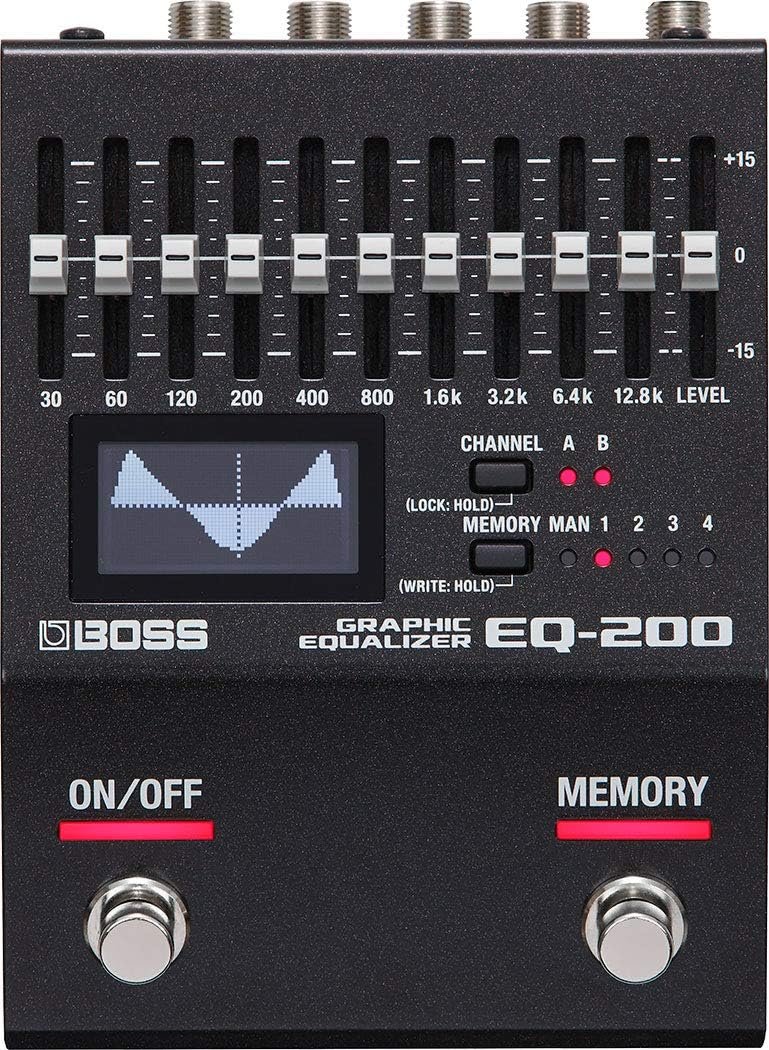
BOSS EQ-200 Graphic Equalizer
As an Amazon Associate I earn from qualifying purchases.
The BOSS EQ-200 Graphic Equalizer takes a familiar guitar effect and gives it an unusually flexible set of controls. Rather than offering a single bank of tone-adjustment sliders, it combines two independent 10-band equalizers, programmable memories and several signal-routing options in one pedal.
For guitarists who enjoy shaping their sound, an equalizer can be one of the most useful additions to a pedalboard.
It can reduce unwanted low frequencies, bring greater clarity to chords, soften an overly bright pickup or provide a carefully controlled boost for lead playing.
The EQ-200 takes those possibilities further by allowing different equalizer settings to be stored and recalled without repeatedly adjusting the sliders.
It also provides flexible connections for players who want to shape their sound at different points in an effects chain.
With its graphic display, dedicated footswitches and extensive control options, the EQ-200 is designed for musicians who want precise control rather than another conventional distortion or modulation effect.
Why a graphic equalizer belongs on a guitar pedalboard
An equalizer does not necessarily create an immediately recognisable effect in the way that a chorus, delay or distortion pedal does.
Its purpose is to change the balance of frequencies already present in the signal.
That may sound less exciting than adding an entirely new effect, but it can make a considerable difference to how a guitar sits within a mix.
A rhythm guitar that sounds powerful when played alone can become muddy when combined with bass and drums.
A bright bridge pickup may cut through a band but become uncomfortable when played at higher volume.
A neck pickup may sound warm and expressive during single-note playing yet lack definition when used for complex chords.
These are situations where careful equalization can be valuable.
Reducing excessive bass can improve clarity, while adjusting the middle frequencies can change how prominently the guitar sits alongside other instruments.
The high-frequency bands allow further control over brightness and attack.
The BOSS EQ-200 provides a visual, hands-on way to make these adjustments.
Each slider controls a specific frequency band, making it possible to shape the guitar’s response without relying entirely on an amplifier’s relatively broad tone controls.
The result is a pedal that can be useful with clean sounds, overdrive, distortion and even acoustic-electric instruments.
Dual 10-band equalizers
The most important feature of the EQ-200 is its pair of independent 10-band equalizer channels.
Each channel provides control over ten frequency bands, together with an overall level adjustment.
BOSS allows up to 15 dB of boost or cut on each band.
This gives the player a wide range of tonal adjustment.
Subtle changes can be used to improve balance, while more pronounced settings can create deliberately unusual or focused sounds.
The pedal’s frequency bands can also be configured using three different ranges.
These extend from approximately 30 Hz to 12.8 kHz, 32 Hz to 16 kHz, or 28 Hz to 14 kHz, depending on the selected setting.
The adjustable ranges allow the pedal to accommodate instruments with different frequency characteristics.
For an electric guitarist, the middle frequencies are often particularly important.
Small adjustments in this region can make a guitar sound fuller, more forward or more restrained.
For bass players, the lower frequency bands provide useful control over the balance between weight and definition.
Acoustic-electric players may find the pedal helpful for addressing excessive boominess or shaping the instrument’s response through an amplifier or sound system.
The important advantage is that the equalizer is not restricted to one narrow tonal application.
It can be adapted to different instruments, pickups and musical situations.
Flexible routing with two EQ channels
Having two equalizer channels would be less useful if they could only perform exactly the same function.
BOSS therefore provides several signal-routing arrangements.
The channels can be used in parallel, allowing separate processing paths.
They can also be connected in series, with the signal passing through one equalizer and then the other.
This opens up several practical possibilities.
A guitarist could use the first channel for general corrective equalization and the second for additional tonal shaping.
For example, one channel might reduce excessive bass and low-mid frequencies before the sound reaches another stage of processing.
The second channel could then apply a separate adjustment to the resulting tone.
The EQ-200 also supports stereo operation in its appropriate parallel configuration.
This is useful for guitarists who use stereo effects, two amplifiers or other equipment with separate left and right signal paths.
However, the distinction between its routing modes is important.
Series operation combines the signal into a mono processing path, so it should not be assumed that every routing arrangement preserves a stereo signal.
For players using relatively simple mono pedalboards, the additional routing options may remain unused.
For more complicated rigs, they are among the pedal’s strongest features.
Shape your tone before and after other effects
One of the more interesting possibilities is using the EQ-200 with other pedals positioned between its two equalizer stages.
The pedal’s insert arrangement allows an external effect, or a chain of effects, to be incorporated into the signal path.
This creates opportunities for equalization both before and after an overdrive or distortion pedal.
The position of an equalizer can significantly influence the result.
Placed before distortion, an EQ changes the frequencies entering the clipping stage.
Reducing low frequencies before distortion can help prevent the sound from becoming overly loose or muddy.
Boosting selected middle frequencies can change how the distortion responds to the guitar.
Placed after distortion, an equalizer instead shapes the sound produced by the distortion effect.
This can help soften harsh frequencies, improve clarity or adjust the balance between rhythm and lead tones.
Using both positions provides a level of control that would ordinarily require two separate equalizer pedals.
It also makes the EQ-200 interesting for musicians who already own several drive pedals and want to make those sounds more adaptable.
The exact connections require planning, but the flexibility is a genuine advantage.
Programmable memories for different sounds
Traditional graphic equalizer pedals rely on the physical positions of their sliders.
If a player wants to return to an earlier setting, the sliders must be moved back to their previous positions.
That is manageable at home but less convenient during rehearsals or performances.
The EQ-200 solves this problem through programmable memories.
With the appropriate system software, it provides 127 stored memory locations plus a manual setting.
Earlier firmware versions offered a much smaller selection, so owners of older units should check whether the software is current.
Saved equalizer arrangements can be recalled using the pedal’s controls or compatible MIDI equipment.
For a guitarist who changes between several instruments, this is particularly useful.
A Stratocaster fitted with traditional single-coil pickups may benefit from a different EQ arrangement than a guitar with humbuckers.
An acoustic-electric instrument may require another set of adjustments.
Instead of repeatedly moving the sliders, the player can recall a previously stored configuration.
The same principle applies to different songs.
One memory might be intended for clean rhythm playing, another for a more prominent solo sound and another for a deliberately narrow or unusual tonal character.
The pedal also allows the range of memories available through footswitch scrolling to be restricted.
This is useful during live playing because there is little benefit in stepping through dozens of unused settings to reach the next required sound.
For musicians who like consistent, repeatable tones, the memory system may be the most valuable part of the EQ-200.
A useful pedal for clean and driven guitar sounds
The EQ-200 can perform different jobs depending on the guitar, amplifier and other effects being used.
With a clean guitar sound, small frequency changes may help improve note separation and balance.
A bright guitar can be softened without necessarily changing the amplifier settings for every other instrument.
A warmer pickup can be given additional definition by reducing excessive low-mid frequencies.
For overdriven sounds, the EQ can be used to refine the relationship between bass, middle and treble.
Reducing unwanted low frequencies can help create a tighter response.
Adjusting the middle frequencies can make lead notes stand out more clearly against other instruments.
The separate level control also gives the pedal a useful role as a volume boost.
A carefully chosen EQ curve combined with an appropriate output-level adjustment can help a guitar become more prominent during a solo.
However, there is an important distinction between using an equalizer before and after a distortion stage.
A level boost before distortion may produce additional saturation rather than a substantial increase in final loudness.
A level boost after distortion may have a more direct effect on output volume, provided the following equipment has sufficient headroom.
Understanding the signal chain helps the player make better use of the EQ-200’s capabilities.
What it feels like to use
Despite its extensive digital functions, the EQ-200 retains the familiar appearance of a graphic equalizer.
The ten frequency sliders are arranged on the top panel, with a separate level slider alongside them.
This provides a more immediate approach than a pedal that requires every adjustment to be made through several layers of menus.
Moving a slider provides a clear physical indication of the frequency being adjusted.
The backlit graphic LCD shows the current equalizer curve, making it easier to understand the overall shape of a setting.
This is particularly useful when recalling stored memories, because the display can show the stored EQ arrangement even when the physical sliders are in different positions.
A dedicated channel button allows the user to move between the two equalizer channels.
The memory controls provide access to stored settings.
BOSS also includes a Panel Lock function, which prevents accidental adjustment of the controls.
That is a practical consideration on a crowded pedalboard, where equipment may be handled during setup or transport.
There are two onboard footswitches.
By default, they provide effect on/off operation and memory switching, although their functions can be reassigned.
For basic equalization, the pedal offers familiar controls.
For advanced routing, MIDI and expression-pedal functions, the user will need to spend time learning the menu system.
High-resolution digital processing
The EQ-200 uses 32-bit AD/DA conversion, 32-bit floating-point processing and a 96 kHz sampling rate.
These are substantial specifications for a compact equalizer pedal.
The processing system is designed to support accurate tonal adjustments while maintaining a high-quality audio signal.
That is important because an equalizer is often used throughout an entire performance rather than occasionally for a particular effect.
An EQ pedal should provide control without introducing unnecessary noise or distracting artifacts.
However, digital specifications alone do not determine how a pedal will sound in every setup.
The guitar, cables, amplifier, other pedals and gain structure remain important.
Extreme frequency boosts can exaggerate existing noise or cause excessive signal levels.
The most useful approach is to make measured adjustments and listen to the result at realistic playing volume.
The EQ-200 also uses buffered bypass.
This can be useful in a pedalboard containing longer cable runs, although players who specifically require true bypass should be aware of the difference.
The pedal is designed for reliable signal processing and flexible control rather than providing a purely passive signal path.
MIDI and external control
For guitarists using more complicated pedalboards, the EQ-200 offers additional control through MIDI and external switches.
Its MIDI input and output use miniature TRS connections.
Compatible MIDI equipment can be used to recall stored equalizer settings.
This is particularly valuable when several programmable effects are controlled together.
A single MIDI command can form part of a larger preset arrangement, helping the player change multiple aspects of the sound at once.
The pedal can also accommodate compatible external footswitches.
These can be assigned functions such as changing memories or switching equalizer channels.
An expression pedal can provide real-time control over channel level or overall output level.
That offers another creative possibility.
Rather than using the EQ-200 only for fixed settings, the player can incorporate level changes into a performance.
The connections are useful, although the MIDI arrangement requires suitable cables, and external controllers are separate equipment.
The micro-USB connection is provided for system software updates.
It is not intended to function as a USB audio interface.
For players with an established MIDI-controlled rig, these features make the EQ-200 a useful component of a larger system.
For someone using only a few straightforward pedals, they may be more capability than is required.
Power and pedalboard considerations
The EQ-200 can operate using three AA alkaline batteries or a compatible BOSS PSA-series power adaptor.
The adaptor is sold separately.
BOSS specifies an approximate battery operating time of seven hours under continuous use, although actual performance will vary.
For occasional home use, batteries provide a convenient option.
For regular rehearsals and live performances, a suitable external power supply is likely to be more practical.
The pedal draws approximately 170 mA, so anyone incorporating it into a pedalboard power system should ensure that the selected output meets the manufacturer’s requirements.
Physically, the EQ-200 measures approximately 101 mm wide, 138 mm deep and 60 mm high, excluding the rubber feet.
That makes it wider than a conventional compact single-foot-switch BOSS pedal.
The larger housing provides room for the graphic sliders, display and two footswitches.
It also requires a little more thought when arranging a crowded pedalboard.
For players who value hands-on controls, the additional space may be justified.
The drawbacks
The BOSS EQ-200 is a sophisticated and capable equalizer, but it is not the most appropriate option for every guitarist.
The first drawback is its complexity.
A basic graphic equalizer is straightforward.
Move a slider, listen to the difference and make another adjustment if necessary.
The EQ-200 can operate in this familiar way, but its complete feature set is considerably more involved.
There are two EQ channels, several routing arrangements, programmable memories, different frequency ranges and numerous control assignments.
Understanding how these functions interact takes time.
A guitarist who only wants to reduce excessive bass or slightly boost the middle frequencies may find the additional options unnecessary.
Some players enjoy learning advanced effects processors.
Others prefer equipment that can be connected and adjusted without consulting a manual.
The EQ-200 is more attractive to the first group.
The second limitation concerns the physical sliders and stored memories.
When a stored preset is recalled, the saved equalizer curve may no longer correspond to the physical positions of the sliders.
This is a common compromise with programmable equipment that uses conventional controls rather than motorised or endless encoders.
The display helps by showing the stored equalizer curve.
Nevertheless, anyone accustomed to judging an EQ setting purely by looking at its physical sliders may initially find the arrangement confusing.
The distinction between live slider positions and recalled memory values becomes particularly important when editing an existing preset.
Understanding the pedal’s manual and memory behaviour is necessary to avoid unexpected changes.
The stereo and series functions also require careful attention.
The EQ-200 offers several useful signal-routing possibilities, but those arrangements are not interchangeable.
Parallel routing can accommodate separate signal paths, while series operation places the equalizers one after the other.
In series mode, the signal is combined into mono.
A player using an elaborate stereo pedalboard should therefore understand the routing before connecting the EQ-200.
Selecting the wrong structure could change the intended signal path.
For someone using one guitar amplifier and a conventional mono effects chain, this may not present a problem.
For players relying on stereo delays, reverbs or two-amplifier arrangements, the distinction is important.
The routing flexibility is an advantage only when it is configured appropriately.
Using external effects between the EQ stages introduces additional wiring.
One of the pedal’s strongest features is the ability to shape the sound before and after other effects.
However, making full use of this arrangement is more complicated than connecting a conventional EQ pedal with one input and one output.
The additional connections need to be planned around the rest of the pedalboard.
That may involve more cables, additional routing decisions and careful signal-chain organisation.
It can also make troubleshooting less straightforward if a connection becomes loose or an unexpected sound occurs.
For a guitarist who frequently rearranges pedals, the extra complexity may become inconvenient.
Someone who simply wants a permanent EQ before an amplifier may not benefit enough from the feature to justify the additional setup.
The EQ-200 also takes up more space than a basic compact pedal.
Its relatively wide housing accommodates the sliders, display and two footswitches.
That is useful for operation, but pedalboard space is often limited.
A player using a small board with only a tuner, drive, delay and modulation pedal may struggle to accommodate another comparatively wide unit.
The top-mounted controls also need to remain accessible.
Positioning the EQ-200 too close to surrounding pedals could make it difficult to adjust the sliders comfortably.
The additional control surface is valuable, but it comes at the expense of compactness.
The power requirements are another consideration.
The EQ-200 can run on three AA batteries, but BOSS estimates approximately seven hours of continuous alkaline battery operation.
Actual running time may vary.
For regular live use, relying entirely on batteries is not particularly convenient.
A compatible PSA-series power adaptor is not included as standard.
Anyone using a pedalboard power supply must also check that it provides the correct power specification and sufficient current.
The EQ-200 draws approximately 170 mA.
It should not be assumed that every existing power output intended for a small analogue pedal will be suitable.
Providing the correct power is straightforward when planned properly, but it is another detail to consider.
MIDI operation may require additional equipment.
The pedal uses miniature TRS MIDI connections rather than conventional five-pin MIDI sockets.
This helps conserve space on the housing.
However, players using equipment with standard MIDI connections will need compatible adaptor cables.
External MIDI controllers and additional footswitches are also separate items.
For a musician who already uses a MIDI-controlled pedalboard, this is unlikely to be a major issue.
For someone starting from scratch, the additional connections and configuration can make the setup more complicated than expected.
A MIDI input does not automatically make the entire system simple to operate.
The player still needs to understand the controller, program changes and the EQ-200’s relevant settings.
The USB connection has limited functionality.
Some modern guitar processors use USB for audio recording, computer-based editing and direct integration with recording software.
The EQ-200’s micro-USB connection is intended for firmware updates.
It should not be purchased with the expectation that it will function as a USB audio interface.
Nor should the presence of the USB socket be taken as evidence of a comprehensive computer-based tone editor.
The pedal’s main editing approach remains its own controls and display.
For guitarists accustomed to managing large preset libraries on a computer, this may feel less convenient than other digital effects equipment.
The expanded memory capacity depends on the installed firmware.
BOSS originally supplied the EQ-200 with a smaller number of available memories.
The Version 1.1 update expanded this to 127 stored memories plus manual operation.
That is a substantial improvement, but an older unit may not have the necessary software installed.
Buyers should therefore check the firmware version rather than assuming that every unit in circulation already supports the complete memory arrangement.
Updating firmware is a normal part of maintaining many modern digital devices.
Nevertheless, it requires following the manufacturer’s instructions carefully and having access to suitable equipment.
For someone who prefers equipment without software maintenance, that is worth considering.
An equalizer can also make a poor guitar sound worse when used carelessly.
The EQ-200 provides up to 15 dB of boost or cut on each band.
That amount of adjustment is powerful.
It also makes it possible to exaggerate frequencies that would be better left alone.
Large low-frequency boosts can produce an excessively muddy sound.
Strong high-frequency boosts may emphasise hiss, picking noise or harshness.
Excessive level boosts can overload following equipment, depending on the available headroom.
A complicated EQ curve may sound impressive when playing alone yet become difficult to accommodate in a complete band mix.
The most effective adjustments are often relatively modest.
This pedal rewards listening and experimentation rather than simply pushing several sliders to extreme positions.
The need for equalization also depends on the rest of the equipment.
A guitarist with a well-matched guitar, amplifier and speaker arrangement may already have satisfactory tone control.
If only a little additional adjustment is required, the amplifier’s built-in bass, middle and treble controls may be sufficient.
Some modern amplifiers and multi-effects processors also provide programmable equalization internally.
In those circumstances, the EQ-200 could duplicate functions already available elsewhere.
Its advanced routing and memory features offer additional possibilities, but they are not automatically necessary.
The sensible question is whether the player has a genuine problem to solve or a specific tonal function in mind.
Adding another pedal merely because it offers extensive controls does not guarantee an improvement.
The buffered bypass arrangement may not suit every preference.
BOSS specifies buffered bypass rather than true bypass.
A well-designed buffer can be useful when a guitar signal passes through several pedals and long cables.
However, some players deliberately organise their signal path around particular buffer arrangements or prefer true-bypass switching.
The EQ-200’s design may therefore require consideration when being integrated into a carefully planned board.
This is not evidence of inferior sound quality.
It is simply an aspect of the pedal’s electrical design that may matter to players with specific requirements.
Finally, the EQ-200 is more about precision than instant gratification.
Distortion, delay and modulation pedals can produce obvious changes that are immediately recognisable.
An equalizer often works more subtly.
Its greatest value may be heard when the guitar is combined with other instruments or when it corrects an awkward frequency balance.
Someone expecting a dramatic new effect every time the pedal is switched on may find equalization less exciting than anticipated.
The EQ-200 is best appreciated as a tool for refining and organising existing sounds.
Its strengths become clearer when the player understands what needs changing and why.
For guitarists who enjoy careful tone shaping, that is precisely the attraction.
For those who prefer a simple pedalboard with minimal adjustment, the additional complexity may outweigh the benefits.
Who it suits best
The BOSS EQ-200 Graphic Equalizer is particularly well suited to guitarists who use several different sounds during rehearsals and performances.
Players who switch between guitars with different pickup configurations may appreciate the programmable memories.
Blues and classic-rock guitarists can use the EQ to shape drive sounds, manage brightness and create more focused lead tones.
Musicians using several overdrive and distortion pedals may find the pre/post processing options especially valuable.
The EQ-200 is also suitable for players who use MIDI controllers or more elaborate stereo effects systems, provided the routing is configured correctly.
Bass players and acoustic-electric guitarists may also appreciate the adjustable frequency ranges and detailed tonal control.
It is less suitable for someone who wants only a simple, compact equalizer with no interest in presets, external control or advanced signal routing.
Is it worth the pedalboard space?
The BOSS EQ-200 Graphic Equalizer offers considerably more flexibility than a traditional single-channel graphic EQ pedal.
Its dual 10-band equalizers, programmable memories and adjustable signal routing provide practical tools for shaping guitar sounds.
The option to process a signal before and after other effects is particularly interesting for players who use overdrive and distortion.
The graphic display and physical sliders offer a useful balance between hands-on adjustment and digital control.
MIDI compatibility, external footswitch support and expanded memory capacity make it suitable for more complex playing setups.
There are compromises.
The pedal requires more space than a basic compact equalizer, its advanced functions take time to understand, and the AC adaptor is sold separately.
Players must also pay attention to firmware versions, signal routing and the relationship between physical slider positions and stored presets.
Nevertheless, these limitations are understandable consequences of the additional flexibility.
For a guitarist who wants to improve an existing tone, manage several instruments or create repeatable EQ settings for different songs, the EQ-200 offers a comprehensive set of tools.
It may not be the most exciting pedal on a board, but it can be one of the most useful.
For players who value precise, consistent control over their guitar sound, the BOSS EQ-200 deserves serious consideration.
For more guitar effects, equalizers and tone-shaping equipment, explore our Effects & Pedals guides.
As an Amazon Associate I earn from qualifying purchases.