
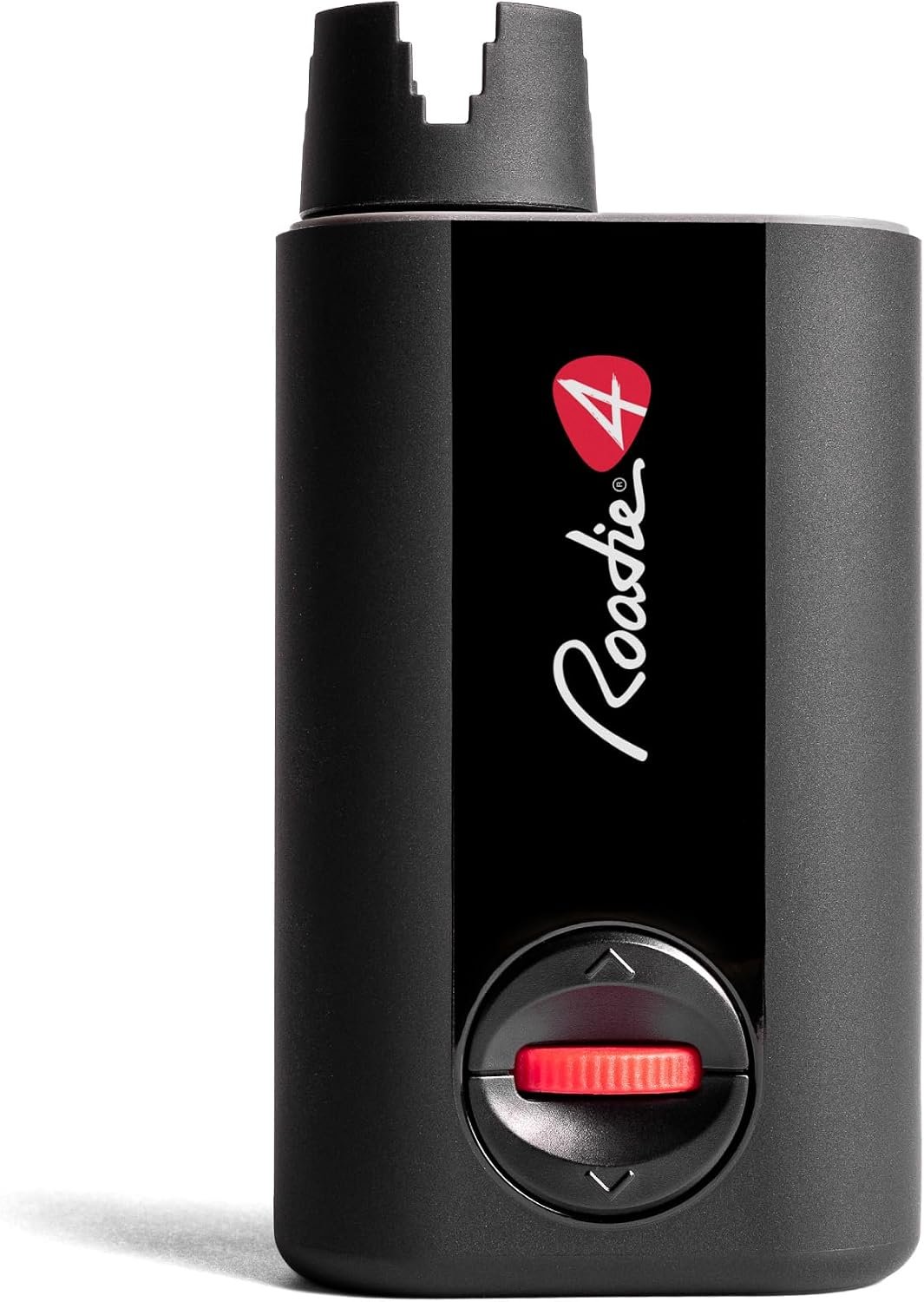
Roadie 4 Automatic Guitar Tuner
As an Amazon Associate I earn from qualifying purchases.
Keeping a guitar in tune is one of the most important parts of playing, whether you’re practising at home, recording or preparing for a performance. While conventional guitar tuners tell you when a string is sharp or flat, the Roadie 4 Automatic Guitar Tuner goes a step further by physically turning the tuning peg for you.
This handheld motorised tuner combines pitch detection, automatic peg adjustment, a full-colour display and a selection of more than 150 alternative tunings.
It also includes a motorised string winder and a built-in metronome, making it more than a straightforward tuning accessory.
Designed for guitars and other instruments with compatible geared tuning pegs, the Roadie 4 offers an interesting alternative to conventional clip-on and pedal tuners.
Its main appeal is convenience.
Rather than repeatedly plucking a string, checking the pitch and adjusting the machine head by hand, the player positions the Roadie 4 over the tuning peg, plucks the string and allows the motor to make the necessary adjustment.
The process still requires the player to guide the device around the headstock, but much of the actual peg-turning is handled automatically.
For guitarists who regularly change tunings, maintain several instruments or replace strings frequently, this could be particularly useful.
However, the Roadie 4 is a more complicated piece of equipment than a basic electronic tuner.
It requires charging, careful positioning and an understanding of its controls. It is also not compatible with every instrument.
The question is whether its additional functions provide enough practical benefit to justify choosing a motorised system over a simpler alternative.
Why it works for guitarists
The Roadie 4 approaches tuning differently from the familiar clip-on tuner.
Most electronic guitar tuners detect the pitch of a vibrating string and display whether the note needs to be raised or lowered.
The guitarist then makes the adjustment manually.
The Roadie 4 combines those two operations.
Its vibration-sensing system measures the pitch while the motor turns the machine head.
The device continues making adjustments until the string reaches the selected note.
A visual indication, audible beep and vibration confirm when tuning is complete.
This removes much of the repeated manual adjustment involved in bringing strings to pitch.
That is especially useful when working with several guitars or changing between different tunings.
For example, a guitarist might normally play in standard E tuning but occasionally switch to Drop D or Open G.
With a conventional tuner, the player must remember the desired notes and turn each relevant peg manually.
The Roadie 4 allows the appropriate tuning to be selected from its built-in library before the strings are adjusted.
This does not make guitar tuning entirely hands-free, but it simplifies an important part of the process.
The device also supports separate instrument profiles.
A player with an acoustic guitar, an electric guitar and a 12-string instrument can create different setups rather than starting from the beginning each time.
That makes the Roadie 4 particularly interesting for musicians who own more than one guitar.
Its usefulness comes from combining accurate pitch detection with a motorised mechanism and practical instrument management.
Motorised tuning without repeated manual adjustments
The motorised peg connector is the central feature of the Roadie 4.
It fits over a compatible tuning key and rotates it as the instrument’s string vibrates.
To begin, the guitarist selects the appropriate instrument profile and tuning.
The Roadie 4 is then positioned on the first tuning peg.
Once the string is plucked, the device detects its pitch and adjusts the peg towards the required note.
When the string reaches the target pitch, the unit signals completion.
The process is repeated for the remaining strings.
This arrangement reduces the need to alternate between watching a tuner and turning the machine head.
It can also make tuning more approachable for beginners who are not yet confident about which direction to turn the pegs.
However, the player must still understand which tuning is appropriate for the instrument.
The Roadie 4 does not remove the need for sensible handling of strings and machine heads.
An incorrectly selected tuning, damaged string or unsuitable peg could still cause problems.
It is also important not to force the motorised connector against a machine head that does not fit properly.
For compatible guitars, though, the principle is straightforward.
The Roadie 4 listens to the vibrating string and performs the peg adjustment that would otherwise be made by hand.
Automatic string detection
One of the notable improvements introduced with Roadie 4 is automatic string detection.
Earlier approaches to motorised tuning commonly relied on the player following a particular string sequence or manually selecting the string being tuned.
The Roadie 4 includes an Auto-Detect function that can identify the string being played.
With the feature enabled, the guitarist does not have to tune every string in a predetermined order.
For example, someone might notice that only the G string has moved out of tune.
Instead of starting with the low E string, the player can position the Roadie 4 on the G-string tuning peg, pluck that string and allow the device to identify the note.
This provides greater flexibility during ordinary practice.
It can also be useful when making small adjustments between songs.
Auto-Detect needs to be enabled in the settings, and Roadie recommends keeping the firmware updated to access the latest functionality.
Although automatic detection is convenient, it should still be used with care.
The correct instrument profile must be selected, and the guitarist needs to ensure the connector is placed on the intended tuning peg.
The system is designed to identify the sound of the string, not to understand every possible physical arrangement of a guitar’s headstock.
When used correctly, however, automatic string detection makes the Roadie 4 more adaptable than a device that requires a fixed tuning sequence.
More than 150 alternative tunings
Alternative tunings are one of the strongest reasons to consider the Roadie 4.
The device includes more than 150 built-in tuning options across supported instrument types.
For guitarists, these include familiar alternatives such as Drop D, Open D, Open G, DADGAD and various lowered tunings.
These arrangements can significantly change how a guitar responds to familiar chord shapes.
Open G, for example, provides a distinctive approach to slide playing and open-string chord voicings.
DADGAD is popular with players exploring fingerstyle arrangements and resonant acoustic textures.
Drop D is commonly used when a lower bass note is required without retuning the entire guitar.
The Roadie 4 allows these configurations to be selected from its menu.
Once selected, the automatic tuning mechanism helps move the relevant strings towards their new target pitches.
For musicians who experiment regularly, this can remove some of the inconvenience associated with changing tunings.
A player may be more willing to explore unfamiliar arrangements when the process of returning to standard tuning is simpler.
The device also supports custom tunings through its companion app.
This is valuable for musicians who use unusual string configurations or personal tuning arrangements.
However, there is an important distinction between selecting a tuning and ensuring that the guitar is suitable for it.
Not every guitar or string set is appropriate for every tuning.
Large changes in string tension may require different string gauges or adjustments to the instrument.
The Roadie 4 can help achieve the selected pitches, but it cannot determine whether those pitches are mechanically appropriate for every guitar.
That remains the player’s responsibility.
A larger colour display and improved controls
The Roadie 4 features a 1.9-inch full-colour LCD screen.
This is a noticeable part of its design.
A larger display gives the device more space to present instrument information, selected tunings and operating menus.
For someone managing multiple guitars, clear on-screen information can make the process easier to follow.
The screen is accompanied by a scroll wheel and dedicated navigation buttons.
This arrangement allows the user to move through instrument profiles, tuning selections and settings without relying on a smartphone for everyday operation.
The scroll wheel is particularly useful when navigating the large library of alternative tunings.
Instead of repeatedly pressing a small button, the player can move through the options more naturally.
The Roadie 4 also has an anti-slip grip and a taller body than its predecessor.
These features are intended to improve handling while positioning the motorised connector.
This matters because the device must be held against the tuning peg during operation.
A secure grip is important, particularly on guitars with angled headstocks or closely spaced machine heads.
The larger display and revised controls make the Roadie 4 feel more like a dedicated electronic instrument tool than a conventional tuner.
However, its interface still takes some learning.
Anyone accustomed to clipping a small tuner onto the headstock may find the additional menus unnecessary.
The benefit is greatest for players who actually use the wider selection of features.
A practical motorised string winder
Changing guitar strings is an unavoidable part of instrument maintenance.
Removing old strings and winding replacements onto tuning posts can become repetitive, particularly when several guitars need attention.
The Roadie 4 includes a motorised string-winding function designed to make this easier.
The winding mechanism can rotate the tuning peg to loosen an old string or tighten a replacement.
The player can select the winding direction and control the process using the device’s controls.
This may be especially useful for guitars with traditional machine heads that require several rotations during a string change.
Instead of turning each key manually, the guitarist can allow the motor to perform much of the movement.
Roadie 4 also provides a procedure for winding a new string sufficiently tight and then continuing directly into automatic tuning.
That makes the string winder more closely integrated with the tuning system than a separate winding accessory.
However, there is an important limitation.
The motor should not be allowed to tighten a string without supervision.
The manufacturer’s instructions warn against overtightening, which can cause a string to snap.
The guitarist must stop winding when the string has enough tension to vibrate and then use the normal tuning function to reach the intended note.
Care is also required when attaching new strings to the bridge and tuning posts.
The Roadie 4 does not replace correct restringing technique.
It simply reduces the manual turning involved.
For a player who changes strings regularly, the winding feature could become one of the device’s most useful functions.
Built-in metronome for practice
The Roadie 4 includes a metronome, giving the device a second role during guitar practice.
A metronome helps musicians maintain a consistent tempo while working on scales, picking exercises, chord changes and rhythmic passages.
The Roadie 4 can provide an audible or vibrating beat.
Its metronome also includes adjustable rhythm settings.
This gives players another way to practise timing without necessarily reaching for a separate accessory.
For example, a guitarist working on alternate picking might set a comfortable tempo and gradually increase it as the exercise becomes more familiar.
A fingerstyle player could use the metronome to maintain an even pulse while developing more complicated patterns.
The vibrating option can also be useful when an audible beat is undesirable.
However, the Roadie 4 is still primarily a tuning tool.
Its metronome should be regarded as a convenient additional function rather than a replacement for every feature offered by a dedicated rhythm-training device.
A musician who requires complex programmed rhythms, extensive visual practice information or advanced accompaniment functions may prefer a specialised app or metronome.
For everyday timing exercises, however, having the feature available in the same device is a practical advantage.
Separate profiles for different guitars
One of the more useful software features is the ability to create separate instrument profiles.
A guitarist with several instruments can store their details individually.
For example, an acoustic guitar may normally use standard tuning, while another instrument might be kept in DADGAD.
A third guitar could be configured for a lowered tuning.
Creating separate profiles makes it easier to return to the intended arrangement for each instrument.
Roadie recommends creating a different profile for each guitar, even when the instruments are similar.
This allows the tuning system to account for the characteristics of the particular instrument.
Profiles can be created directly on the Roadie 4.
The companion Roadie Tuner app provides additional options for managing instruments and custom arrangements.
This is useful for musicians who maintain several guitars rather than one general-purpose instrument.
However, the value depends on the player’s habits.
Someone with a single acoustic guitar kept permanently in standard tuning may rarely need more than one profile.
For that person, the extra management options may be unnecessary.
For a guitarist with a collection of instruments or a varied performance setup, they become considerably more relevant.
Compatible guitars and other stringed instruments
The Roadie 4 supports a broad selection of stringed instruments fitted with compatible geared tuning pegs.
These include electric guitars, acoustic guitars, classical guitars and various other string instruments.
Roadie also lists support for instruments such as ukuleles, mandolins, banjos and some less common designs.
The revised peg connector is intended to accommodate a wider range of machine-head sizes.
This is useful for musicians who play different instruments, as tuning pegs can vary considerably in shape.
The device can also be configured for instruments with unusual string counts, including 7-string and 12-string guitars.
However, compatibility should never be assumed solely because an instrument has strings.
The Roadie 4 requires suitable geared tuning mechanisms.
It is not intended for traditional friction pegs.
Most importantly, it is not designed for bass guitars.
Bass strings are generally thicker and require different torque characteristics.
Roadie makes a separate model, the Roadie Bass, for that purpose.
Guitarists who also play bass should not assume the Roadie 4 can handle both instruments.
Before purchasing, it is sensible to check that the particular guitar’s machine heads are compatible with the motorised connector.
That is especially important for unusual hardware or modified instruments.
Rechargeable battery and everyday portability
The Roadie 4 includes an internal rechargeable battery.
Charging is handled through a USB-C connection.
This eliminates the need to keep replacing disposable batteries during normal use.
It also makes the tuner practical for carrying in a guitar case or accessory bag.
A rechargeable design is convenient for players who move between home, rehearsal rooms and recording spaces.
The device’s compact handheld construction means it is much easier to transport than a large maintenance tool.
However, battery charging introduces another responsibility.
A conventional tuner with easily replaceable batteries may be simpler to keep operational when away from home.
If the Roadie 4 has not been charged before a rehearsal or performance, its motorised functions may be unavailable when needed.
The sensible approach is to recharge it regularly rather than wait until the battery becomes depleted.
Its portability is useful, but it should not be mistaken for a device that can operate indefinitely without preparation.
Tuning accuracy and instrument maintenance
Accurate tuning is essential, but the instrument itself also needs to be in suitable condition.
The Roadie 4 offers Fast Tuning and High Accuracy modes.
Fast Tuning is intended for everyday adjustments when convenience is important.
High Accuracy provides a more deliberate approach when greater precision is desirable, such as during recording preparation.
The device also includes a Tune-Up setting.
When enabled, this is designed to finish the tuning process by bringing the string up to pitch rather than ending with a downward adjustment.
Many guitarists use this technique when tuning manually because it can help reduce slack or backlash in the tuning mechanism.
The Roadie 4 automates that approach.
However, even an accurate tuner cannot overcome every mechanical problem.
Old strings may not hold pitch consistently.
Poorly fitted strings can slip around the tuning posts.
A sticking nut can prevent string tension from equalising properly.
Loose machine heads or issues with the bridge can also affect tuning stability.
For guitars fitted with tremolo systems, changing one string’s tension may influence the others.
The Roadie 4 can adjust the tuning pegs, but it cannot repair these underlying problems.
Regular maintenance, correctly installed strings and suitable hardware remain essential.
A motorised tuner is a useful addition to guitar care, not a replacement for it.
What it feels like to use
The everyday process begins by switching on the Roadie 4 and selecting the relevant guitar profile.
The screen displays the chosen instrument and its tuning configuration.
The player places the motorised connector over the appropriate tuning peg and plucks the corresponding string.
The device detects the pitch and turns the peg towards the selected note.
When the string is in tune, the Roadie 4 provides confirmation.
The player then moves to another tuning peg.
For a guitar kept in standard tuning, this process may feel straightforward once the controls become familiar.
For alternative tunings, the ability to select a prepared arrangement can be particularly convenient.
The device is held in one hand while the string is plucked with the other.
Its ergonomic grip and colour display are designed to make that interaction comfortable.
However, using the Roadie 4 is not exactly the same as operating a clip-on tuner.
It must be physically moved between pegs.
There is a motorised mechanism to position, and the player needs to maintain a secure grip.
On certain headstock designs, accessing every peg may require changing the angle of the device.
After a short period of familiarisation, the procedure may become routine.
The main benefit is not that the guitarist does nothing.
It is that the device performs much of the actual tuning adjustment, allowing the player to concentrate on selecting the correct notes and moving between strings.
The drawbacks
The Roadie 4 offers several interesting advantages, but its additional technology also introduces limitations that matter in everyday guitar use.
It is more complicated than a conventional tuner.
A basic clip-on tuner can usually be attached to the headstock and used immediately.
The Roadie 4 requires an instrument profile, an appropriate tuning selection and correct positioning over the machine head.
The menus and operating modes also take time to understand.
Although these features provide flexibility, they may be unnecessary for someone who only wants to keep one guitar in standard tuning.
A straightforward electronic tuner is often quicker to pick up and use for a minor adjustment.
The Roadie 4 is most worthwhile when its motorised operation and additional functions are genuinely useful.
It does not make tuning completely hands-free.
Despite the automatic adjustment system, the player still has to hold the device against each tuning peg.
The relevant string must also be plucked.
The Roadie 4 does not attach permanently to the guitar or tune all the strings simultaneously.
It works through a sequence of individual adjustments.
This distinction matters because the term automatic can create unrealistic expectations.
The mechanism turns the peg, but the guitarist remains actively involved throughout the process.
It cannot tune bass guitars.
This is a significant limitation for musicians who play both guitar and bass.
The Roadie 4 is designed for instruments with compatible geared pegs and strings within its intended operating range.
Bass guitars place different demands on the motor.
The manufacturer specifically recommends the separate Roadie Bass model for bass instruments.
Trying to use the Roadie 4 outside its intended capabilities is not sensible.
A guitarist who regularly maintains bass instruments would need a different solution.
Not every tuning peg is compatible.
The revised peg connector fits a broad selection of machine heads, but compatibility is not universal.
Traditional friction pegs are not supported.
Certain unusual or modified guitar hardware may also require closer checking.
Even when the connector fits, there must be enough room around the headstock to position the device correctly.
Closely spaced machine heads or unusual headstock shapes may make access less convenient.
It is therefore important to check the intended instrument before assuming the Roadie 4 will work comfortably with every tuning mechanism.
The motor must be used carefully when restringing.
A powered string winder can save time, but it also makes it possible to turn the tuning peg rapidly.
If a new string is tightened too far, it may break.
The guitarist must understand when to stop winding and begin the normal tuning process.
The device cannot replace careful string installation.
Strings still need to be secured correctly at the bridge and tuning post.
Anyone unfamiliar with restringing should learn the proper procedure before relying on the motor.
The additional convenience does not remove the risk of overtightening.
Automatic tuning cannot correct poor guitar setup.
If a guitar has unstable machine heads, binding at the nut, worn strings or a badly adjusted bridge, it may continue drifting out of tune.
The Roadie 4 cannot resolve those underlying mechanical faults.
It can only adjust the tuning pegs in response to the measured pitch.
A guitarist may therefore find that the instrument needs additional tuning after playing, despite the device working correctly.
Good instrument maintenance remains essential.
Alternative tunings can change string tension considerably.
Having more than 150 tuning options is attractive, but not every arrangement suits every guitar.
Lower tunings can make strings feel loose.
Higher tunings can increase tension.
Some arrangements may require a different string gauge or modifications to the instrument’s setup.
The Roadie 4 does not automatically assess the mechanical suitability of every tuning for a particular guitar.
Players need to understand the implications of significant pitch changes.
The availability of a tuning preset should not be taken as confirmation that it is safe or appropriate for every string set.
The battery needs to be charged.
Rechargeable operation is convenient, but it introduces another item that needs regular attention.
If the battery is depleted, the Roadie 4 cannot perform its normal powered functions.
A simple clip-on tuner with a replaceable battery may be easier to keep as an emergency backup.
Players who carry the Roadie 4 to rehearsals or performances should ensure it is charged beforehand.
For important situations, keeping an ordinary tuner available is sensible.
The companion app adds another layer of setup.
Basic tuning functions are available directly on the Roadie 4, but the companion app provides additional profile management, custom tuning creation and firmware updates.
For someone comfortable with smartphone applications, this is useful.
For someone who prefers equipment that operates entirely without additional software, it may be less appealing.
Custom configurations require more preparation than selecting one of the built-in presets.
The device’s software also needs to be maintained when new firmware becomes available.
The app adds flexibility, but not everyone will want to use it.
The tuning process depends on reliable string vibration.
The Roadie 4 detects pitch from the vibrating string.
It still requires an appropriate signal to identify the note correctly.
Very quiet vibration, unusual string behaviour or incorrect positioning may make the process less straightforward.
The manufacturer advises plucking normally rather than repeatedly striking the string rapidly.
If the device does not complete the adjustment immediately, the user may need to pluck the string again.
This is not necessarily a fault.
It reflects the way the tuning system measures pitch.
Players should allow the tuner to work rather than attempting to rush every adjustment.
It cannot compensate for every tremolo or bridge arrangement.
On guitars with floating tremolo systems, altering one string’s tension can affect the pitch of other strings.
This means tuning may require several passes.
A motorised tuner can perform individual peg adjustments, but it cannot eliminate the physical interaction between strings, springs and the bridge.
Similarly, some locking-nut systems require particular steps before tuning adjustments can be made.
The Roadie 4 is not a substitute for understanding how the guitar’s hardware operates.
The larger design may be unnecessary for occasional tuning.
Compared with a tiny clip-on tuner, the Roadie 4 is a more substantial handheld device.
Its motor, screen, battery and controls require additional space.
It is portable, but it is not as unobtrusive as a miniature headstock tuner that can remain in a case pocket.
For musicians travelling with very little equipment, a simpler tuner may be more convenient.
The Roadie 4 makes greater sense when the user wants its additional functionality.
The metronome is useful but not especially specialised.
Having a built-in metronome is a welcome addition.
However, musicians who regularly practise complex rhythmic arrangements may already use dedicated metronome apps, drum machines or other practice tools.
The Roadie 4 does not replace the full range of features available from those devices.
Its metronome is best regarded as a convenient extra.
Someone choosing a product primarily for rhythm practice would probably be better served by equipment designed specifically for that purpose.
A manual tuner may still be faster for some players.
Experienced guitarists often become very efficient at making small pitch adjustments.
A quick glance at a clip-on tuner and a brief turn of the machine head may be all they need.
Using the Roadie 4 requires picking up the device, selecting the relevant instrument and positioning the connector.
For a single slightly flat string, this could involve more steps than a manual adjustment.
The benefit becomes more apparent when changing several strings, switching tunings or restringing an instrument.
It creates another piece of equipment to maintain.
The rechargeable battery, motorised connector, controls and display all introduce components that can become worn or damaged.
The connector should be kept clean and protected from knocks.
The device should not be forced onto unsuitable machine heads.
Its charging port and screen also need sensible handling.
Unlike a simple mechanical string winder, the Roadie 4 depends on electronic and motorised systems.
That additional complexity is part of the trade-off for its convenience.
It cannot replace listening to the guitar.
An electronic tuner identifies pitch, but good guitar playing involves more than matching notes to a display.
Players still need to listen for unwanted string buzz, unstable tuning and the way chords sound together.
A guitar can appear correctly tuned while requiring adjustment to its setup or intonation.
The Roadie 4 can assist with pitch adjustment, but it does not replace the player’s judgement.
Learning to recognise tuning problems remains an important skill.
These drawbacks do not make the Roadie 4 a poor choice. They simply show that its strengths are most relevant to a particular type of guitarist.
Who it suits best
The Roadie 4 Automatic Guitar Tuner is particularly well suited to players who own several guitars or regularly experiment with alternative tunings.
A musician moving between standard tuning, Drop D and open tunings may appreciate being able to select prepared configurations without repeatedly calculating the required notes.
The device can also appeal to guitarists who change strings frequently.
Its motorised winding function reduces some of the manual work involved in removing old strings and fitting replacements.
For acoustic players, the ability to explore arrangements such as DADGAD or Open G may be especially interesting.
Electric guitarists who use different tunings for particular songs may also benefit from the stored profiles and automatic adjustments.
Guitarists who want a larger screen and clearly organised tuning information may appreciate its colour display and scroll-wheel controls.
It is less suitable for someone who wants the smallest possible tuner, has no interest in alternative tunings or already finds manual tuning quick and convenient.
It is also not the appropriate choice for bass guitar tuning.
The Roadie 4 is best viewed as a multifunction guitar-maintenance accessory rather than simply a replacement for the most basic tuning devices.
Is it worth a place in your guitar gear?
The Roadie 4 Automatic Guitar Tuner combines several genuinely useful functions in one handheld device.
Its motorised tuning mechanism can make routine string adjustment more convenient, while automatic string detection adds flexibility.
The large colour display and scroll-wheel interface improve access to the extensive alternative tuning library.
Separate instrument profiles make the device particularly interesting for players with several guitars.
The integrated string winder adds practical value during maintenance, and the metronome provides another useful feature for everyday practice.
These functions give the Roadie 4 a broader purpose than a conventional electronic tuner.
There are limitations.
It cannot tune bass guitars, it requires compatible geared machine heads, and the additional technology makes it more complicated than a simple clip-on tuner.
It also needs regular charging and sensible handling when tightening new strings.
Most importantly, it cannot correct the underlying mechanical problems that sometimes cause guitars to drift out of tune.
For a guitarist who only needs to make occasional adjustments to one instrument, a conventional tuner may remain the simpler choice.
However, for someone who enjoys alternative tunings, maintains several guitars or regularly changes strings, the Roadie 4 offers a useful combination of automatic tuning and instrument-care functions.
Its strongest appeal is not novelty.
It is the convenience of having a motorised tuner, string winder, tuning library and practice metronome together in one well-organised piece of guitar equipment.
For more useful guitar accessories, tuning equipment and practical tools for maintaining your instrument, explore our Guitar Gear guides.
As an Amazon Associate I earn from qualifying purchases.