Walrus Audio Canvas Tuner
As an Amazon Associate I earn from qualifying purchases.
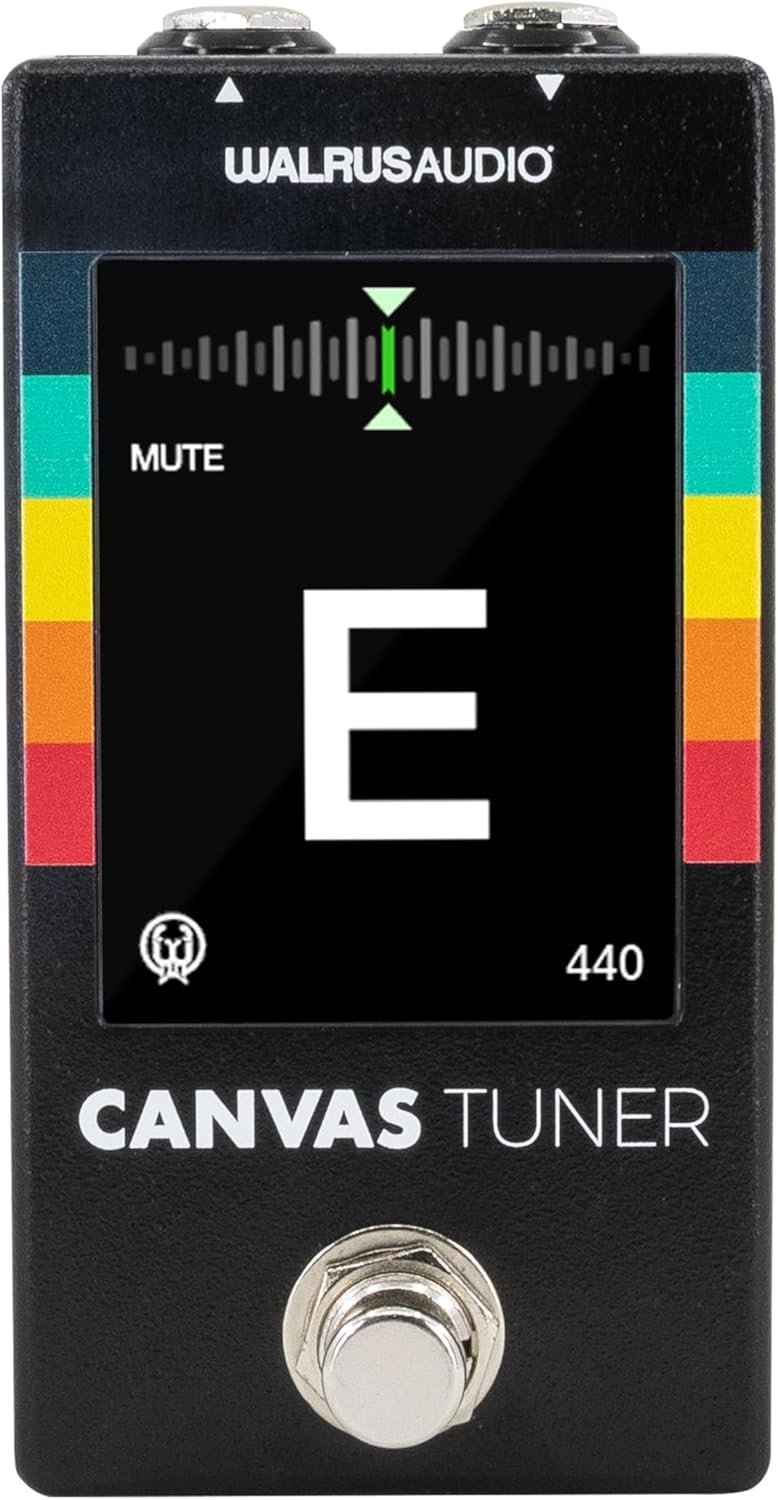
The Walrus Audio Canvas Tuner takes a familiar pedalboard essential and gives it a more modern approach. With a bright colour display, several tuning modes and a compact enclosure, it is designed for guitarists and bassists who want accurate tuning without struggling to read a tiny screen.
Its appeal is not simply that it tells you whether a string is sharp or flat. The Canvas Tuner provides different ways to display tuning information, allowing players to choose an arrangement that feels comfortable for their playing environment.
For musicians building a carefully organised pedalboard, that flexibility is particularly attractive.
Why It Works on a Guitar Pedalboard
A tuner is often the first piece of equipment a guitarist reaches for before playing.
Whether preparing for a rehearsal, recording a guitar part or getting ready for a performance, accurate tuning provides the foundation for everything that follows.
The Canvas Tuner is designed to sit comfortably among other effects pedals while offering a clear visual indication of pitch.
Its colour display is particularly useful when working under changing lighting conditions.
The ability to adjust the display orientation also makes it easier to accommodate different pedalboard layouts.
For guitarists who take tuning precision seriously, our Peterson StroboStomp HD Tuner guide explores another premium approach, with an emphasis on strobe tuning and specialist tuning presets.
The Walrus takes a similarly serious approach to tuning but places considerable emphasis on visual customisation and straightforward pedalboard integration.
What It Feels Like to Use
The Canvas Tuner has the reassuringly purposeful appearance of a professional effects pedal.
Its enclosure has a compact, rectangular shape, with a footswitch positioned beneath the colour screen.
Rather than relying on a row of small indicator lights, the display provides a more detailed visual reference.
This can make a difference when tuning quickly between songs.
A guitarist can glance down, identify the note and make the necessary adjustment without repeatedly bending closer to the pedalboard.
The selectable tuning displays also allow musicians to settle on a presentation they find easiest to interpret.
Some players prefer a conventional moving indicator, while others appreciate more detailed visual feedback.
The important point is that the tuner can adapt to different preferences rather than forcing everyone to use the same display.
Display Options and Tuning Flexibility
One of the Canvas Tuner’s strongest features is its selection of six tuning modes.
These give players different ways to follow pitch adjustments and identify when a note has reached its intended tuning.
The colour display adds another layer of visual clarity.
For musicians who perform regularly, readability can be just as important as the underlying tuning accuracy.
A sophisticated tuner is of limited practical value if its display becomes difficult to interpret during a performance.
The Canvas Tuner is particularly appealing to players who want tuning information presented clearly without unnecessary distractions.
It also suits bass guitarists, who benefit from a dependable visual reference when adjusting lower-pitched strings.
A Neater Pedalboard Setup
Pedalboard space is valuable, particularly when several effects need to fit into a relatively small area.
The Canvas Tuner’s compact enclosure makes it suitable for many conventional layouts.
Its adjustable screen orientation gives musicians additional freedom when deciding where the pedal should sit.
That flexibility can be useful when cable connections, power supplies and neighbouring pedals restrict positioning.
A well-organised board should allow every pedal to be reached comfortably without creating a tangle of cables.
Our STRICH Pedal Board guide explores a practical approach to arranging effects and keeping a working setup organised.
The Canvas Tuner fits naturally into this type of arrangement, providing a dedicated tuning position without requiring an elaborate setup.
The Drawbacks
The Canvas Tuner has plenty of appealing features, but it is not necessarily the right choice for every guitarist.
A Premium Tuner Is Not Essential for Everyone
The most obvious consideration is whether the additional features justify choosing a sophisticated dedicated tuner.
A guitarist who mainly practises at home may already have a perfectly adequate clip-on tuner or tuning function built into another device.
The Canvas Tuner offers greater display flexibility and pedalboard convenience, but those advantages matter most when they are regularly used.
For occasional tuning, a simpler solution may be entirely sufficient.
The Display Options Can Feel Unnecessary
Six tuning modes provide useful flexibility, but not every musician wants several ways to perform the same basic task.
Some players prefer a straightforward indicator that immediately shows whether a string is sharp, flat or correctly tuned.
Exploring the available display arrangements may take a little time before settling on a favourite.
Once configured, the tuner should be straightforward to use, but its customisation may be more than a beginner needs.
Power Requirements Need Checking
The Canvas Tuner requires a suitable external power supply.
Walrus Audio specifies a 9V DC centre-negative supply with sufficient current capacity, so it is important to check compatibility before connecting the pedal.
Players with older pedalboard power supplies may find that an available output cannot provide enough current.
A power supply should never be selected solely because its connector appears to fit.
The voltage, polarity and available current must all be suitable.
It Still Occupies Pedalboard Space
Although compact, the Canvas Tuner remains a dedicated piece of equipment.
For guitarists using small pedalboards, every additional pedal reduces the space available for effects.
Someone using a multi-effects processor with an integrated tuner may not need another tuning device.
The dedicated format makes more sense for musicians who prefer separate pedals and want their tuner immediately accessible.
Accurate Tuning Cannot Fix a Poorly Set Up Guitar
Even a sophisticated tuner cannot compensate for worn strings, unstable tuning machines or poorly adjusted intonation.
A guitar may appear perfectly tuned when its open strings are played, yet produce sharp notes higher up the neck.
Excessive finger pressure, unsuitable string height and mechanical problems can all contribute.
The Canvas Tuner can help identify pitch differences, but correcting the underlying problem may require proper instrument maintenance.
It Does Not Replace Other Effects
The Canvas Tuner is designed specifically for tuning rather than altering guitar tone.
Players hoping to simplify their equipment may prefer a multi-effects unit that combines tuning with several other functions.
For example, our Valeton GP-50 guide explores a compact processor designed to handle multiple effects and direct recording duties.
The Canvas Tuner is a more specialised tool, and that distinction is worth considering before dedicating space to it.
Who It Suits Best
The Walrus Audio Canvas Tuner is particularly suitable for guitarists and bassists who use dedicated pedalboards and want a clear, adaptable tuning display.
It should appeal to live performers who need to tune quickly between songs, recording musicians who value careful pitch adjustment and players who appreciate equipment with flexible visual settings.
Its compact format and selectable display arrangements also make it interesting for musicians refining an established pedalboard.
For more equipment that helps shape and organise a guitar setup, explore our Effects & Pedals guides.
Players who only need occasional tuning at home may find a simpler tuner more appropriate.
Is the Walrus Audio Canvas Tuner Worth the Space?
The Walrus Audio Canvas Tuner is a thoughtfully designed tuning pedal that places clarity, accuracy and visual flexibility at the centre of its appeal.
Its colour display and selectable tuning modes offer practical advantages for musicians who regularly use a pedalboard.
The main compromises are its external power requirements, dedicated footprint and features that may be unnecessary for casual players.
For guitarists and bassists who value a clearly readable tuner and want a permanent, dependable addition to their setup, the Canvas Tuner is a convincing option.
As an Amazon Associate I earn from qualifying purchases.