Peterson StroboStomp HD Tuner
As an Amazon Associate I earn from qualifying purchases.
Accurate tuning is one of those small details that can make an enormous difference to how a guitar sounds. Even a well-made instrument can lose its clarity when the strings are slightly out of tune, particularly when playing chords, recording or performing alongside other musicians.
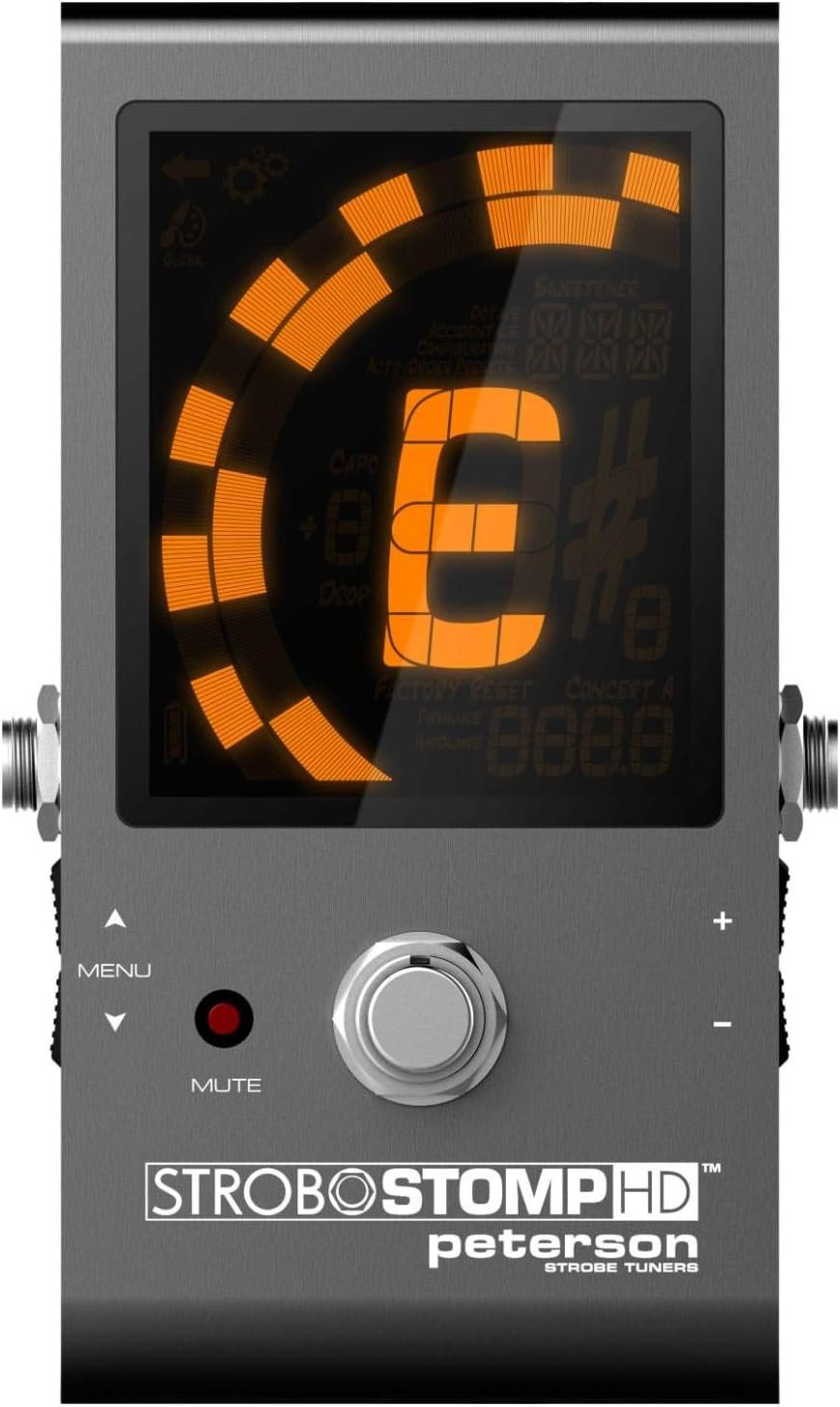
The Peterson StroboStomp HD is a professional-grade pedal tuner designed for guitarists and bassists who want greater precision than a basic tuning pedal provides.
With 0.1-cent accuracy, a large colour-adjustable strobe display and over 135 Sweetened Tuning presets, it offers a particularly detailed approach to keeping an instrument in tune.
Its stainless-steel enclosure and flexible bypass settings also make it a practical addition to an established pedalboard.
Why Accurate Tuning Matters
Most conventional guitar tuners use a needle or indicator to show whether a note is sharp or flat.
The StroboStomp HD takes a different approach. Its moving strobe pattern responds to tiny pitch differences, allowing the guitarist to make very fine adjustments.
As the string approaches the correct pitch, the pattern slows. When the display becomes stationary, the note is accurately centred on the selected tuning reference.
Peterson specifies accuracy within 0.1 cents, equivalent to one-thousandth of a semitone.
That level of precision is particularly valuable when setting guitar intonation, preparing instruments for recording or working with alternative tuning systems.
For everyday playing, it also gives musicians a clear visual indication of small pitch differences that less sensitive displays might overlook.
A Large, Easy-to-Read Display
The StroboStomp HD features a high-definition LCD screen with adjustable LED backlighting.
Unlike compact tuners with tiny displays, the Peterson provides a large tuning pattern and prominent note identification.
The screen colour can be adjusted to suit different lighting conditions or personal preferences.
This is useful for musicians moving between home practice, rehearsal rooms and brightly illuminated stages.
Different colours can also be assigned to tuning presets, helping players identify their selected configuration more quickly.
The display is designed to remain readable in strong lighting, although its appearance can change in direct sunlight.
For live performers, being able to recognise the correct note and tuning status at a glance is particularly important.
Sweetened Tunings Explained
One of the StroboStomp HD’s most distinctive features is its collection of more than 135 Sweetened Tuning presets.
These presets use carefully selected pitch adjustments rather than relying entirely on conventional equal temperament.
The aim is to help particular instruments and chord arrangements sound more balanced.
For example, Peterson provides dedicated settings for electric guitars, acoustic guitars, basses, 12-string guitars and several specialist instruments.
These adjustments can be useful where ordinary tuning leaves certain chords sounding slightly unsettled.
The pedal also supports guided alternative tunings, including familiar arrangements such as Drop D and DADGAD.
Instead of displaying only note names, guided modes can show string numbers to help players work through the selected tuning.
This makes the tuner particularly interesting for musicians who regularly experiment beyond standard EADGBE.
However, Sweetened Tunings are optional. Standard chromatic tuning remains available for those who prefer a conventional approach.
Built for a Working Pedalboard
The StroboStomp HD uses a stainless-steel enclosure with a substantial footswitch and a compact rectangular shape.
Measuring approximately 129 mm long and 66 mm wide, it fits comfortably into many conventional pedalboard arrangements.
The pedal weighs around 408 grams, giving it a solid physical specification without becoming excessively large.
Peterson provides three operating arrangements: true bypass, buffered output and monitor mode.
True bypass allows the guitar signal to pass through the pedal without active buffering when the tuner is disengaged.
Buffered operation can be useful when longer cables or several effects pedals introduce signal-loading concerns.
Monitor mode allows tuning information to remain visible while the guitar signal continues through the pedal.
This flexibility is valuable for musicians who want to keep the tuner connected throughout a performance.
Power and Everyday Convenience
The StroboStomp HD operates using a 9V battery or a compatible centre-negative 9V DC power supply.
Peterson specifies a typical current requirement of 85 mA.
A useful addition is the 9V power-through connection, which can supply another compatible pedal when an appropriate external supply has sufficient capacity.
This may help with power distribution on a busy pedalboard.
The tuner also includes a micro-USB connection for configuration and firmware updates through Peterson Connect.
For guitarists who enjoy personalising equipment, the software allows tuning configurations and display settings to be managed in greater detail.
How It Compares with Other Tuning Accessories
The Peterson focuses on precision and pedalboard convenience, but not every guitarist needs this particular approach.
Our Roadie 4 Automatic Guitar Tuner guide explores a different solution, using motorised tuning to physically turn compatible tuning pegs.
The Roadie prioritises convenience when adjusting strings, while the Peterson provides detailed visual feedback for manual tuning.
Pitch accuracy also matters when using accessories such as a capo.
Our D’Addario PW-CP-19 Guitar Capo guide explains the importance of appropriate string pressure, particularly on 12-string instruments.
A precise tuner can help identify pitch problems, but the guitar’s setup and accessories still influence how accurately it plays.
The Drawbacks
The Peterson StroboStomp HD offers impressive precision, but there are practical limitations worth understanding before adding it to a pedalboard.
The Strobe Display Takes Practice
The moving strobe pattern behaves differently from a conventional needle tuner.
Instead of waiting for an indicator to reach the centre, the guitarist must adjust the string until the moving pattern becomes stationary.
This can initially feel more demanding, particularly when making tiny adjustments.
The display is also sensitive enough to reveal natural fluctuations in a vibrating string. Players may need to develop a gentle, consistent tuning technique rather than chasing every small movement.
Someone who prefers a simple green light indicating that a string is in tune may find a conventional tuner easier.
Extreme Accuracy Isn’t Always Necessary
The quoted 0.1-cent accuracy is impressive, but not every musical situation requires it.
A guitarist practising basic chords at home may be perfectly satisfied with a less sophisticated tuner.
The additional precision becomes more relevant for instrument setup, detailed intonation adjustments, recording and specialist tuning requirements.
It is worth considering whether those advantages will actually be used.
Buying a highly accurate tuner will not automatically make every guitar sound better if the instrument itself has mechanical or setup problems.
Sweetened Tunings Can Be Confusing
More than 135 tuning presets provide considerable flexibility, but that selection can become overwhelming.
Some presets are intended for particular instruments or tuning systems rather than general guitar playing.
Choosing an unsuitable preset may lead to confusion when comparing tuning results with another instrument.
Players unfamiliar with tempered tuning systems should begin with standard chromatic tuning and explore the alternatives gradually.
The large selection is a strength for experienced musicians, but a potential complication for beginners.
It Cannot Correct Poor Instrument Setup
A precision tuner cannot repair worn strings, unstable tuning machines, a binding nut or badly adjusted intonation.
If a guitar consistently drifts out of tune after playing, the underlying mechanical problem still needs attention.
Likewise, fretted notes may sound sharp because of excessive string height or finger pressure, even when the open strings have been tuned accurately.
The Peterson can help reveal these problems, but it does not correct them automatically.
Good strings, suitable maintenance and proper setup remain essential.
Power Supply and Connectivity Limitations
Although the pedal accepts a standard 9V battery, regular pedalboard use is generally more convenient with an external supply.
The compatible mains adapter is optional, so buyers should check what is included with their particular listing.
Powering another pedal through the output also requires sufficient capacity from the external supply.
The micro-USB connection is intended for configuration and updates, not for recharging an internal battery.
In fact, the StroboStomp HD does not have a rechargeable battery.
A Dedicated Pedal Takes Up Space
The stainless-steel enclosure is reassuringly substantial, but it still occupies space that could be used for another effect.
Guitarists who rarely perform and mainly tune at home may prefer a small clip-on tuner.
The Peterson also needs suitable audio connections when installed as part of a pedalboard.
Its construction and performance features make more sense for regular use than for someone who only tunes a guitar occasionally.
Who It Suits Best
The StroboStomp HD is particularly suitable for guitarists and bassists who value accurate tuning and dependable pedalboard equipment.
It should appeal to recording musicians, live performers and players who regularly adjust their instrument’s intonation.
Its Sweetened Tuning presets also make it attractive to musicians exploring 12-string guitars, alternative tunings and specialist instruments.
For other useful accessories that help keep instruments ready to play, explore our Guitar Gear collection.
Those who simply need a basic tuner for occasional home practice may find the Peterson more sophisticated than necessary.
Is the Peterson StroboStomp HD Worth the Space?
The Peterson StroboStomp HD combines exceptionally precise tuning, a highly visible display and flexible pedalboard operation in a solid stainless-steel enclosure.
Its Sweetened Tuning presets and alternative operating modes provide useful options for musicians who want more than basic tuning assistance.
The main compromises are the learning curve of the strobe display, the complexity of some advanced settings and the need to justify a dedicated pedal.
For guitarists who take tuning seriously, particularly during recording, instrument setup and live performance, the StroboStomp HD is a well-considered piece of equipment that could remain useful for many years.
As an Amazon Associate I earn from qualifying purchases.