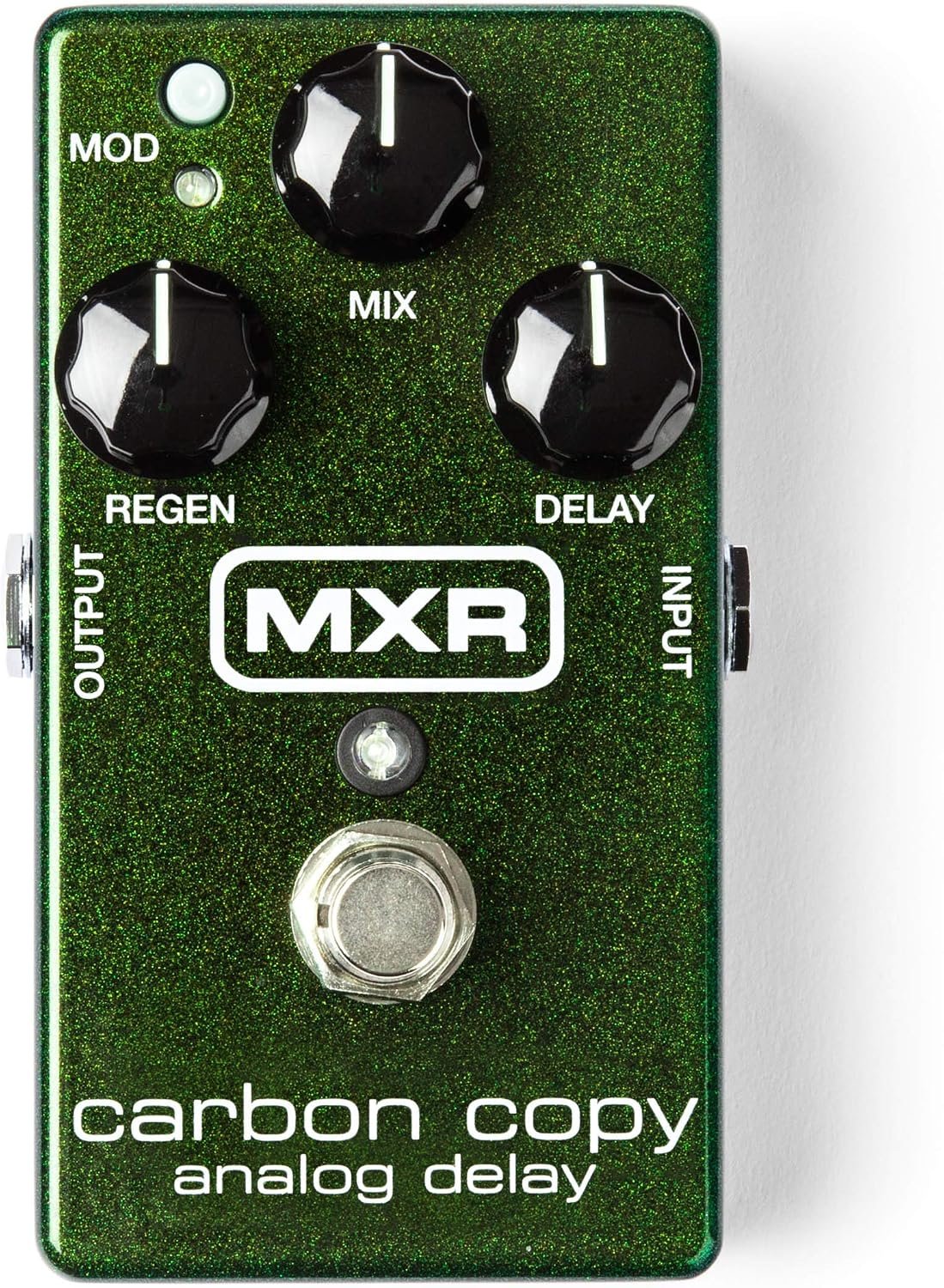
MXR M169 Carbon Copy Analog Delay Pedal
As an Amazon Associate I earn from qualifying purchases.
The MXR M169 Carbon Copy Analog Delay Pedal is designed for guitarists who appreciate warm, natural echoes without complicated digital menus or unnecessary controls.
Built around traditional analogue bucket-brigade technology, it produces everything from short slapback echoes to longer, atmospheric repeats. Its distinctive metallic green enclosure, straightforward layout and switchable modulation give it a character that suits both traditional and modern guitar playing.
Rather than offering dozens of different delay algorithms, the Carbon Copy concentrates on doing one particular job well.
For players who prefer dedicated effects pedals with a clear musical purpose, that simplicity is an important part of its appeal.
Why It Works on a Guitar Pedalboard
Delay is one of the most versatile effects available to electric guitarists.
A short echo can add body to country picking, blues solos and rockabilly rhythms. Longer repeats can create depth behind lead guitar passages or introduce movement into slower, atmospheric arrangements.
The MXR Carbon Copy uses a completely analogue signal path for its delay processing, producing repeats that gradually soften as they decay.
Unlike many digital delays, which can reproduce the original note with considerable precision, the Carbon Copy gives its echoes a darker, rounded character.
That distinction is particularly useful when playing lead guitar. Repeated notes can sit behind the original performance rather than competing with every new note being played.
The pedal also uses true bypass switching, allowing the guitar signal to bypass the effect circuitry when the pedal is disengaged.
Simple Controls With Useful Flexibility
One of the Carbon Copy’s strongest characteristics is its uncomplicated control layout.
Three external knobs provide the essential adjustments, while a small modulation switch introduces additional movement.
Delay, Mix and Regen
The Delay control determines the time between the original guitar note and its repeats.
With an adjustable delay range of approximately 20 to 600 milliseconds, the pedal covers short slapback effects, conventional lead-guitar delay and longer atmospheric echoes.
The Mix control adjusts the balance between the original signal and the delayed sound.
At restrained settings, the effect can remain subtle, adding a little depth without becoming the main attraction.
Regen controls the number of repeats. Lower settings produce a handful of echoes, while higher settings allow the repeats to build and continue for longer.
Together, these controls provide considerable flexibility without requiring programming or navigating screens.
Switchable Modulation
The Carbon Copy also includes a modulation circuit that can be activated using the MOD switch.
This introduces gentle pitch movement into the delayed signal, creating a slightly wavering quality reminiscent of vintage tape echoes.
The modulation can add richness to sustained notes and softly picked chords.
Internal adjustment controls allow the modulation speed and width to be changed, although accessing them requires removing the pedal’s bottom plate.
What It Feels Like to Use
The M169 has a compact, traditional stompbox design that should feel familiar to guitarists accustomed to individual effects pedals.
Its metal enclosure provides a substantial protective housing, while the metallic green finish makes it easy to recognise among other pedals.
The three black control knobs are clearly separated, and the modulation switch sits above them.
There is no display, complicated navigation system or extensive collection of buttons.
That makes the basic operating arrangement particularly approachable.
For home practice, the Carbon Copy can be connected between a guitar and amplifier using standard instrument cables.
It can also become part of a larger pedalboard, sharing space with overdrive, distortion, modulation and reverb effects.
Power comes from a 9-volt battery or a compatible 9-volt DC supply.
Its straightforward design is especially appealing to players who would rather adjust their sound directly than spend time managing digital presets.
From Slapback Echo to Atmospheric Guitar
The Carbon Copy offers several useful musical applications despite its relatively limited number of controls.
For country, rockabilly and vintage blues, shorter delay settings can create a lively slapback effect that adds presence to individual notes.
For rock and blues lead guitar, moderate delay times with restrained repeats can help sustain melodic passages without obscuring the original performance.
Longer delay settings are useful for atmospheric playing, especially when combined with the modulation circuit.
Slow chords and sustained notes can develop into layered textures, making the pedal suitable for ambient rock and expressive instrumental music.
Delay also combines naturally with reverb.
Guitarists interested in adding more expansive ambience can explore our Strymon Cloudburst Ambient Reverb Pedalarticle, which examines a different approach to creating spacious guitar sounds.
The two effects serve different purposes: delay produces distinct repetitions, while reverb creates the impression of sound continuing within an acoustic space.
Dedicated Analogue Delay or Multi-Effects?
The Carbon Copy makes most sense when a guitarist specifically wants the character of analogue delay.
It does not attempt to replace an entire pedalboard.
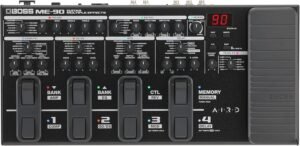
For musicians who need amplifier modelling, multiple modulation effects, different delay algorithms and programmable sounds, an integrated processor may be more practical.
Our BOSS ME-90 Multi-Effects Pedal article explores that broader approach.
The MXR takes a deliberately narrower path, concentrating on a particular delay character with immediate physical control.
Neither approach is automatically better. It depends on whether specialised sound or greater versatility matters most.
The Drawbacks
The MXR M169 Carbon Copy is a thoughtfully designed pedal, but its traditional analogue approach introduces several limitations.
These are important considerations, particularly for guitarists comparing it with modern digital delay pedals.
Dark Repeats Will Not Suit Every Style
The Carbon Copy’s warm, softened echoes are central to its character.
However, that darker response will not appeal to everyone.
Guitarists who want sharply defined repeats, bright rhythmic patterns or exceptionally clear note separation may find the sound too subdued.
This becomes more noticeable when playing complicated rhythmic passages where individual echoes need to remain clearly audible.
A brighter digital delay may be more appropriate for those applications.
No Tap Tempo
One of the most significant omissions is tap tempo.
Delay time must be adjusted using the dedicated knob rather than tapping a footswitch in time with the music.
For home playing, this may be a minor inconvenience.
During live performances, however, guitarists who regularly change songs or tempos may prefer a pedal that allows quicker rhythmic adjustments.
It is possible to set the delay by ear, but matching exact musical subdivisions requires more effort.
Modulation Adjustments Are Less Convenient
Although the modulation circuit adds useful character, its detailed controls are not accessible from the top panel.
Changing the modulation speed or width requires access to internal adjustment controls.
This is manageable when setting up the pedal at home, but considerably less convenient during rehearsals or performances.
Players who frequently change modulation settings may prefer equipment with dedicated external controls.
No Presets or Advanced Digital Features
The Carbon Copy does not offer programmable presets, MIDI control or selectable digital delay algorithms.
Every adjustment is made manually.
For guitarists who use the same delay sound throughout a performance, that simplicity can be an advantage.
However, anyone needing several precisely stored settings will find the arrangement restrictive.
There are also no reverse delay, multi-head echo or other specialised digital modes.
The pedal is designed to provide traditional analogue repeats rather than an extensive collection of effects.
A Maximum Delay Time of 600 Milliseconds
The available delay range covers many conventional guitar applications.
Nevertheless, the 600-millisecond maximum may be restrictive for musicians creating very long rhythmic echoes or elaborate ambient soundscapes.
More advanced delay pedals can offer considerably longer delay times and additional control over how repeated notes develop.
The Carbon Copy remains useful for atmospheric playing, but it is not a replacement for a dedicated ambient workstation.
Power and Connectivity Limitations
The Carbon Copy supports battery operation, but fitting or replacing the battery requires removing the bottom plate.
For regular pedalboard use, a compatible external power supply is generally more convenient.
A power adapter is not included, so guitarists should check their existing power arrangements before purchasing.
The pedal also provides conventional mono input and output connections rather than stereo processing.
That is perfectly adequate for many guitar-and-amplifier setups, but musicians building elaborate stereo rigs may prefer a more flexible delay pedal.
Who It Suits Best
The MXR Carbon Copy is particularly appealing to guitarists who enjoy blues, classic rock, country, roots music and atmospheric instrumental playing.
It suits musicians who value warm analogue echoes and prefer direct physical controls over screens and digital programming.
Players building a compact collection of dedicated effects may also appreciate its straightforward operation and traditional sound.
However, musicians who require tap tempo, multiple presets, stereo operation or a wide range of digital delay types should consider alternatives.
For other carefully selected sound-shaping equipment, explore our Effects & Pedals collection.
Is It Worth the Pedalboard Space?
The MXR M169 Carbon Copy Analog Delay Pedal offers a focused combination of traditional analogue sound, simple controls and practical construction.
Its warm repeats, adjustable delay time and optional modulation provide useful creative possibilities for guitarists who favour expressive playing over elaborate programming.
The absence of tap tempo, presets and more advanced connectivity will understandably limit its appeal for some musicians.
However, those compromises are also part of a deliberately straightforward design.
For players who want a dedicated analogue delay with a distinctive musical character, the Carbon Copy remains a sensible choice.
Its greatest strength is not the number of features it offers, but the way a few carefully chosen controls allow guitarists to shape warm, natural echoes around their playing.
As an Amazon Associate I earn from qualifying purchases.