Strymon Cloudburst Ambient Reverb Pedal
As an Amazon Associate I earn from qualifying purchases.
The Strymon Cloudburst Ambient Reverb Pedal is designed for guitarists who want more than a little background ambience. It combines carefully shaped reverb with a distinctive Ensemble effect that can turn ordinary guitar notes into rich, evolving atmospheric textures.
What makes the Cloudburst interesting is its focused approach. Rather than offering dozens of unrelated effects, Strymon has concentrated on creating spacious, expressive reverb sounds within a compact pedal.
The result is an unusually versatile ambience processor. It can add subtle depth to clean guitar playing, create long atmospheric trails or produce string-like layers that develop beneath sustained notes and chords.
Its blue aluminium enclosure, straightforward controls and compact dimensions also make it an attractive option for a thoughtfully arranged pedalboard.
However, the Cloudburst is a specialist effects pedal. Its strengths are considerable, but not every guitarist needs the elaborate soundscapes it can produce.
Why It Works on a Guitar Pedalboard
Reverb is one of the most useful effects available to guitarists.
At modest settings, it adds a sense of space and helps a guitar sound less dry or isolated. Increase the decay and the effect becomes a more noticeable part of the music.
The Strymon Cloudburst takes this principle considerably further.
Its reverb engine covers everything from relatively intimate spaces to expansive, slowly developing atmospheric sounds.
An important part of its design is the Decay control.
Rather than simply extending the duration of one fixed reverb algorithm, Strymon adjusts several internal parameters as the control is turned.
This allows the character of the reverberation to change as the virtual space becomes larger.
For practical playing, that means the pedal can move between subtle ambience and enormous sustained textures without requiring complicated programming.
The original guitar signal remains central to the effect, making the Cloudburst useful for individual melodic notes, open chords and gentle fingerstyle passages.
The Ensemble Effect Makes It Different
The Cloudburst’s most distinctive feature is its Ensemble processing.
This is not an ordinary chorus effect or a conventional pitch-shifting pedal.
Instead, Strymon uses a specialised processing system that analyses the incoming guitar signal and generates additional harmonic content.
The effect responds dynamically to what the guitarist plays.
Changes in picking position, guitar pickups and playing intensity can influence the resulting texture.
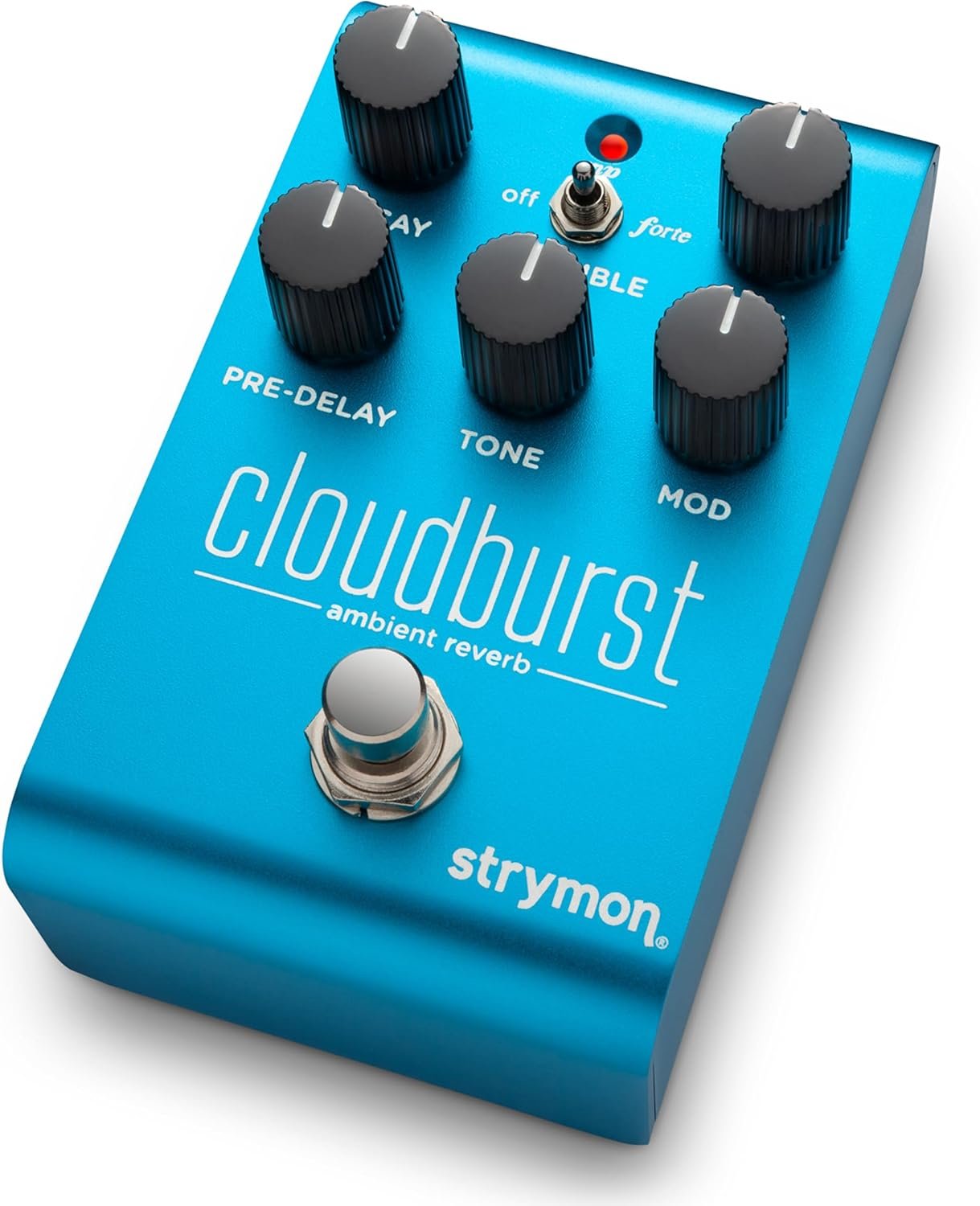
The Ensemble switch provides three positions: Off, mp and forte.
With Ensemble switched off, the Cloudburst operates as a spacious reverb pedal without the additional harmonic layers.
The mp position introduces a more restrained Ensemble effect, adding gentle complexity to the reverberation.
Select forte and the generated harmonics become more prominent, creating lush, string-like textures beneath the guitar.
For ambient music, this can be particularly appealing.
A slowly played chord can develop into an expansive background layer, while individual notes can leave shimmering harmonic textures behind them.
The effect is especially interesting for players who enjoy creating atmosphere without relying on a separate synthesiser.
However, Ensemble does not reproduce an actual orchestral recording. It creates its own synthesised harmonic character, which is an important distinction.
Straightforward Controls With Plenty of Expression
Despite its sophisticated digital processing, the Cloudburst has a relatively simple control layout.
Five knobs provide direct adjustment over the main reverb parameters.
The Decay control determines the character and duration of the reverberation.
Pre-Delay adjusts the interval between the original guitar note and the beginning of the reverb.
This can help preserve clarity, particularly when playing melodic passages where the initial pick attack needs to remain audible.
The Tone control changes the brightness of the reverberation.
Lower settings create a darker, softer atmosphere, while higher settings introduce additional brightness and presence.
The Mod control adds modulation to the reverb, introducing movement into sustained textures.
Finally, Mix determines the balance between the dry guitar signal and the processed sound.
This arrangement makes the Cloudburst approachable for musicians who prefer physical controls rather than extensive menus.
Small adjustments can produce meaningful changes without interrupting the playing experience.
What It Feels Like to Use
The Cloudburst has the compact, purposeful appearance associated with Strymon’s smaller pedals.
Its blue anodised aluminium enclosure provides a durable metal housing without occupying the space of a much larger multi-effects processor.
The five knobs are arranged across the upper surface, with the Ensemble selector clearly positioned nearby.
A single footswitch handles normal effect engagement and bypass.
For a guitarist using a conventional amplifier, the basic arrangement is straightforward: connect the guitar signal, supply power and adjust the reverb until it complements the instrument.
The physical controls encourage experimentation.
A restrained Mix setting and shorter Decay can provide gentle ambience for everyday playing.
Increasing the decay, modulation and Ensemble intensity moves the sound towards more atmospheric territory.
The most useful approach is often to start with a relatively simple reverb setting before gradually introducing the Ensemble effect.
That allows the harmonic layers to support the original guitar rather than overwhelming it.
Stereo Sound and Modern Connectivity
Although the Cloudburst is compact, its connections offer considerably more flexibility than a basic mono stompbox.
It supports stereo input and output through TRS connections.
This makes it suitable for guitarists using stereo amplifiers, recording interfaces or more elaborate signal chains.
Stereo operation can be particularly useful with long reverberation, where the additional width helps create a larger sense of space.
The Cloudburst also supports MIDI control.
Up to 300 preset locations can be accessed through compatible MIDI equipment, allowing different sounds to be recalled during rehearsals, performances or recording sessions.
An EXP/MIDI connection provides options for external control, including expression-pedal operation.
Compatible external switching can also provide Freeze and Infinite functions for sustaining reverb textures.
A USB-C connection supports MIDI communication and firmware updates.
These capabilities make the Cloudburst useful beyond a simple guitar-and-amplifier arrangement.
However, some of the advanced functions require additional equipment and configuration.
How It Compares With Other Guitar Effects
The Cloudburst is particularly interesting when compared with Strymon’s other reverb-focused equipment.
Our guide to the Strymon Flint V2 Tremolo & Reverb Pedal explores a different approach.
The Flint combines vintage-inspired tremolo with spring, plate and hall reverbs, making it particularly suitable for classic amplifier-style sounds.
The Cloudburst concentrates more directly on expansive ambience and its distinctive Ensemble processing.
For guitarists who enjoy atmospheric music, that specialisation may be more appealing.
Other musicians may prefer an all-in-one effects processor.
The BOSS ME-90 Multi-Effects Pedal combines amplifier modelling, modulation, delay, reverb and other effects in one floor unit.
It provides considerably more variety across different effect categories.
The Cloudburst takes the opposite approach, concentrating its processing and controls on a particular style of reverb.
Neither arrangement is automatically better. The choice depends on whether versatility or specialised ambience matters more.
The Drawbacks
The Strymon Cloudburst offers sophisticated reverb processing, but there are several practical limitations worth considering before giving it a permanent place on a pedalboard.
Its Specialised Sound Will Not Suit Everyone
The Cloudburst is particularly strong at creating expansive ambient textures.
That is appealing for atmospheric rock, post-rock, cinematic music and experimental guitar arrangements.
However, guitarists who mainly play straightforward blues, traditional rock or tightly controlled rhythm parts may rarely need its more elaborate capabilities.
Although the pedal can produce subtle reverberation, its distinctive character and advanced Ensemble processing may be unnecessary for players who only want a little background ambience.
An amplifier’s built-in reverb or a simpler pedal could already provide everything required.
Its specialisation is a strength, but only when those sounds are genuinely useful.
The Ensemble Effect Can Become Overpowering
The Ensemble feature is arguably the Cloudburst’s main attraction, but it also requires restraint.
At stronger settings, the additional harmonic layers can become a prominent part of the overall sound.
That can be wonderful for slow chord progressions and atmospheric passages.
In a busy arrangement, however, those sustained textures may compete with vocals, keyboards and other instruments.
The effect can also soften the distinction between individual notes when combined with extensive reverb decay.
For rhythm guitarists who depend on clear separation and precise timing, heavy Ensemble settings may prove distracting.
Careful adjustment of Mix, Decay and Ensemble intensity is important.
It Does Not Replace a Multi-Effects Processor
The Cloudburst is primarily a dedicated reverb pedal.
It does not provide a complete collection of overdrive, distortion, conventional delay, wah and amplifier-modelling effects.
Guitarists wanting these sounds will need additional pedals or a separate processor.
That introduces extra cabling, power requirements and pedalboard space.
Players who regularly move between radically different musical styles may find a broader multi-effects system more practical.
The Cloudburst makes considerably more sense when reverb is an important part of the guitarist’s existing sound.
No Power Supply Is Included
Strymon specifies a regulated 9V DC, centre-negative power supply capable of delivering at least 250mA.
The power adapter is not included.
Anyone adding the Cloudburst to an existing pedalboard should check that their power supply has an available output with the correct voltage, polarity and current capacity.
It is not suitable for ordinary battery operation.
This is especially relevant for guitarists accustomed to simple pedals that draw very little current.
A suitable isolated power output is generally a sensible choice for a digital pedalboard arrangement.
Stereo Connections Require the Correct Cables
The Cloudburst provides stereo input and output, but it achieves this through compact TRS connections rather than separate left and right sockets.
For stereo operation, compatible TRS cables or adapter arrangements are required.
The rear-panel routing switch must also be configured correctly.
This is perfectly manageable once the connections are understood, but it is less immediately obvious than a pedal with individual mono jacks for each stereo channel.
Guitarists using a single conventional amplifier are unlikely to encounter much difficulty.
Those building stereo rigs should allow for the additional cabling and setup.
Advanced Presets Need External Equipment
The advertised MIDI capabilities provide considerable flexibility.
However, having access to 300 presets does not mean the pedal includes 300 immediately accessible onboard memories with dedicated selection buttons.
Making full use of MIDI preset recall requires appropriate external equipment.
Expression control and some extended footswitch functions also rely on compatible accessories.
For a musician already using a programmable pedalboard, this may be entirely reasonable.
For someone wanting a completely self-contained pedal, it introduces additional complexity.
The standard controls remain straightforward, but the advanced functionality requires more planning.
It Cannot Replace Every Type of Reverb
Although the Cloudburst covers a useful range of spaces, it does not offer a large library of individually selectable spring, plate, hall and other traditional reverb algorithms.
Its controls work within Strymon’s particular Cloudburst reverb design.
That gives the pedal a distinctive and consistent character.
However, guitarists who specifically want the splash of a vintage spring tank or the precise character of several different studio reverbs may prefer a more conventional multi-algorithm pedal.
The Cloudburst is designed around one carefully developed reverb concept rather than trying to reproduce every type of acoustic space.
Long Reverb Trails Need Careful Control
Extended decay settings can create beautiful sustained backgrounds.
They can also make faster playing sound less defined.
When notes overlap heavily, the accumulated reverberation may reduce clarity, especially through an already compressed or heavily distorted guitar sound.
This is not necessarily a fault with the processing. It is a natural consideration when using very long reverb tails.
Players need to balance the effect against their playing style, amplifier settings and the rest of the band.
The ability to create enormous atmospheric sounds is useful, but those sounds will not fit every arrangement.
Who It Suits Best
The Strymon Cloudburst is particularly well suited to guitarists who enjoy atmospheric, expressive playing.
Ambient, post-rock, worship and cinematic musicians may appreciate the way its Ensemble processing creates harmonic backgrounds beneath individual notes and chords.
It should also appeal to recording guitarists who want expansive stereo textures without relying entirely on software effects.
Players who already own a dependable amplifier and a small selection of quality pedals may find that the Cloudburst introduces a distinctive new dimension to their existing setup.
However, guitarists who mainly require conventional reverb or a broad collection of unrelated effects may be better served elsewhere.
For more carefully selected sound-shaping equipment, explore our Effects & Pedals collection.
Is It Worth the Pedalboard Space?
The Strymon Cloudburst is a thoughtfully designed ambient reverb pedal with a clearly defined purpose.
Its responsive Ensemble effect, adjustable reverb character and stereo connectivity provide considerable creative potential within a compact aluminium enclosure.
The straightforward physical controls also make it approachable without requiring musicians to explore complicated menus during ordinary playing.
Nevertheless, its strengths are specialised.
A separate power supply, additional equipment for advanced control and the absence of multiple traditional reverb algorithms are all worth considering.
For guitarists who regularly use spacious reverberation and enjoy building atmospheric arrangements, the Cloudburst offers a distinctive alternative to conventional reverb pedals.
For players who only need occasional background ambience, its capabilities may be more than necessary.
Ultimately, the Cloudburst deserves its place when creating expressive, evolving soundscapes is an important part of the music you play.
As an Amazon Associate I earn from qualifying purchases.