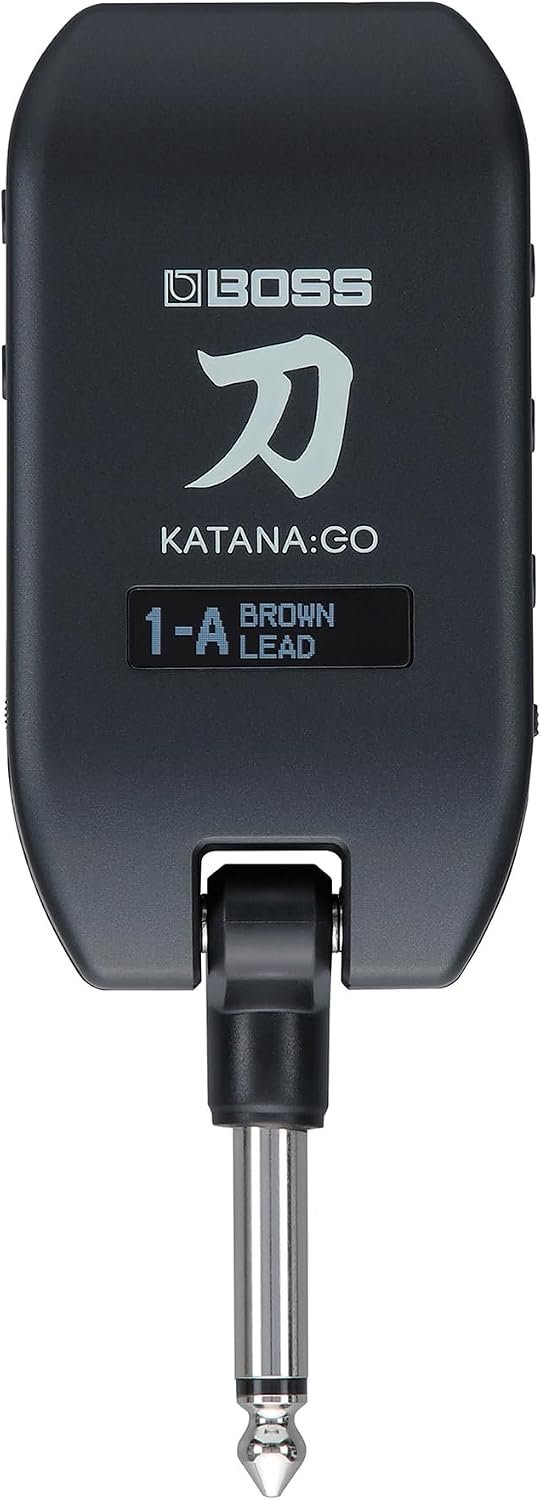
BOSS Katana:GO Headphone Amplifier
As an Amazon Associate I earn from qualifying purchases.
Not every guitarist needs to switch on a full-size amplifier to enjoy a satisfying practice session. Sometimes, being able to plug in, put on headphones and start playing is exactly what’s needed.
The BOSS Katana Headphone Amplifier brings the sound-shaping capabilities of the Katana amplifier range into a compact device that connects directly to an electric guitar or bass.
With built-in amplifier models, effects, Bluetooth audio streaming and spatial sound technology, it offers considerably more than basic headphone amplification.
For players practising at home, travelling or sharing living space with others, its appeal is the freedom to play without setting up a conventional amplifier and pedalboard.
Why it works for private guitar practice
The Katana is built around convenience without abandoning the variety of sounds associated with BOSS amplifiers.
Guitar mode offers 10 amplifier types, ranging from clean sounds through crunch and higher-gain tones. More than 60 effects provide additional ways to shape the instrument’s sound.
That means a guitarist can move between clean chord work, blues leads, classic rock and heavier playing without needing separate pedals.
Bass players are also catered for, with a dedicated mode containing three amplifier types and its own selection of effects.
The unit includes 30 sound memories for guitar and another 30 for bass, providing ready-to-use sounds and space for personalised settings.
An integrated tuner adds another practical feature, removing the need to reach for a separate tuning device during practice.
For guitarists who want a broader floor-based system for rehearsals and performances, the BOSS ME-90 Multi-Effects Pedal offers a different approach, with physical footswitches and controls designed for live playing.
The Katana is smaller and more focused. Its purpose is to make private practice as convenient as possible.
What it feels like to use
At approximately 65 grams, the Katana is light enough to carry in a pocket or the accessory compartment of a guitar case.
Its compact housing measures approximately 125 mm long, 45 mm wide and 29 mm high. The integrated quarter-inch instrument plug folds away when the device is not being used.
That folding design makes storage convenient and protects the connector from being left exposed.
To begin playing, the user connects the unit directly to a compatible guitar or bass output socket, attaches wired headphones and selects a sound.
The small OLED display shows useful information, including the current memory and built-in tuner.
Physical controls provide access to essential adjustments such as volume and sound selection.
There is something appealing about a practice setup that doesn’t require cables running across the floor or a collection of equipment occupying the corner of a room.
However, the compact design naturally means that its buttons and controls are smaller than those found on a conventional amplifier.
For quick adjustments, the onboard controls are useful. More detailed sound editing is handled through the BOSS Tone Studio smartphone app.
This gives players the flexibility to begin with the supplied sounds and explore more detailed adjustments when they want to.
Bluetooth and Stage Feel technology
One of the most useful features is Bluetooth connectivity for playing along with music from a compatible mobile device.
Guitarists can stream backing tracks, songs or lesson material while hearing their instrument through the connected headphones.
This makes the Katana particularly suitable for working through difficult passages, learning solos or practising rhythm alongside recorded music.
BOSS also includes its Stage Feel technology.
Instead of presenting the guitar and backing music as a conventional headphone mix, Stage Feel can position the sounds within a more spacious stereo environment.
Different settings create the impression of amplifier sound and backing music coming from different directions.
This may make extended headphone sessions feel less confined, although the preferred setting will depend on the player and their headphones.
The BOSS Tone Studio app provides further control over these sound settings, alongside effects editing and sound-memory management.
Access to BOSS Tone Exchange also allows compatible sounds to be explored and shared.
These features give the Katana considerable creative flexibility despite its small dimensions.
Useful for practising and recording
The Katana is primarily designed for headphone practice, but it also offers USB-C audio connectivity.
This allows it to exchange audio with compatible recording software on a computer or supported mobile device.
For guitarists developing ideas at home, that can be useful when capturing a riff, working on a song or recording a practice performance.
It doesn’t require a conventional microphone positioned in front of a speaker cabinet.
The rechargeable battery offers up to five hours of continuous operation under BOSS’s stated conditions, with charging taking approximately three hours.
For shorter practice sessions, that provides useful flexibility without a permanent connection to mains power.
Players who prefer a traditional amplifier with an actual speaker might also consider the Fender Frontman 10G Amplifier, which offers a more conventional approach to home playing.
The Katana takes the opposite route, concentrating on portability and private listening.
The drawbacks
The most obvious limitation of the BOSS Katana is that it does not contain a speaker.
That makes it excellent for private practice, but unsuitable as a direct replacement for a conventional guitar amplifier when playing with other musicians.
There is no room-filling sound, no physical movement of air from a speaker cabinet and none of the interaction between a loud amplifier and guitar that some players enjoy.
For guitarists who regularly rehearse with a drummer or perform live, the Katana is better considered a supplementary practice tool than their main amplification system.
Wired headphones are essential. Although the unit includes Bluetooth, that connection is intended for features such as music streaming and app communication. It does not provide conventional wireless Bluetooth headphone listening.
Players expecting to use their existing wireless earbuds without a cable may be disappointed.
The quality and character of the headphones also matter. A good pair of wired headphones can provide a more satisfying playing experience than inexpensive earbuds with limited bass response or uncomfortable fittings.
The compact controls are another compromise.
At just 65 grams, the unit is wonderfully portable, but there is limited space for physical adjustment.
Changing settings directly on the device is not as immediate as reaching for the large gain, EQ and effects controls on a traditional amplifier.
Players who enjoy making frequent adjustments while playing may find the small buttons less convenient, particularly when the unit is attached to the guitar’s output jack.
The smartphone app helps with detailed editing, but that introduces another device into the process.
Some guitarists enjoy shaping tones through software. Others simply want to turn a physical knob and hear the result.
For those who dislike smartphone-dependent equipment, the Katana may feel more complicated than its compact appearance initially suggests.
Battery life also deserves consideration.
BOSS specifies approximately five hours of continuous operation, although actual running time varies with use.
That is reasonable for everyday practice, but players who frequently forget to recharge equipment may find it inconvenient.
Charging takes approximately three hours, so it isn’t something that can always be topped up immediately before a long session.
The rechargeable battery also introduces a long-term consideration. Like other lithium-ion batteries, its capacity can decline with age and repeated charging.
A conventional mains-powered practice amplifier avoids that particular concern.
The direct plug-in design will not be equally convenient with every instrument.
Guitars have different output-jack positions. Some have sockets on the front of the body, while others use recessed or angled connections.
The physical position of the Katana may therefore vary between instruments, potentially making its controls less accessible or leaving the unit protruding from the guitar.
Care is also needed to avoid placing unnecessary pressure on the instrument socket or the amplifier’s folding connector.
This is especially relevant when sitting down with a guitar resting against the body or furniture.
There is also the question of whether all the available effects are necessary.
The Katana offers a substantial collection of amplifier sounds and effects, but not every guitarist wants that much choice during practice.
Someone concentrating primarily on technique, chord changes or scales may prefer a simpler device with fewer options.
Large sound libraries can encourage experimentation, which is enjoyable, but they can also become a distraction from the actual playing.
The Stage Feel feature is another matter of personal preference.
Some players may enjoy its wider spatial presentation, while others will prefer a direct, conventional headphone sound without additional spatial processing.
It is useful to have the choice, but it shouldn’t be assumed that every guitarist will prefer the enhanced presentation.
Recording connectivity has limitations too.
USB-C audio support is useful, but compatibility with every computer, mobile device and recording application is not guaranteed.
Anyone intending to make recording a major part of their setup should check their particular software and hardware requirements before relying on it.
For more involved recording or performance setups, a dedicated amplifier-modelling pedal such as the Universal Audio UAFX Dream ’65 may offer a more appropriate signal-routing approach.
Ultimately, the Katana is designed around convenience rather than replacing every function of a conventional amplifier, pedalboard or recording system.
Understanding that distinction is important before deciding whether it belongs in a guitar setup.
Who it suits best
The BOSS Katana makes particular sense for guitarists who practise regularly but cannot always use a conventional amplifier.
Apartment living, shared accommodation, late-night playing and travelling are all situations where its compact headphone-based design can be valuable.
It should also appeal to players who enjoy experimenting with amplifier sounds and effects without building a large pedalboard.
Bass guitarists gain a dedicated set of amplifier sounds, making it useful for musicians who play both instruments.
More experienced players may appreciate having a convenient practice setup that can be used without preparing their main equipment.
However, anyone primarily interested in live performance, physical amplifier controls or playing without headphones should consider a conventional amplifier instead.
Is it worth the space in your guitar case?
The BOSS Katana manages to combine an impressive selection of guitar and bass sounds with a remarkably portable design.
Its amplifier models, effects, Bluetooth backing-track playback and Stage Feel technology provide useful flexibility for private playing.
The small controls, limited battery runtime and dependence on wired headphones are genuine compromises.
Nevertheless, its purpose is clear.
For a guitarist who wants to practise more often without setting up an amplifier, the Katana offers a practical way to keep playing wherever a suitable pair of headphones and a guitar are available.
It doesn’t replace the experience of a real amplifier filling a room, but it provides something equally useful in the right circumstances: a convenient reason to pick up the guitar and play.
As an Amazon Associate I earn from qualifying purchases.