Squier Classic Vibe Starcaster
As an Amazon Associate I earn from qualifying purchases.
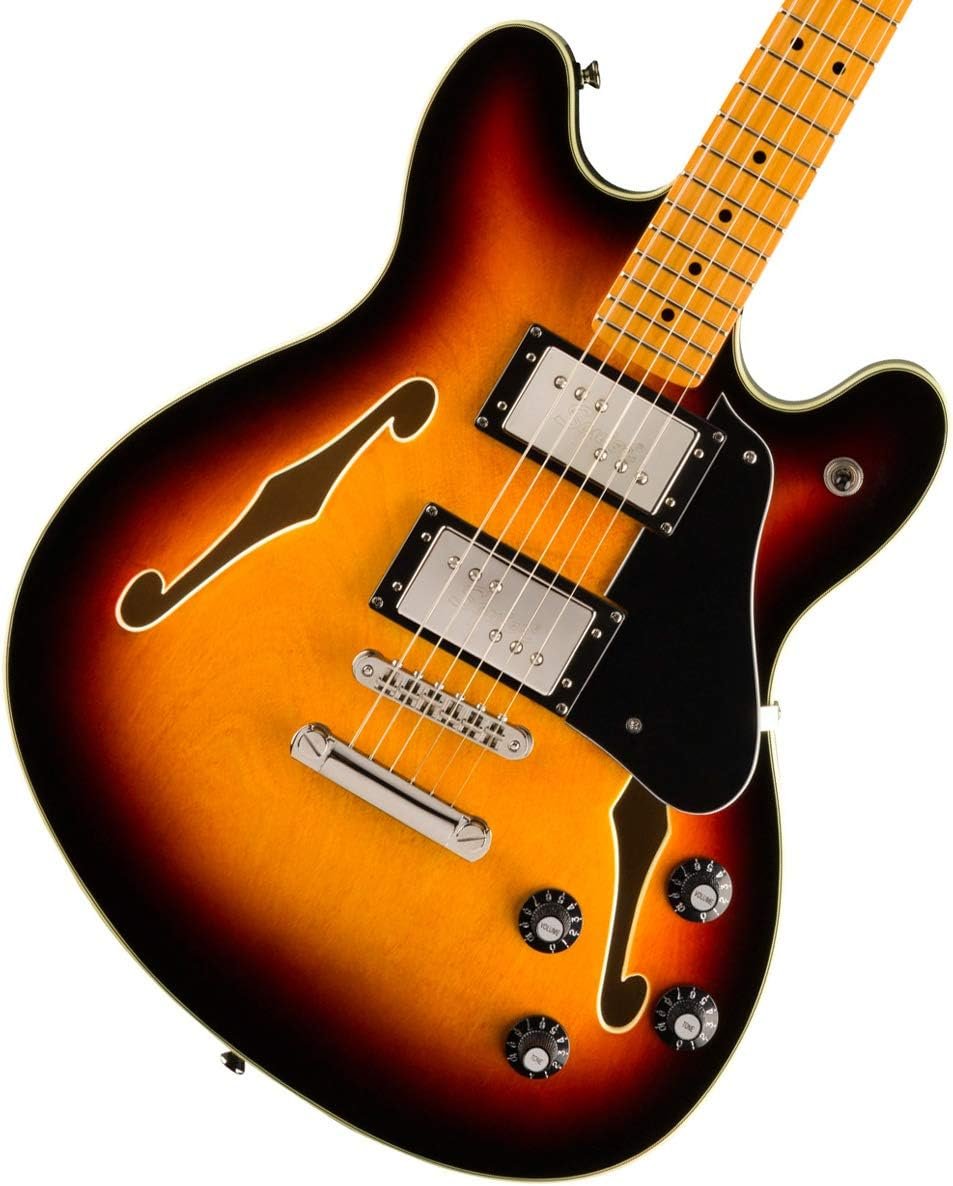
The Squier Classic Vibe Starcaster is one of those guitars that makes sense for players who like familiar Fender ideas but do not necessarily want another Stratocaster or Telecaster shape. Its large offset semi-hollow body, twin f-holes and oversized headstock give it a very different presence, while the Natural finish lets the laminated maple construction become part of the look rather than hiding it beneath an opaque colour.
Fender currently specifies this version with a laminated maple semi-hollow body, maple neck and maple fingerboard, together with two Fender-Designed Wide Range humbuckers. It is an unusual mixture: visually very much a child of the 1970s, but with a layout that remains straightforward enough for everyday playing.
Why the Starcaster stands apart
The body is the obvious starting point. Rather than using a conventional symmetrical semi-hollow shape, the Starcaster has an offset outline with two f-holes and a centre block inside the body. Fender says that centre block is intended to help minimise feedback, which is useful when the guitar is being played at higher amplified levels.
The Natural version also has cream body binding and a gloss polyurethane finish. Combined with the nickel-plated hardware and black three-ply pickguard, it has quite a warm, slightly retro appearance without looking overly ornate.
That larger semi-hollow construction should feel more substantial against the body than a compact solid-body electric. It is not trying to disappear into the player; visually and physically, the body shape is part of the experience.
What it feels like to play
The neck follows a fairly approachable Fender-style recipe. It is maple with a C-shaped profile, a 9.5-inch fingerboard radius, 22 narrow-tall frets and a 25.5-inch scale length. The nut width is 1.650 inches, or 42 mm.
Those dimensions should make the Starcaster feel familiar to players who have spent time with many Fender-style electrics. The 25.5-inch scale gives the strings a slightly firmer feel than a shorter-scale guitar using the same string gauge, while the 9.5-inch radius sits comfortably between very vintage curvature and flatter modern fingerboards.
The neck has a tinted gloss urethane finish rather than a dry satin surface. Some players like the smooth, polished feel of a gloss neck, while others prefer something less shiny under the hand. That comes down largely to personal preference rather than being inherently better or worse.
Dual Wide Range-style humbuckers
The Classic Vibe Starcaster uses two Fender-Designed Wide Range humbucking pickups, arranged in the familiar neck-and-bridge configuration. Switching is handled by a three-position toggle, while each pickup has its own volume and tone control.
That separate control layout is particularly useful on a two-pickup guitar because the player can set the neck and bridge pickups differently and then move between them with the toggle switch.
The humbucker configuration also distinguishes the Starcaster from many traditional Fender electrics. Players who want the visual language and longer scale of a Fender-style instrument but prefer a fuller dual-humbucker setup may find this arrangement particularly appealing.
Bridge, hardware and tuning
At the bridge, Squier uses a six-saddle adjustable bridge with a stop tailpiece. This is important because the Starcaster does not use a tremolo system. The strings anchor through the fixed stop tailpiece, giving the guitar a straightforward, mechanically simple arrangement.
The guitar also uses vintage-style tuning machines and nickel-plated hardware. Fender specifically highlights the adjustable bridge and stop tailpiece as part of the design intended to provide solid tuning stability.
For a guitar with such an unconventional body shape, the hardware is actually quite traditional. There are no complicated switching systems or unusual bridge mechanisms to learn.
The drawbacks
The Starcaster’s greatest attraction can also be its first drawback: the body is large. Anyone accustomed to a Stratocaster, Telecaster or another relatively compact solid-body may find the semi-hollow Starcaster noticeably broader across the torso. For seated playing in particular, some guitarists may need a little time to find the most comfortable position.
The offset shape also makes it less universally familiar than a conventional electric guitar. Its 1970s styling, oversized headstock and sweeping semi-hollow body are deliberately distinctive. If you prefer restrained, traditional guitar shapes, the Starcaster is unlikely to quietly blend into the background.
The gloss neck finish deserves consideration as well. Fender specifies a tinted gloss urethane finish, which contributes nicely to the vintage appearance, but players who strongly favour a satin or unfinished-feeling neck may find the glossy surface less appealing, particularly when their hands become warm during longer sessions.
There is also no tremolo system. The six-saddle bridge and stop tailpiece are deliberately simple and stable, but players who regularly use a vibrato arm will not get that facility here. Adding a tremolo effect would therefore have to come from technique or external equipment rather than the guitar itself.
The separate volume and tone controls for each pickup offer flexibility, but four knobs plus a three-position switch can also feel busier than the simpler control layouts found on many modern electrics. Players who like one volume control and very little else may regard the Starcaster’s arrangement as unnecessary complexity.
Another practical consideration is the semi-hollow construction. Fender includes a centre block specifically to help reduce feedback, but semi-hollow guitars can still behave differently at high volume from a completely solid instrument. Anyone playing with large amounts of gain should expect to learn how the guitar responds in relation to the amplifier and speakers rather than assuming it will behave exactly like a solid-body.
Finally, a gig bag is not included according to Fender’s current specification. Because of the Starcaster’s distinctive body shape, it is worth making sure any case or bag is genuinely suitable rather than assuming a standard electric-guitar bag will fit comfortably.
Who it suits best
The Classic Vibe Starcaster makes most sense for someone who wants an electric guitar with genuine visual character but still wants familiar controls and conventional playing dimensions.
It should particularly appeal to players drawn to semi-hollow instruments who do not want the traditional rounded outline associated with many guitars of that type. The dual humbuckers, individual pickup controls and fixed bridge also make it a versatile platform for players who prefer a straightforward two-pickup electric without complicated electronics.
It may also suit a guitarist who already owns a conventional solid-body and wants their next instrument to feel noticeably different rather than simply adding another variation of the same basic design.
Is it worth the guitar space?
The Squier Classic Vibe Starcaster has a clear identity. Its laminated-maple semi-hollow body, offset shape, dual Wide Range-style humbuckers and maple neck give it a combination you do not see on every guitar rack.
It will not suit everyone. The body is substantial, the styling is unapologetically retro, the gloss neck will divide opinion and there is no tremolo. But those are meaningful characteristics rather than accidental shortcomings.
For a player who likes the Starcaster shape and wants a semi-hollow electric that feels distinctly different from the usual Fender designs, that individuality is precisely the reason to give it space.
For more guitars with their own character, explore our Electric Guitars guides on SwapStrings.
As an Amazon Associate I earn from qualifying purchases.