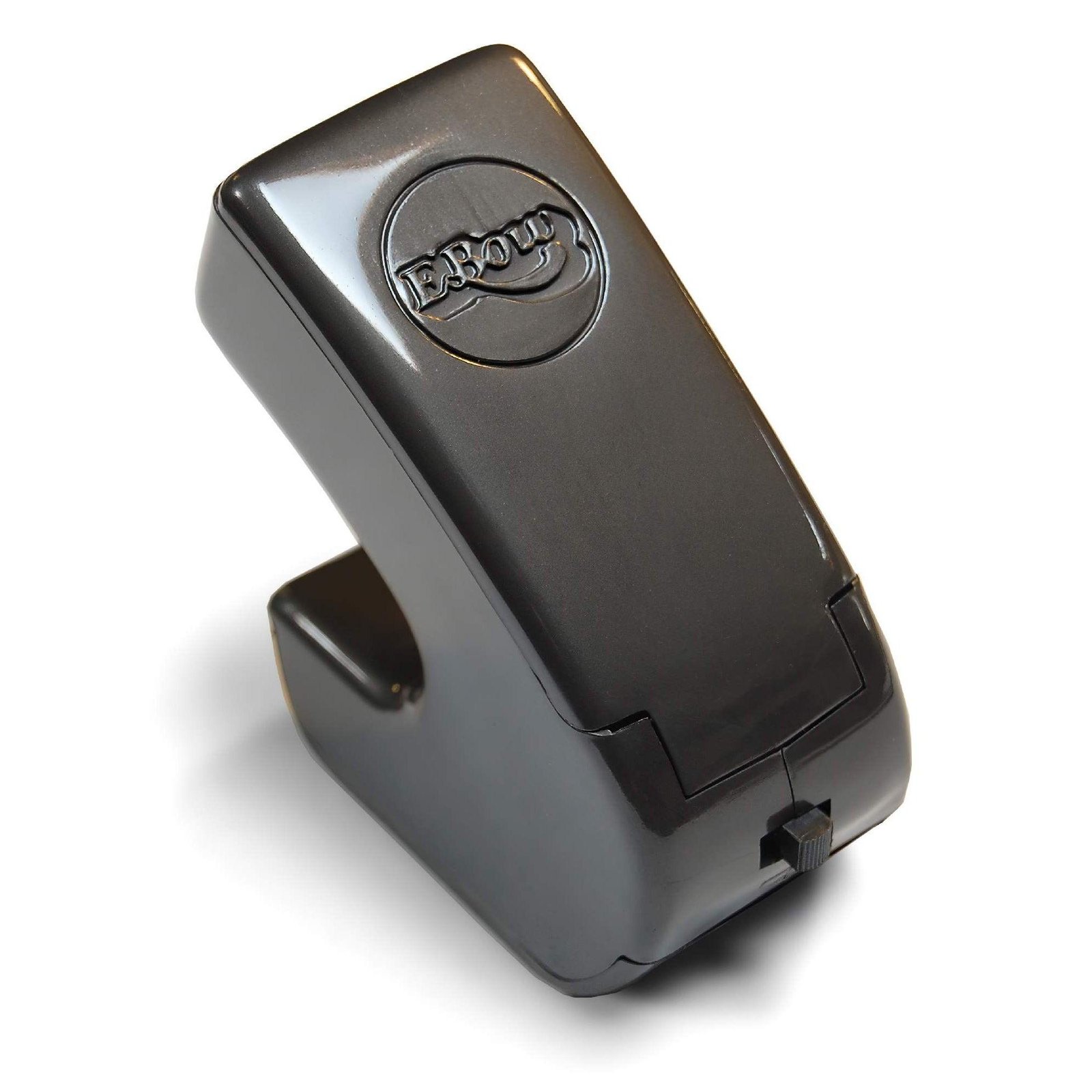
EBow Plus Electronic Guitar Bow
As an Amazon Associate I earn from qualifying purchases.
Imagine playing a guitar note that continues singing long after you would normally expect it to fade. No repeated picking, no enormous amplifier volume and no conventional effects pedal required.
The EBow Plus Electronic Guitar Bow makes this possible by using an electromagnetic field to keep a guitar string vibrating.
It’s an unusual little device that opens up sustained melodies, violin-like swells and atmospheric guitar textures.
But there’s an important distinction: the EBow doesn’t magically turn an ordinary guitar into a bowed instrument. Its sound depends heavily on positioning, technique and the guitar itself.
Understanding those details is essential before deciding whether this creative accessory belongs in your setup.
A Different Way to Play Electric Guitar
The EBow is a handheld electronic string sustainer.
Instead of striking a string repeatedly with a pick, you hold the device above a selected string and allow its magnetic drive field to maintain vibration.
The guitar’s pickups then reproduce that vibration through your amplifier or other connected equipment.
The result can be a long, smoothly sustained note without the usual sharp picking attack.
This makes the EBow particularly interesting for musicians creating ambient music, expressive solos and unusual instrumental textures.
Unlike a conventional effects pedal, it changes how the string vibrates before the sound reaches the guitar’s electronics.
Two Modes for Expressive Sounds
The EBow Plus offers two operating modes.
Standard mode emphasises the fundamental note, making it useful for sustained melodic lines and smoother, bowed-string effects.
Harmonic mode encourages stronger upper harmonics, adding a brighter and sometimes more dramatic character.
Moving the EBow towards or away from a pickup can also change volume and tone.
These movements allow players to experiment with sounds that would be difficult to achieve through ordinary picking alone.
For guitarists interested in the relationship between string vibration and amplified tone, our article on Fender Tex-Mex Pickups explores another aspect of how electric guitars produce their distinctive sounds.
Creative Possibilities Beyond Ordinary Picking
The EBow can be used for slowly developing melodies, atmospheric backgrounds and expressive musical passages.
Combined with suitable reverb or delay effects, sustained notes can become part of a much larger soundscape.
However, the EBow doesn’t contain those effects itself.
A guitarist using an organised pedal setup such as the D’Addario XPND 1 Expandable Pedalboard can combine the EBow’s string-sustaining technique with separate effects when desired.
It’s a creative accessory rather than a complete effects-processing system.
And that distinction leads to several important considerations.
What You Should Know Before Buying
The EBow Plus is genuinely unusual, but it isn’t necessarily easy to master.
Its biggest limitations involve playing technique, compatibility and understanding what the device can realistically achieve.
It Doesn’t Sustain Entire Chords
This is probably the most important point for prospective buyers.
The EBow concentrates its magnetic drive field on one guitar string at a time.
It doesn’t sustain all six strings of a chord simultaneously.
You can move between strings to create arpeggios and flowing musical passages, but that requires a different technique from strumming.
Someone expecting to play a full chord and keep every note ringing indefinitely will be disappointed.
The EBow is primarily an expressive single-note instrument.
There’s a Real Learning Curve
The manufacturer recommends beginning on the middle guitar strings before attempting more complicated techniques.
Two guide grooves rest on neighbouring strings, positioning the central drive channel over the string you want to sustain.
Correct alignment is essential.
If the device is positioned incorrectly, the string may respond slowly, buzz or fail to vibrate as expected.
Moving smoothly between strings also takes practice.
Players accustomed to immediately usable plug-in effects may find this frustrating initially.
The EBow rewards patience and experimentation rather than providing instant mastery.
The Outside Strings Are More Difficult
The low and high E strings are less straightforward to activate because the EBow has only one neighbouring string supporting its guide grooves.
The manufacturer identifies the high E string as particularly challenging to activate quickly.
Additional adjustments to angle, pressure or fretting technique may be needed.
This matters because a beginner might assume the device is defective when it simply requires different handling.
Learning on the middle strings first can help avoid unnecessary frustration.
Pickup Position Makes a Big Difference
The EBow’s response changes depending on its distance from the guitar pickup.
The manufacturer describes a particularly responsive area near the selected pickup as the HotSpot.
Moving towards this area can dramatically increase the output level and brightness.
Moving away generally produces a softer response.
A guitarist who doesn’t understand this relationship may experience unexpectedly loud notes or inconsistent sustain.
The official instructions recommend beginning with reduced guitar volume and treble settings.
The EBow isn’t simply something you place anywhere above the strings and expect identical results.
Guitar Setup Can Affect Performance
The distance between the strings and pickups matters.
If a pickup sits unusually close to the strings, the EBow may not have sufficient clearance for comfortable movement.
The manufacturer’s guidance explains that pickup height adjustments may sometimes be necessary.
However, altering pickup height can also change the guitar’s normal amplified response.
Owners should understand their instrument’s setup before making adjustments.
The EBow is not guaranteed to behave identically on every electric guitar.
It Isn’t a Conventional Effects Pedal
Despite creating unusual sounds, the EBow doesn’t connect between your guitar and amplifier with ordinary audio cables.
You hold it in your picking hand and physically control its position.
That means the hand normally used for picking is occupied while operating the device.
Switching between conventional picking and EBow playing requires practice and planning.
It also cannot be operated with a footswitch in the way a traditional sustain or effects pedal might be.
Someone who wants an always-available sustain effect while continuing to pick normally should consider whether a different solution would be more appropriate.
You Need a Suitable Electric Guitar Setup
The EBow is primarily designed around the response of magnetic guitar strings and electric guitar pickups.
Its traditional playing techniques assume an appropriate magnetic pickup system.
It isn’t intended as a universal accessory for every acoustic, nylon-string or unconventional instrument.
Although experienced players have experimented with alternative instruments, buyers shouldn’t assume compatibility without checking the manufacturer’s guidance.
A Battery Is Required
The EBow Plus operates using a 9V battery.
It isn’t powered by your amplifier, guitar cable or pedalboard power supply.
That means you need to monitor the battery and keep a suitable replacement available.
Unlike a passive guitar pick, the EBow cannot operate without electrical power.
The battery requirement is relatively straightforward, but it is another responsibility for anyone using the device regularly.
It Can Produce Unexpectedly Loud Sounds
The EBow’s magnetic drive can produce a strong signal, particularly when positioned close to a pickup.
Its output may be considerably louder than ordinary picking.
The manufacturer specifically recommends lowering volume and treble settings when learning.
Players using headphones should be especially careful about sudden level changes.
The ability to sustain notes at low listening volumes is useful, but it doesn’t eliminate the need for sensible volume control.
It Doesn’t Automatically Sound Like a Violin
The EBow can produce bowed-string-like sounds, but achieving convincing musical expression requires technique.
Subtle movement, controlled note changes and appropriate guitar settings all contribute.
Simply holding the device over a string won’t necessarily produce the smooth, expressive sound heard in demonstrations.
Some players may initially hear an uneven response, excessive brightness or abrupt changes in volume.
This is an instrument-like technique that develops with practice.
Fast Playing Requires Different Skills
The EBow is particularly appealing for long, sustained notes, but fast melodic passages are possible with practice.
However, rapid changes between strings can be demanding.
The manufacturer describes specialised techniques involving hammer-ons, pull-offs and controlled movement between strings.
Someone expecting ordinary picking speed immediately may find the device limiting.
The EBow encourages a different musical approach rather than simply making every existing technique easier.
It Won’t Replace Your Other Guitar Equipment
The EBow doesn’t include a tuner, amplifier, recording interface, reverb or delay.
For example, a dedicated device such as the Walrus Audio Canvas Tuner performs an entirely different job in a guitarist’s setup.
The EBow concentrates on sustaining the physical vibration of a guitar string.
Any additional sound processing requires suitable separate equipment.
That makes it a specialist creative accessory rather than a complete replacement for conventional effects.
Who Should Probably Avoid This Product?
The EBow Plus isn’t ideal for guitarists who want instant results without learning a different playing technique.
It may also disappoint rhythm guitarists looking to sustain complete chords or players who need both hands free for conventional techniques.
Anyone expecting a pedal that automatically adds sustain to ordinary picking should understand that this device works differently.
And guitarists who mainly play acoustic or nylon-string instruments should not assume it will suit their equipment.
Who Will Benefit Most?
The EBow Plus is particularly appealing to experimental guitarists, ambient musicians and players who enjoy developing unusual melodic textures.
It may also interest recording musicians looking for sustained background parts and expressive guitar sounds without relying entirely on software effects.
Its strongest appeal comes from treating it as a new playing technique rather than simply another piece of electronic equipment.
For more equipment that complements different playing styles, explore our Guitar Gear guides.
A Different Kind of Musical Inspiration
The EBow Plus offers something genuinely distinctive: a new way to interact with guitar strings and shape sustained notes.
Its two operating modes, expressive possibilities and unusual electromagnetic design make it interesting for creative musicians.
But the learning curve is real. It requires careful positioning, practice and an understanding of how guitar pickups respond.
For players who enjoy experimenting and are willing to develop a new technique, the EBow Plus offers an intriguing way to explore sounds beyond ordinary picking.
As an Amazon Associate I earn from qualifying purchases.