Xvive U8 Acoustic Guitar Wireless System
As an Amazon Associate I earn from qualifying purchases.
Amplifying an acoustic guitar isn’t always as straightforward as plugging in an electric. The natural sound comes from the instrument’s vibrating strings and resonating wooden body, and capturing that character on stage can require careful microphone placement.
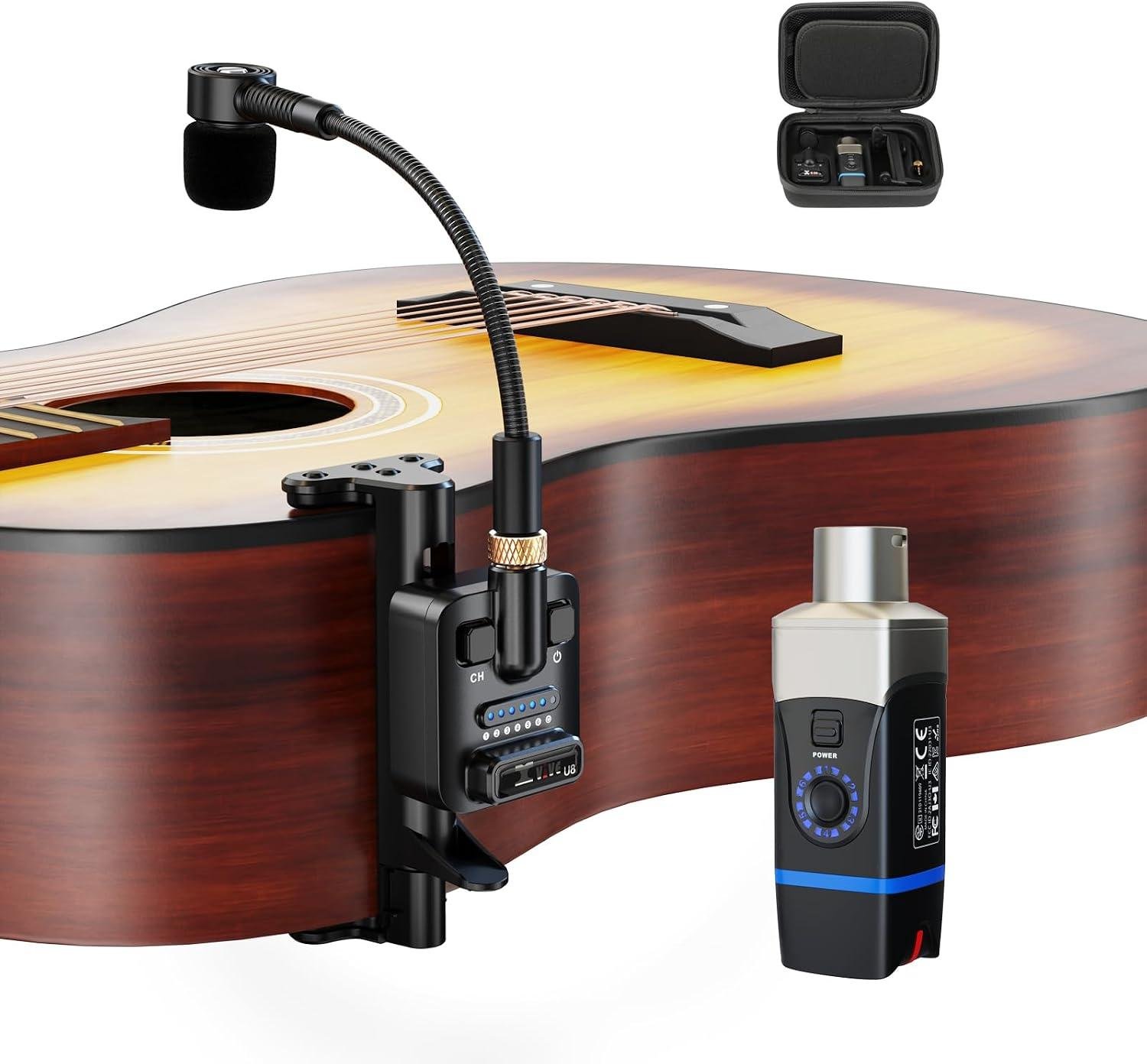
The Xvive U8 Acoustic Guitar Wireless System takes an interesting approach. Instead of relying on an internal pickup or a microphone stand, it uses a small clip-on gooseneck microphone attached directly to the guitar.
A rechargeable transmitter sends the sound wirelessly to an XLR receiver connected to a suitable sound system.
It offers musicians greater freedom to move while retaining the character of microphone-based acoustic sound, although there are important practical limitations.
What You Should Know Before Buying
Check your guitar’s body thickness
The first consideration is physical compatibility.
Xvive specifies that the mounting clip fits acoustic and classical guitar bodies measuring between 2.9 and 4.13 inches thick.
That covers many conventional instruments, but not every guitar.
Thin-bodied electro-acoustics, unusually shaped travel guitars and certain compact instruments may fall outside the supported range.
Measure the intended mounting point rather than assuming the clip will fit because the instrument is described as acoustic.
The clip also makes physical contact with the guitar’s body. Careful fitting and removal are important, particularly with delicate finishes.
This is a microphone system, not an ordinary guitar transmitter
The U8 captures sound using a supercardioid condenser microphone mounted on an adjustable gooseneck.
That is fundamentally different from transmitting the electrical signal produced by a guitar’s built-in pickup.
The microphone responds to the sound of the vibrating instrument, giving players an opportunity to capture more of its natural acoustic character.
However, it also means microphone positioning becomes part of the setup.
Players who prefer the simplicity of plugging directly into onboard electronics may find the Yamaha FGX800C Acoustic-Electric Guitar an interesting example of a more conventional amplified approach.
The U8’s main attraction is its external microphone, but that also introduces additional considerations.
Microphone positioning affects the sound
The adjustable gooseneck allows the microphone to be aimed towards different parts of the guitar.
Moving it towards the soundhole can increase bass response, but positioning it too close may produce an excessively boomy sound.
Moving towards the strings or bridge can emphasise attack and definition.
There is no single position guaranteed to suit every guitar.
Fingerstyle playing, gentle strumming and forceful flatpicking can all benefit from different placements.
A proper soundcheck is therefore worthwhile before performing.
The microphone’s supercardioid design helps reject sound arriving from certain directions, but it cannot completely isolate the guitar from the surrounding environment.
Feedback remains a genuine possibility
This is particularly important for musicians performing with stage monitors or loudspeaker systems.
Because the U8 uses a microphone, amplified sound from nearby speakers can potentially re-enter the microphone and create feedback.
The supercardioid pickup pattern helps control unwanted sound, but it does not eliminate that risk.
Speaker placement, equalisation, monitoring levels and microphone orientation all influence the result.
A quiet solo performance may present relatively few problems. A loud band with several floor monitors requires more attention.
Players accustomed to feedback-resistant pickup systems should not assume the U8 will behave identically.
The receiver uses XLR connectivity
The U8 receiver has a balanced male XLR output.
This makes it suitable for connecting to compatible microphone inputs on mixers, portable PA systems and recording equipment.
However, it is not designed to plug directly into an ordinary quarter-inch guitar amplifier input.
Anyone hoping to connect the receiver to a conventional practice amp should check the available connections first.
The Fender Telepath Wireless System illustrates a different design intended to replace the regular instrument cable between a guitar and compatible amplifier.
The Xvive concentrates on wireless microphone transmission rather than reproducing a standard guitar cable connection.
Wireless performance depends on the environment
The U8 operates in the 2.4 GHz wireless frequency band.
Xvive provides six selectable channels, allowing users to change channels when interference becomes a problem.
The manufacturer specifies a range of up to 90 feet under suitable conditions.
However, the actual operating distance depends on obstacles, competing wireless equipment and radio-frequency interference.
Busy venues with numerous wireless systems and Wi-Fi networks may present more challenging conditions than a quiet rehearsal room.
The stated transmission range should be viewed as a maximum under favourable circumstances, not a guarantee of uninterrupted operation everywhere.
Battery life needs planning
Both the transmitter and receiver contain rechargeable lithium-ion batteries.
Xvive quotes up to five hours of operating time from a full charge.
That should comfortably cover many rehearsals and shorter performances, but musicians playing extended events need to plan accordingly.
Both units require charging, and either running out of power will interrupt the system.
The supplied dual USB-C cable allows simultaneous charging using a suitable 5V/2A power supply.
A full charge takes approximately two and a half hours.
Unlike a conventional microphone cable, the U8 cannot be relied upon indefinitely without checking its battery status.
It adds equipment to the guitar body
The transmitter weighs approximately 35 grams, with the microphone adding another 35 grams.
Individually, these components are light, but the mounting clip and adjustable gooseneck still create a physical attachment to the instrument.
Some players will barely notice it. Others may find the additional equipment distracting, particularly when changing playing positions or moving energetically.
The gooseneck also needs careful handling when packing away the instrument.
Xvive includes a dedicated carrying case, which helps protect the separate components between performances.
Understand what comes in the package
The standard U8 system includes the microphone, transmitter, receiver, guitar mounting clip, charging cable, foam windscreen, fur windshield and carrying case.
The windscreens are useful for reducing unwanted wind noise, particularly in outdoor settings.
However, the system does not include a guitar, amplifier, mixer or complete PA setup.
Those items must already be available or obtained separately.
The U8 also provides wireless sound transmission rather than onboard recording, effects processing or automatic mixing.
Who Should Probably Avoid This Product?
Guitarists who only play through a standard quarter-inch amplifier input may find the XLR connection inconvenient.
Players with unusually thin-bodied guitars should check compatibility before considering it.
Musicians working on very loud stages may prefer an internal pickup system that is less sensitive to surrounding sound.
Anyone wanting a completely maintenance-free setup should also consider the extra responsibilities of charging two devices and managing wireless channels.
And performers who already have an acoustic-electric guitar with a sound they particularly enjoy may not need another amplification method.
The U8 is a specialist solution rather than a universal replacement for every existing guitar setup.
Who Will Benefit Most?
The Xvive U8 is particularly interesting for acoustic musicians who enjoy the natural character of a microphone but dislike being restricted to a fixed microphone stand.
Singer-songwriters performing in smaller venues may appreciate the freedom to move while maintaining a consistent microphone position relative to the guitar.
Classical guitarists could also find the system appealing, especially when they want amplification without modifying their instruments.
The microphone supports sound pressure levels up to 142 dB, while the wireless system provides 24-bit/48 kHz audio and less than five milliseconds of specified latency.
Those specifications demonstrate that the U8 has been developed with live musical performance in mind.
Its compact carrying case also helps travelling musicians keep the microphone, transmitter and receiver organised.
For players comparing more conventional professional wireless setups, our Shure GLXD16+ Digital Wireless Guitar Pedal System guide explores an alternative with a pedalboard receiver and different connectivity requirements.
The wider selection of accessories in our Guitar Gear guides also provides useful comparisons for musicians building a practical performance setup.
The right equipment ultimately depends on the instrument, the venue and the sound a musician wants to achieve.
The Xvive U8 combines an adjustable acoustic microphone with rechargeable wireless transmission in a compact, portable package.
Its appeal lies in allowing acoustic players to move more naturally without abandoning microphone-based sound.
It requires thoughtful positioning, compatible equipment and attention to wireless conditions, but for musicians who value flexibility and acoustic character, it offers an interesting alternative to conventional pickups and stationary microphones.
As an Amazon Associate I earn from qualifying purchases.
Opens Amazon (paid link)