A Portable Amp for Real-World Playing
Amazon Associate Disclaimer: As an Amazon Associate, we may earn from qualifying purchases. This comes at no extra cost to you and helps support our website.
A Portable Amp for Real-World Playing
There’s a certain kind of freedom in being able to plug in anywhere. Not just in a rehearsal space with a half-stack behind you, but on a tabletop, a desk, or the floor of a living room where you’re trying to work out a part before the rest of the band shows up. Most players have been through the cycle of buying gear that sounds great in theory but doesn’t translate to the spaces where we actually play. A portable amp with effects, drum patterns, and recording capabilities starts to look less like a convenience and more like a necessity for staying connected to the instrument between gigs.
The Practical Side of Having a Compact Amp
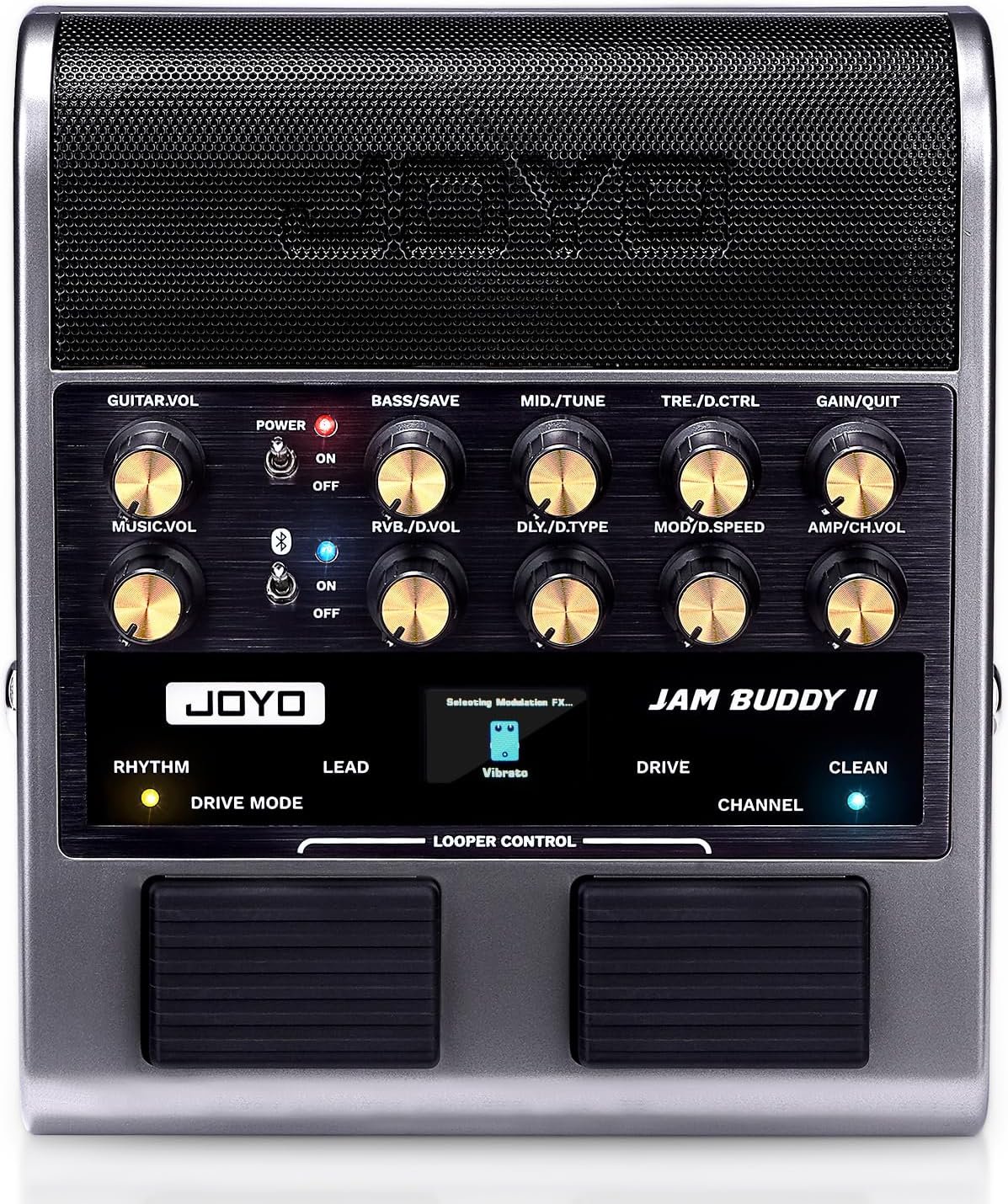
When you’re used to hearing your guitar through a larger rig, there can be a hesitation before picking up a small practice unit. You expect the sound to be thin, or the controls to feel like afterthoughts. The JOYO JAM Buddy II, however, approaches the concept differently. It sits in a palm-sized housing weighing just under a kilogram, so it’s meant to be moved around, set up wherever there’s a surface, and treated like a tool you use daily. The build uses ABS and metal construction, which makes it feel sturdy without adding unnecessary weight. It doesn’t feel like something you’d worry about tossing into a gear bag.
Having a 10-watt output with dual 2-inch full-range speakers and a bass radiator changes how you think about sound in smaller rooms. You’re not fighting the volume. You’re listening to what’s coming out of the speakers and adjusting your playing to match. It’s a different kind of ear training, hearing the nuances of your tone in a contained space. The bass radiator adds enough low-end presence that you aren’t missing the thump of a larger cabinet. It helps bridge the gap between a practice amp and something you’d actually want to spend time with.
Navigating Amp Models and Tone Shaping
One of the more practical details is the layout of the control section. A multi-function knob that responds to both pressing and rotating makes the process of adjusting parameters feel more like working with a pedalboard than a typical practice amp. You’re not scrolling through endless menus. You’re engaging with the sound directly.
The amp models cover a useful range without overwhelming you with options. Starting with the 65 Black Nor and its overdrive counterpart, you get a clean foundation that responds to how you pick. There’s enough headroom to run a pedal into it if you want, but the models themselves stand on their own. The J800 models lean into a brighter, more aggressive midrange, which works well for the kind of rhythmic playing that happens in a band context. If you’re working on a lead part, the DualRect Red and 5153-based models offer the drive and saturation needed to push through a mix. The 5153 EL34 and 6L6 variations give you two different flavors of high-gain response, and having that choice available on a portable unit means you can work out a part at home that will translate to a larger amp later on.
The three-channel setup with Clean, Rhythm, and Lead gives you a way to organize your tones logically. Clean handles the foundation. Rhythm gives you the edge for chord work or palm-muted parts. Lead lets you shift into a solo voicing without needing to adjust everything manually. Storing settings across those channels is straightforward, and the one-tap memory function keeps your custom sounds available. That’s a feature that saves time during practice sessions, especially when you’re jumping between parts in a setlist.
Drum Patterns and Looper as Practice Tools
Practicing with a metronome is essential, but there’s something about playing along with a drum pattern that changes the feel of a session. The built-in 36-pattern drum machine covers a solid variety of rhythms, from rock and blues to more intricate time signatures. Having the ability to adjust the BPM and volume means you can slow things down for detailed work on a difficult run, or speed them up to test your endurance. It shifts the focus from simply repeating a part to placing it in a rhythmic context.
The 30-second looper adds another dimension. It’s short enough to stay focused, but long enough to build a chord progression, layer a lead line over it, and experiment with phrasing. Looping on a portable amp like this makes the practice process feel less like homework and more like sketching out ideas. You can lay down a progression, switch channels to a lead tone, and work through different melodic approaches without stopping to start a recording on another device.
For songwriting or learning how parts fit together, this type of workflow is valuable. It encourages you to think in sections rather than isolated licks. When you can hear how a rhythm part interacts with a lead over a drum beat, you start to understand the arrangement more clearly. The looper becomes a tool for musical problem-solving rather than just a gimmick.
Recording and Listening Back
The OTG direct recording feature via USB-C opens up possibilities beyond just practicing. Being able to connect directly to a phone or computer means you can capture ideas quickly, without setting up microphones, interfaces, or extra hardware. This is helpful when inspiration hits and you want to get a part down before you forget the nuance of it.
Recording directly through the amp also means you’re capturing the amp models and effects the way you hear them. There’s no loss of tone from mic placement or room acoustics. The USB-C connection and Bluetooth stability allow you to run backing tracks through the amp while playing along. The dedicated volume knobs for guitar and Bluetooth audio give you control over the mix. That kind of balance makes it easier to work on parts over a track without boosting the guitar volume too high and losing the context of the rhythm.
The line output also lets you connect to a mixer or PA system. If you’re doing an acoustic gig that requires a small setup, or if you want to use the amp models as part of a larger signal chain, having that option available gives you flexibility. The same tones you dial in at home can be sent to a sound system, which reduces the need to retweak everything when you show up at a venue.
Battery Life and Ready-to-Go Use
Portability means nothing if the battery drains quickly. The JAM Buddy II gives you up to five hours of playing on a full charge. That’s enough for multiple practice sessions or a long afternoon of working through songs. Recharging takes about three hours, which is reasonable for a unit this size. The auto power-off feature kicks in after 20 minutes of inactivity, which helps preserve the battery when you step away.
The phone mount that comes with the amp is a practical addition. It holds a phone or tablet securely, so you can keep tabs, chords, or backing tracks visible while you play. It eliminates the need to prop a device against a chair or balance it on a nearby surface. The design keeps everything in front of you, which is useful for staying focused during a session.
Playing Styles and Adaptability
Whether you’re working on technique, writing parts, or simply playing through songs you enjoy, having a unit that adapts to your approach makes the experience more engaging. The amp doesn’t push a single style. It gives you tools to shape the sound to fit what you’re doing at the moment.
For the player who spends time working on blues phrasing, the clean models and dynamic response provide a good foundation. For someone exploring rock and metal, the high-gain options and built-in delay and reverb add depth to the sound. The modulation effects—flanger, phaser, tremolo, chorus, vibrato—give you ways to color the tone without adding external pedals. The delay options include both analog and digital, and the reverb covers hall and church styles. That range lets you dial in ambient textures or tight, focused repeats depending on the song.
Having nine effects available in a compact unit means you’re not constantly turning to a pedalboard or rack gear to change your sound. The effects are integrated into the workflow, so adjusting them feels seamless. It encourages experimentation because the barrier to changing a setting is low. You press the knob, rotate to the effect, adjust the parameter, and move on. That kind of direct control makes the practice session feel productive rather than frustrating.
Everyday Playing and Musical Growth
The goal with any piece of gear is to reduce friction and increase time spent playing. If you have to set up multiple devices, cables, and power supplies just to get a usable tone, the motivation to practice can drop off. A portable amp with effects, drum patterns, and recording features removes that barrier. You sit down, plug in, and you’re ready to work.
The ease of use supports long-term enjoyment because you can move between different activities—technique practice, songwriting, recording, jamming along with backing tracks—without stopping to reconfigure your setup. The consistency of the tone models means you’re not chasing a different sound every time you turn it on. The settings stay where you left them, which helps you pick up where you left off.
For a player who regularly moves between practice spaces, rehearsals, and small venues, having an amp that fits in a bag and handles a variety of roles is practical. It’s not a replacement for a larger rig, but it’s a complement to it. You can use it as a reference for tone, a practice tool for tightening up parts, or a recording device for capturing moments of inspiration. It doesn’t try to do everything, but it does what it does in a way that feels natural in real playing situations.
Closing Thoughts on a Practical Tool
Staying connected to the guitar means having gear that works around your schedule and your space. A compact unit like this doesn’t dictate how you play. It adapts to how you play. The amp models, effects, drum patterns, looper, and recording capabilities all serve the same purpose: making it easier to pick up the guitar and get something productive done.
Whether you’re refining your tone for an upcoming rehearsal or simply playing through a song you’ve been working on, having tools that fit into your routine makes a difference. The JAM Buddy II is one of those tools. It’s straightforward, adaptable, and built for the kind of playing that happens between gigs, in living rooms, on road trips, and in the quiet hours of the day when you’re just trying to get a part right.
The material in this article is provided for general informational purposes and reflects the author’s opinions based on product specifications. It does not constitute professional advice, and you should consult the product manufacturer or a qualified professional for any specific questions or concerns regarding product functionality, compatibility, or safety.
Check It Out!