Shure GLXD16+ Digital Wireless Guitar Pedal System
As an Amazon Associate I earn from qualifying purchases.
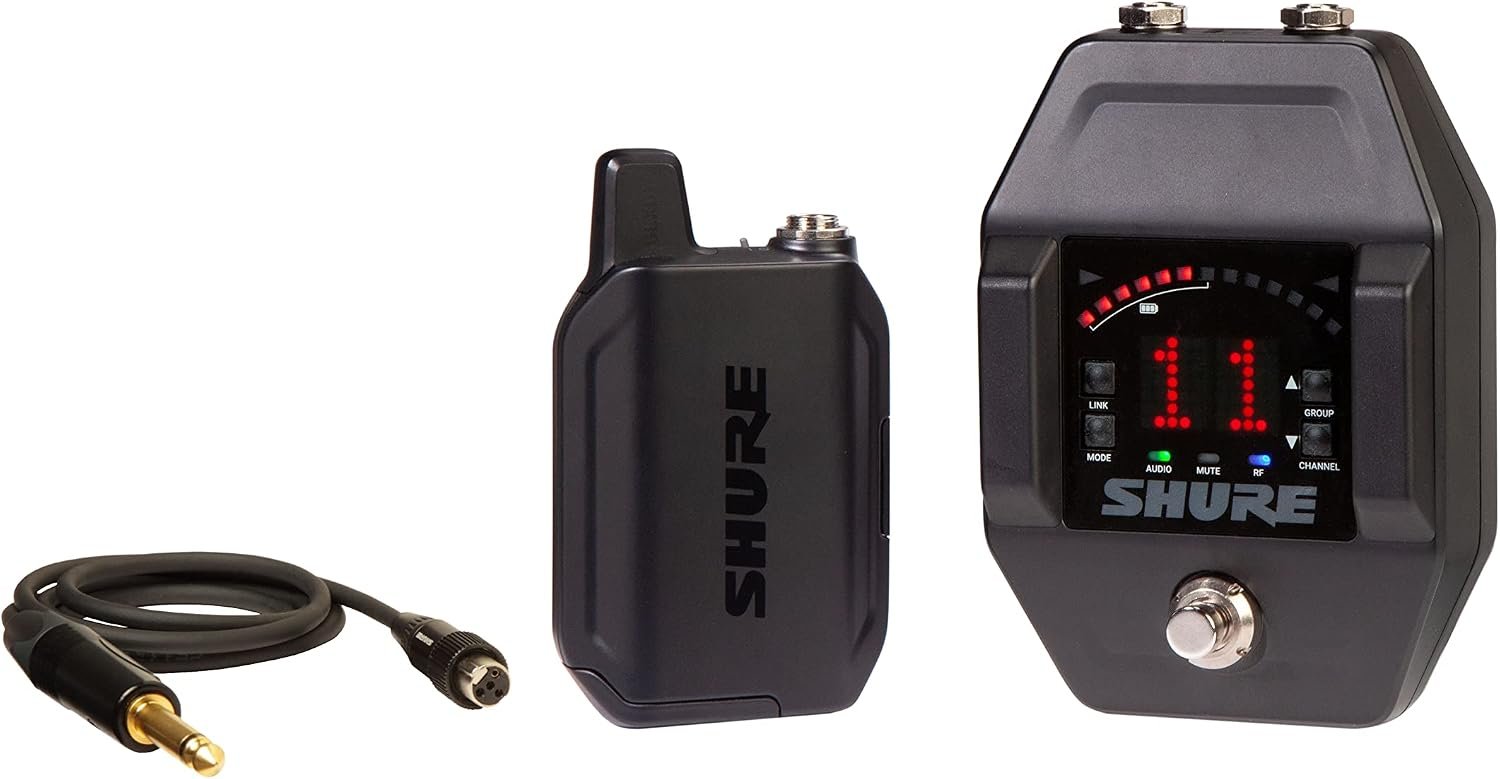
The Shure GLXD16+ Digital Wireless Guitar Pedal System is designed for guitarists and bass players who want to remove the cable between themselves and the pedalboard without turning the rig into something complicated.
Instead of using a separate tabletop receiver that needs to be placed somewhere around an amplifier, the GLXD16+ puts the receiver into a rugged metal pedal format. It can live alongside the rest of the pedalboard, while the GLXD1+ bodypack clips onto a strap or clothing and connects to the instrument through the supplied WA305 cable.
That makes the system feel like part of a normal guitar rig rather than a piece of stage equipment added afterwards.
Why wireless can make sense for a guitarist
A traditional guitar cable is wonderfully simple.
Plug one end into the guitar, the other into the pedalboard or amplifier, and play.
The problem appears when you start moving.
A cable can wrap around microphone stands, work its way beneath pedals, catch around the legs of another musician or simply limit how far you can move from the board.
For a guitarist who stands largely in one place, none of that may matter.
But on a stage, rehearsal room or even a busy home setup, removing that first long cable can make moving around considerably easier.
Wireless also lets you walk away from the amplifier while checking how the guitar actually sounds in the room.
That can be surprisingly useful during soundcheck because the tone heard directly beside an amplifier is not necessarily what the audience hears several metres away.
Dual-band wireless operation
The GLXD16+ uses Shure’s GLX-D+ Dual Band system, operating across both the 2.4 GHz and 5.8 GHz bands where permitted.
The system automatically manages the wireless connection and can move away from interference without interrupting the audio.
That automation is important.
A guitarist generally does not want to become a radio-frequency technician immediately before playing.
The ideal wireless system is one that connects reliably and then largely disappears from your attention.
Using two frequency bands gives GLX-D+ more wireless space to work with than the original single-band GLX-D generation. Shure specifically identifies dual-band operation as one of the major improvements in the newer system.
A receiver that belongs on a pedalboard
The GLXD6+ receiver is built into a metal pedal-style chassis.
That makes much more sense for guitar and bass than a conventional wireless rack or tabletop receiver if the rest of the rig already lives on the floor.
It has a standard quarter-inch output for feeding the next pedal in the chain, and Shure says it can run from a regular 9V pedalboard power supply providing at least 400mA.
That means it can potentially share the same isolated power system as the rest of the board, provided the supply has an output capable of delivering enough current.
Shure also supplies its own power adaptor with the system, so a dedicated pedalboard power supply is not compulsory.
For somebody trying to build a tidy stage rig, having the wireless receiver bolted down with the other pedals is much easier than having another box and cable sitting loose beside the amplifier.
The built-in tuner removes another pedal
The receiver also contains a chromatic tuner.
Shure provides both needle and strobe-style display modes, with adjustable reference pitch from 432 to 447 Hz.
For most guitarists, standard A=440 Hz tuning will be all that is needed.
But adjustable reference pitch is useful for musicians working with instruments or ensembles using something different.
Having the tuner built into the wireless receiver can also free one pedalboard position.
If you already use a dedicated tuner that you particularly like, there is nothing forcing you to abandon it.
But when pedalboard space matters, combining the wireless receiver and tuner into one unit is a sensible design decision.
What it feels like to use
The practical setup is straightforward.
The guitar connects to the GLXD1+ bodypack transmitter using the supplied WA305 instrument cable.
The receiver sits on the pedalboard and feeds the rest of the signal chain through a normal quarter-inch connection.
Once the transmitter and receiver are linked, the instrument behaves much as it would through a conventional cable.
The bodypack is the part you actually carry.
Because it clips to a strap or clothing, you need to decide where it sits comfortably without getting in the way.
For a guitarist who changes instruments regularly during a set, that may take a little organisation.
For someone using one main guitar for most of the performance, it quickly becomes part of the normal strap-and-cable routine.
Up to 12 hours from the rechargeable battery
The GLXD1+ uses Shure’s SB904 lithium-ion rechargeable battery, rated for up to 12 hours of operation.
That should comfortably cover most rehearsals and performances without requiring a battery change during the session.
The receiver also displays transmitter battery information, making it easier to see how much operating time remains rather than guessing.
Shure also provides a useful quick-charge feature.
A 15-minute charge can provide approximately 1.5 hours of use, which could rescue a rehearsal or performance if the battery was accidentally left low.
That does not remove the need for sensible charging habits, but it is reassuring.
Rechargeable power also avoids continually buying disposable batteries, which makes more sense for equipment used several times every week.
Switching between wired and wireless instruments
One of the more interesting features is the receiver’s additional quarter-inch true-bypass input.
Shure designed this so a player can have one wireless instrument and one wired instrument available and switch between them using the pedal receiver.
That could be particularly useful on stage.
A guitarist might use the main electric wirelessly but keep an acoustic or second electric connected by cable.
A bassist might have two instruments prepared for different songs.
Instead of unplugging cables or moving the transmitter every time, the pedal receiver provides a quicker way to change between the two arrangements.
It also means the GLXD6+ can remain useful during practice when wireless movement is not necessary.
Guitar and bass both make sense
Nothing about the GLXD16+ limits the idea to six-string guitar.
Shure specifically describes the system for guitar and bass use, and the supplied WA305 cable connects the bodypack to a standard instrument output.
For bass players, wireless freedom can be particularly useful on larger stages where amplifier and pedalboard positions may be separated from the musician.
The pedal-style receiver is equally convenient for bass pedalboards.
The key benefit remains the same: remove the long instrument cable while allowing the rest of the rig to remain familiar.
Useful at rehearsal as well as on stage
Wireless systems are often associated primarily with live performance, but rehearsal may be where some players appreciate them most.
Small rehearsal rooms can become chaotic surprisingly quickly.
There may be several instrument cables, microphone leads, power cables, pedalboards and stands occupying the same floor space.
Removing one long guitar cable does not solve every problem, but it reduces one of the things capable of tangling around everything else.
It is also useful when adjusting amplifiers.
You can play while walking between the normal playing position and the amplifier rather than repeatedly putting the guitar down or dragging a long cable behind you.
That can make dialling in stage volume and EQ more practical.
The drawbacks
Wireless is convenient, but a cable remains the simpler technology.
A good instrument cable has no battery to charge, no transmitter to attach and no wireless environment to manage.
If you play seated beside an amplifier at home and rarely move more than a metre or two, the GLXD16+ may solve a problem you simply do not have.
The benefits become much clearer when stage movement, cable management or rehearsal-room clutter genuinely matters.
Battery management is the next consideration.
The SB904 offers up to 12 hours of runtime, which is generous, but it still needs charging.
A forgotten cable works exactly as it did yesterday.
A forgotten transmitter battery may not.
The battery display and quick-charge feature reduce that risk, but developing the habit of charging the system after use remains sensible.
For musicians who play professionally, carrying a charged spare SB904 would also provide extra reassurance.
The bodypack introduces another component onto the player.
You need somewhere secure to clip it.
Depending on the strap, clothing and playing style, finding the most comfortable position can take a little experimentation.
The short instrument lead from the guitar to the transmitter also needs routing so it does not interfere with the strap or controls.
Once arranged properly it should become routine, but it is still more equipment physically attached to you than a conventional cable.
Wireless conditions can vary too.
Shure designed GLX-D+ to automatically work across 2.4 and 5.8 GHz and move away from interference, but these are frequency ranges also used by other wireless equipment.
A quiet rehearsal room and a crowded venue full of wireless networks are not identical environments.
Automatic frequency management is one of the reasons to choose a developed system such as GLX-D+, but no sensible wireless user should assume that radio conditions are exactly the same everywhere.
For important performances, checking the system during soundcheck remains good practice.
The pedal receiver also needs a relatively substantial 400mA minimum power supply when powered from a pedalboard source.
That is much more current than many simple analogue pedals require.
If your existing multi-output power supply has only low-current outputs available, you may need to use the supplied adaptor or rearrange the board.
It is worth checking before mounting everything permanently.
The receiver occupies pedalboard space as well.
The built-in tuner helps justify that footprint because it may replace an existing tuner pedal, but somebody with an extremely compact board still has to find room for the GLXD6+.
A cable, of course, occupies no pedalboard space at all.
There is also the question of instrument changes.
The wired/wireless switching input is helpful, but if you want several guitars all operating wirelessly during a set, one bodypack may become inconvenient.
You need to move the transmitter and cable between instruments unless you have additional compatible equipment.
For a player who changes guitars only once or twice, that may be trivial.
For somebody changing instrument every song, it becomes more noticeable.
The system also includes technology that eventually ages.
A quality guitar cable can remain useful for decades with little more than the occasional connector repair.
A digital wireless system contains rechargeable batteries, radio hardware and electronic processing.
The SB904 battery is replaceable, which is a positive, but batteries are still consumable components over the long term.
There is another practical reason to keep a normal guitar cable in the gig bag.
Even if wireless is your normal setup, a cable is the simplest emergency backup if something unexpected happens.
Wireless freedom should not mean throwing every cable away.
The built-in tuner may not replace every specialist tuner either.
Its strobe and needle modes are more than adequate for normal guitar and bass tuning, with reference pitch adjustable from 432–447 Hz.
But someone who already owns a tuner with specialised alternate-tuning, temperament or bench-setup functions may still prefer keeping that equipment.
Another issue is that wireless can encourage players to wander farther than they actually need to.
The ability to move freely is useful, but on a small stage there is sometimes nowhere worthwhile to go.
For those situations, the system is primarily improving cable management rather than transforming the performance.
Finally, the GLXD16+ is a fairly sophisticated answer to a very simple question.
A cable costs nothing to charge, does not care how crowded the wireless spectrum is and requires almost no setup.
For someone who has never once been bothered by a guitar cable, wireless is unnecessary complexity.
For someone who repeatedly steps on cables, tangles around microphone stands or needs to move freely across a stage, that same complexity can feel completely justified.
Who it suits best
The Shure GLXD16+ makes the most sense for guitarists and bass players who regularly rehearse or perform while using a pedalboard.
The pedal-format receiver integrates naturally into that kind of rig.
Players who move around a stage should gain the most obvious benefit, particularly those who have grown tired of dragging a long instrument cable behind them.
It also suits musicians who value a tidy setup.
Combining wireless reception and tuning into one metal pedal reduces the number of separate boxes needed around the board.
The true-bypass wired input is particularly useful for somebody who switches between two instruments during a performance.
And the rechargeable battery system should appeal to players who use wireless frequently enough that disposable battery replacement would become irritating.
Is it worth the pedalboard space?
The Shure GLXD16+ earns its place by making wireless feel like a normal part of a guitar rig rather than a separate technical system.
The GLXD6+ receiver sits directly on the pedalboard, includes a tuner, works across 2.4 and 5.8 GHz, displays transmitter battery status and can run from a suitable 9V pedalboard supply. The GLXD1+ transmitter then provides up to 12 hours of operation from the rechargeable SB904 battery.
The additional wired input is a particularly thoughtful feature because it allows the receiver to remain useful even when one instrument stays connected conventionally.
There are genuine compromises.
Wireless adds batteries, radio technology and another piece of equipment to maintain. The receiver needs meaningful pedalboard space and a relatively high-current power connection, while somebody who rarely moves from beside an amplifier may gain very little from abandoning a cable.
But for a guitarist or bassist who regularly plays live and wants freedom to move without changing the rest of the rig, the GLXD16+ provides a particularly tidy solution: the cable disappears, while the pedalboard still feels like the pedalboard you already know.
Explore more useful equipment for guitarists in our Guitar Gear section.
As an Amazon Associate I earn from qualifying purchases.