JHS Morning Glory V4 Overdrive Pedal
As an Amazon Associate I earn from qualifying purchases.
The JHS Morning Glory V4 Overdrive Pedal is designed for guitarists who want to add warmth, grit and responsiveness without losing the familiar character of their guitar and amplifier.
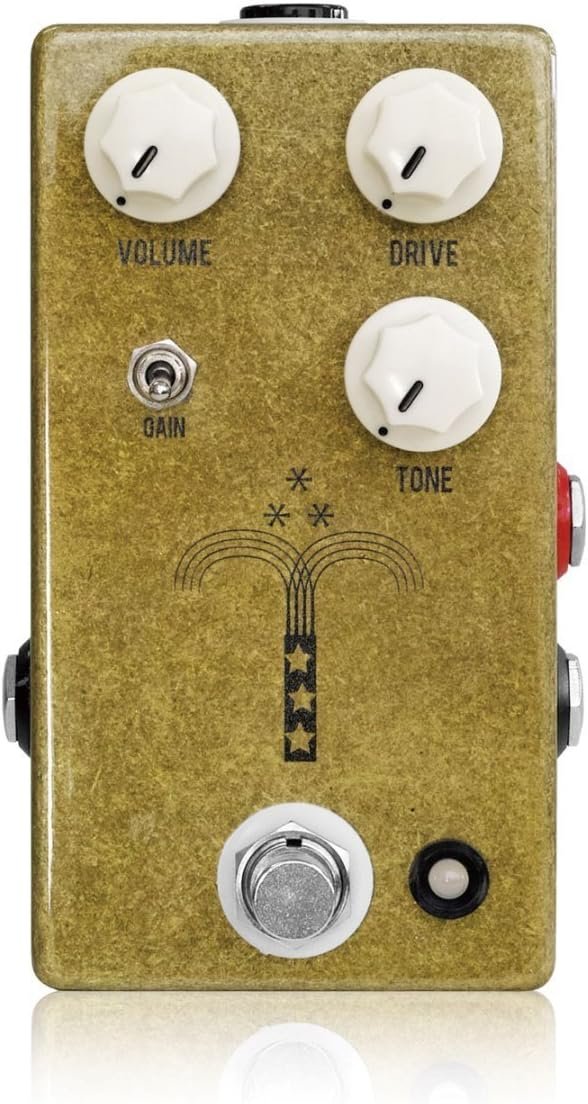
Finished in distinctive gold, this compact overdrive takes a relatively straightforward approach to tone shaping. Its Volume, Drive and Tone controls are complemented by two gain modes, a side-mounted bright-cut switch and compatibility with the optional JHS Red Remote.
Rather than offering extreme distortion or numerous digital effects, the Morning Glory V4 concentrates on low-to-medium gain sounds that respond naturally to playing dynamics.
It can add gentle breakup to a clean amplifier, provide an additional push to an already overdriven sound or serve as a foundation for other drive pedals.
However, its restrained character will not appeal to everyone. Players seeking heavy distortion, extensive tonal controls or a dramatic transformation of their amplifier may find other pedals more appropriate.
For guitarists who appreciate expressive overdrive and simple controls, the Morning Glory V4 offers an interesting balance of traditional sound and practical flexibility.
Why It Works in a Guitar Setup
The purpose of a transparent-style overdrive is to introduce additional gain while retaining much of the underlying character of the instrument and amplifier.
The Morning Glory V4 follows this approach.
At lower drive settings, it can add a little edge to clean chords without making the sound excessively compressed or heavily distorted.
Increase the Drive control, and the pedal produces more pronounced breakup, making it useful for blues, classic rock, country and other styles where playing dynamics remain important.
One of its attractions is the relationship between pick attack and overdrive.
With an appropriate guitar and amplifier combination, lighter playing can produce a cleaner response, while a stronger attack encourages additional grit.
This makes the Morning Glory particularly appealing to guitarists who shape their sound through their hands rather than constantly adjusting pedals.
The guitar’s volume control can also influence how much signal reaches the overdrive circuit.
Reducing the guitar volume may clean up the sound, depending on the gain setting and equipment being used.
The Morning Glory is therefore more about refining an existing sound than replacing it with something entirely different.
What It Feels Like to Use
The Morning Glory V4 has a compact metal enclosure with an uncomplicated layout.
Three white knobs control the main functions.
Volume
The Volume control adjusts the pedal’s output level.
This allows the Morning Glory to operate as a relatively subtle overdrive or push the next stage of the signal chain harder.
With lower drive and sufficient output, it can also serve as a useful boost.
The effect of that boost depends on the amplifier.
A clean amplifier with considerable headroom may become louder, while an amplifier already approaching breakup may produce additional saturation and sustain.
Drive
The Drive control determines the amount of overdrive introduced by the pedal.
Lower settings suit subtle warmth and slightly roughened clean sounds.
Higher settings offer a more assertive character suitable for blues leads, expressive rhythm playing and classic rock.
The Morning Glory is not intended to produce the extreme saturation associated with dedicated high-gain distortion pedals.
Its strength is the range between clean boosting and moderately driven sounds.
Tone
The Tone control adjusts the overall tonal balance.
It helps accommodate guitars with different pickup characteristics and amplifiers with different levels of brightness.
A bright single-coil guitar may benefit from a warmer setting, while a darker humbucker-equipped instrument might need additional definition.
These three controls make the pedal approachable without sacrificing useful adjustment.
Two Gain Modes for Different Sounds
One of the most important additions to the V4 is its switchable higher-gain mode.
The standard mode provides the familiar Morning Glory character, concentrating on clarity and lower-gain overdrive.
Engaging the additional gain stage produces a stronger sound with more low-end weight and grit.
This can be useful when moving from rhythm playing to a more assertive lead passage.
Instead of replacing the pedal or changing several controls, the guitarist can access a different gain character using the onboard toggle.
The indicator changes from blue to red to show which mode is selected.
Optional JHS Red Remote
The Morning Glory V4 also supports the JHS Red Remote, which is sold separately.
Connecting the remote to the dedicated socket allows the guitarist to switch between gain modes using an additional footswitch.
This is particularly useful during performances when reaching down to adjust the pedal would be inconvenient.
When the remote is connected, it takes control of the gain switching in place of the onboard toggle.
The remote does not add an entirely separate overdrive circuit. It provides convenient foot-operated access to the pedal’s existing gain modes.
For home players who rarely change settings during a song, the additional accessory may be unnecessary.
The Bright-Cut Switch
JHS positions the bright-cut switch on the side of the Morning Glory V4.
This provides another useful way to match the pedal to a particular amplifier.
Some guitars and amplifiers naturally produce a brighter sound than others.
Adding overdrive can occasionally make those higher frequencies feel too prominent.
The bright-cut switch provides a simple way to reduce excessive high-end emphasis.
It is particularly useful when a combination of bright pickups and a lively amplifier becomes uncomfortable at higher volume.
However, this is a basic tonal adjustment rather than a sophisticated equalizer.
For more detailed frequency shaping, our BOSS EQ-200 Graphic Equalizer article explores a pedal designed specifically for controlling different parts of the guitar’s frequency range.
The Morning Glory concentrates on keeping ordinary adjustments quick and manageable.
Using the Morning Glory With Different Amplifiers
The Morning Glory V4 can be used with clean or already overdriven amplifiers, but the results will vary.
Clean Amplifiers
Into a clean amplifier, the pedal can provide the breakup that the amplifier is not producing on its own.
This can be particularly useful for players who practise at moderate volume and do not want to turn their amplifier up simply to achieve a driven sound.
The Morning Glory adds its own overdrive character while leaving much of the amplifier’s original response recognisable.
Already Overdriven Amplifiers
When placed before an amplifier that is already producing some breakup, the Morning Glory can push the sound towards greater saturation.
This may add sustain and presence without requiring a completely different amplifier setting.
However, the result depends on the amplifier’s available headroom and existing gain structure.
Increasing the pedal’s output does not always produce a straightforward increase in loudness.
Sometimes the additional signal simply produces more distortion.
Stacking With Other Drive Pedals
The Morning Glory can also work alongside other overdrive pedals.
Placing one overdrive before another changes the signal entering the second pedal, which can alter gain, compression and tonal balance.
For guitarists considering another compact drive option, our MXR Duke of Tone Overdrive Pedal article explores a different approach to expressive overdrive.
Experimenting with pedal order can be worthwhile, particularly when building a setup around several levels of gain.
Power and Pedalboard Space
JHS specifies standard 9V DC centre-negative power for the Morning Glory V4, with a current consumption of 43mA.
A suitable regulated power supply is required.
The enclosure measures approximately 2.6 inches wide, 4.8 inches long and 1.6 inches high.
That makes it practical for most conventional pedalboards.
The Gold finish and clearly arranged controls also make the pedal easy to recognise among other equipment.
Although the basic layout is compact, additional room may be needed for connecting cables and the optional Red Remote.
The Drawbacks
The Morning Glory V4 is designed around a particular style of overdrive, and its relatively focused character brings several limitations.
Limited High-Gain Capability
The pedal excels at cleaner boosting and low-to-medium gain sounds.
However, it is not designed to replace a dedicated high-gain distortion pedal.
Guitarists wanting aggressive modern metal tones or heavily saturated lead sounds may find the available gain insufficient.
Additional pedals or a suitable high-gain amplifier may still be necessary.
Transparent Overdrive Is Not Completely Neutral
The term transparent can create unrealistic expectations.
Every overdrive circuit changes the signal to some degree.
The Morning Glory alters gain, harmonic content and tonal balance, even when the effect is relatively subtle.
Its response also depends on the guitar, pickups and amplifier.
Players should not assume that engaging the pedal will preserve every characteristic of their original sound unchanged.
The Higher-Gain Mode Is Not Independently Adjustable
The two gain modes provide welcome flexibility, but they share the pedal’s main controls.
There are no separate Volume, Drive and Tone settings for each mode.
Consequently, a setting that works particularly well in the standard mode may not produce the ideal balance when the additional gain stage is engaged.
Some compromise may be required.
For musicians who need two completely independent overdrive sounds, separate pedals or a dual-channel design could be more convenient.
The Red Remote Costs Extra
The ability to switch gain modes with an external footswitch is a useful feature.
However, the JHS Red Remote is not included with the standard Morning Glory V4.
Anyone wanting hands-free switching between the two modes needs an additional compatible footswitch and connecting cable.
That also introduces another item to position on the pedalboard.
For a player who rarely switches modes during a performance, the extra equipment may offer little benefit.
The Bright-Cut Switch Is Less Accessible
Moving the bright-cut switch to the side keeps the top of the pedal uncluttered.
However, reaching it can become awkward when the Morning Glory is mounted tightly between other pedals.
Players who frequently change the brightness setting may find this inconvenient.
It is better suited to establishing a preferred sound for a particular guitar and amplifier rather than making adjustments during a performance.
It May Overlap With Existing Equipment
Many amplifiers already provide appealing overdrive sounds.
Some guitarists also own several pedals capable of producing similar low-gain textures.
In those circumstances, the Morning Glory may duplicate a function already covered by other equipment.
Before adding another overdrive, it is worth considering whether the existing setup genuinely lacks the sounds or responsiveness the pedal is intended to provide.
The Power Requirements Need Attention
The Morning Glory requires the correct 9V centre-negative power supply.
Using an unsuitable supply can risk damaging electronic equipment.
It also means the pedal must be incorporated into an appropriate power arrangement.
Guitarists using a compact pedalboard should confirm that their existing supply provides the correct voltage, polarity and sufficient current.
It Will Not Suit Every Playing Style
Some guitarists prefer the stronger midrange emphasis, compression or distinctive coloration of other overdrive circuits.
The Morning Glory’s relatively open character may not provide the focused push they want for every musical situation.
The most suitable overdrive is determined by the complete guitar and amplifier setup, not simply the reputation of the pedal.
Who It Suits Best
The JHS Morning Glory V4 is particularly attractive to blues, country, indie and classic rock guitarists who want responsive overdrive without excessive saturation.
It suits players who already like the basic sound of their amplifier and want to add warmth, breakup or an additional level of gain.
The straightforward controls make it appropriate for home practice, recording and live performance.
Its Red Remote compatibility is also useful for guitarists who regularly alternate between rhythm and lead sounds.
However, musicians seeking extreme distortion, extensive tone shaping or several independently programmable sounds may prefer another design.
Is It Worth the Pedalboard Space?
The JHS Morning Glory V4 concentrates on doing a relatively small number of things well.
Its responsive low-to-medium gain character, straightforward controls and switchable gain modes make it appealing for guitarists who value dynamics and clarity.
The side-mounted bright-cut switch adds useful flexibility, while the optional Red Remote makes switching gain modes more convenient during performances.
Its limitations are equally important.
The shared controls, modest maximum gain and optional switching accessory mean it will not replace every overdrive or distortion pedal.
Nevertheless, for players who appreciate the natural character of their guitar and amplifier, the Morning Glory V4 offers a focused and practical way to introduce expressive drive sounds.
Explore more carefully selected effects in our Effects & Pedals collection.
As an Amazon Associate I earn from qualifying purchases.