Godin Multiac Nylon Encore
As an Amazon Associate I earn from qualifying purchases.
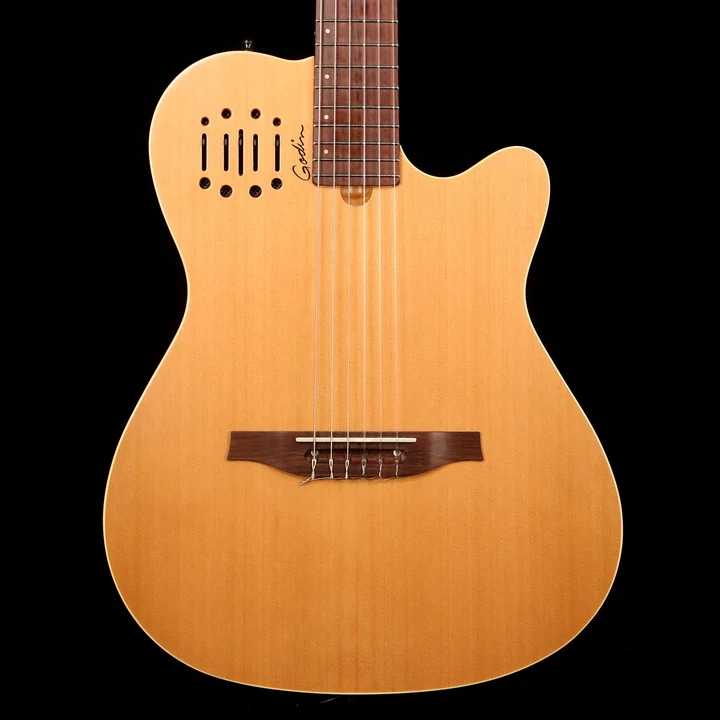
The Godin Multiac Nylon Encore is for players who want the sound and feel of nylon strings in a guitar they’ll often plug in. It pairs a solid cedar top with a slim, chambered body and two pickup sources you can blend. That combination makes sense onstage or when recording directly. It’s a more specialised choice if most of your playing happens at home with the guitar unplugged. Before buying, consider how much sound you need from the body itself and how the neck will fit the music you already play.
What You Should Know Before Buying
The unplugged sound is the first thing to consider
The Encore’s chambered body is shallower than a traditional classical guitar’s. Expect less projection across a room when you play unplugged. You can still hear what you’re doing during quiet practice, but if your usual session is two people playing acoustically and listening to one another, think about how much you rely on the sound carrying beyond your own chair.
The distinction matters even if you already own an electro-acoustic. A conventional acoustic-electric body serves players who spend plenty of time unplugged and only occasionally need a cable. Our Yamaha FGX800C acoustic-electric guide covers that approach in a steel-string guitar. If you want nylon strings and strong natural projection, use a full-bodied classical guitar as your point of comparison.
The neck still feels like a move toward a classical guitar
Godin specifies a 1.9-inch nut width, just over 48 mm, and a 25.5-inch scale. That nut is narrower than the 52 mm width found on many traditional classical guitars, but it will still feel broad if you’re coming from a typical steel-string electric. The scale is also full length, so the slim body doesn’t translate into shorter reaches between frets.
Think about the shapes you use most. Extra room across the strings can help when the thumb and fingers are playing separate parts. If you often wrap your thumb over the edge of the neck or move quickly between familiar electric-guitar chord shapes, the wider grip may take adjustment. Compare the nut width with your current guitar and try the sort of first-position chord that already gives your hand a stretch.
The pickup blend takes time to get right
Godin’s Dual Source system combines an undersaddle pickup with soundboard sensors. The undersaddle source gives you a direct view of the string attack, while adding the soundboard source can bring more of the body into the amplified sound. The blend is useful, but the setting that works at home may need adjusting through a PA in a room with a different sound.
If you play live, leave time at soundcheck to hear each source through the system you’ll actually use. A setting that sounds full when you’re alone may need a little more definition once the other instruments come in. If you already like a guitar with one pickup and a straightforward volume control, consider how often you’ll use the blend after the first few sessions. It earns its place when you regularly need to shape the sound for different rooms or arrangements.
A slim body solves one kind of space problem
The shallower body can make it easier to keep the guitar close while seated, particularly if you find a deep acoustic body puts your picking arm farther out than you like. It still has a full-scale neck and a slotted headstock. If your reason for downsizing is to fit the guitar into a tight storage spot or take it on trips, check the length of the guitar and bag as well as the body depth. The Enya Nova Go travel guitar guide is worth a look if the space available for transport is the deciding factor.
Who Should Probably Avoid This Product?
I’d pass if you mainly want a classical guitar for playing unplugged in lessons, acoustic duets or small rooms where people will be listening from several feet away. The Encore puts much of its appeal into its amplified sound. If you rarely connect a guitar to an amp, interface or PA, you may spend most of your time using the part of the design that offers the least benefit to you.
It’s also worth thinking twice if you mainly strum with a pick and are looking for a guitar with a pronounced acoustic attack. The Encore is a nylon-string instrument, and the response is part of that choice. The Gretsch G9200 Boxcar resonator guide covers a very different acoustic sound if you’re exploring instruments for blues or slide and want the notes to cut through on their own.
Who Will Benefit Most?
The Encore suits a fingerstyle player who wants nylon strings for an amplified set. Think of a singer accompanying themselves in a small venue, or a guitarist adding quiet nylon-string passages between other instruments in a band. The cutaway gives the fretting hand more room to approach higher notes. The pickup blend lets you decide how much definition you need from each note without reaching for the mixer every time.
It also makes sense for home recording if you want to capture a nylon-string part directly. You can listen to the undersaddle source on its own, then add some of the soundboard signal and hear what it does in the track. That’s particularly useful when a part sounds pleasing on its own but loses its shape once the bass and vocals are in. If you’re still working out whether you need direct recording or more natural room sound, browse the SwapStrings Acoustic Guitars guides to compare body styles and pickup options.
Think about where you’d play the Encore on an ordinary week. If your nylon-string parts usually go through an amp, a PA or a recording interface, the slim body and blend controls have a clear job. The case for choosing it is strongest when you already know where the cable will go and what you want to hear at the other end.
As an Amazon Associate I earn from qualifying purchases.
Opens Amazon (paid link)