Gretsch G9200 Boxcar Resonator Guitar
As an Amazon Associate I earn from qualifying purchases.
Some guitars have a sound that immediately takes you somewhere else. The dry attack of early blues recordings, the metallic shimmer of slide guitar and the unmistakable character of traditional American roots music all come to mind when you hear a resonator.
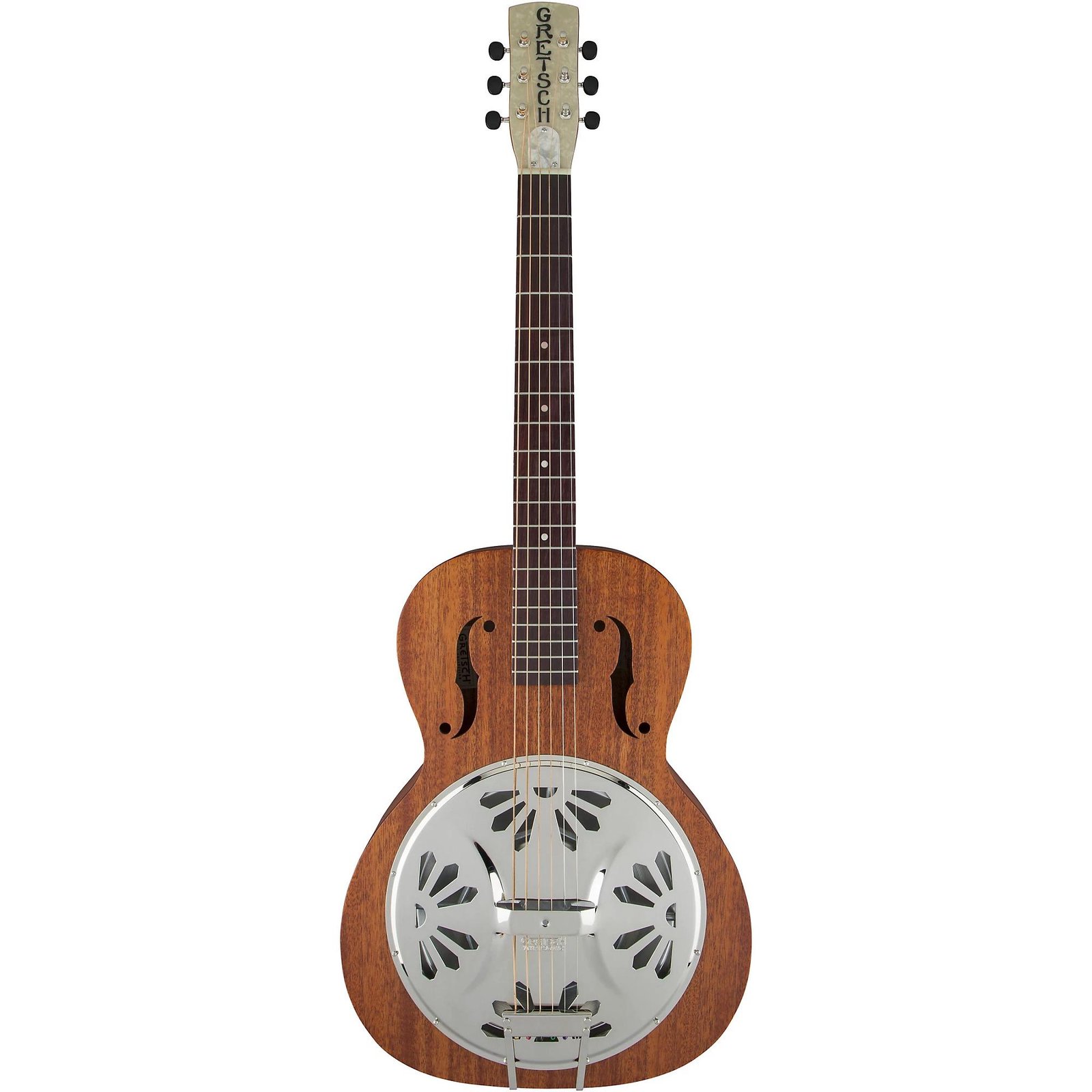
The Gretsch G9200 Boxcar Resonator Guitar brings that distinctive musical character into a traditional round-neck instrument.
Part of Gretsch’s Roots Collection, the G9200 combines a natural laminated mahogany body with an aluminium Ampli-Sonic resonator cone, spider bridge and vintage-inspired detailing.
Its nickel-plated coverplate and 1930s-style headstock give it an unmistakably old-fashioned appearance, while the round neck allows both conventional fretted playing and bottleneck slide techniques.
This isn’t simply another acoustic guitar with unusual decoration. Its resonator construction fundamentally changes how the instrument responds.
However, its distinctive personality also brings limitations that deserve careful consideration.
What You Should Know Before Buying
A Resonator Sounds Different From a Conventional Acoustic
The most important characteristic of the G9200 is its resonator system.
Rather than relying primarily on a wooden soundboard to project string vibrations, the Boxcar uses an aluminium cone beneath its decorative metal coverplate.
Gretsch’s Ampli-Sonic cone is paired with a spider-style bridge, creating the distinctive projection and metallic tonal character associated with resonator instruments.
The sound can be wonderfully expressive for blues, slide guitar and traditional roots music.
However, it won’t provide the same rounded, woody response as a conventional dreadnought.
Players accustomed to the broad bass response and natural warmth of a traditional acoustic may find the resonator’s stronger midrange and metallic edge rather unfamiliar.
For a more conventional acoustic character, our Yamaha FG830 Acoustic Guitar guide explores a traditional solid-top dreadnought.
Neither design is automatically better. They simply produce different sounds for different musical purposes.
The Body Uses Laminated Mahogany
The G9200 features laminated mahogany construction rather than an all-solid wooden body.
Its vintage semi-gloss finish allows the natural wood colour to remain visible, complementing the chrome hardware and decorative resonator coverplate.
Laminated construction is not necessarily a disadvantage in a resonator guitar, where the metal cone plays such an important role in producing the instrument’s sound.
Nevertheless, buyers should understand exactly what they’re purchasing.
Anyone specifically seeking an all-solid acoustic guitar will need to consider another instrument.
The Boxcar’s appeal comes from its distinctive resonator design rather than expensive solid-tonewood construction.
Round Neck or Square Neck?
Gretsch offers different resonator instruments for different playing techniques.
The G9200 has a conventional round neck, making it suitable for fretting chords, playing melodic passages and using a bottleneck slide.
That gives guitarists considerably more flexibility than a dedicated square-neck resonator designed primarily for lap-style playing.
However, a round neck isn’t necessarily the best arrangement for someone planning to play exclusively with the instrument lying across their lap.
Traditional lap-style techniques often rely on different string height and neck construction.
Buyers interested mainly in bluegrass-style lap playing should investigate a purpose-built square-neck instrument rather than assuming the Boxcar will provide the same experience.
Slide Playing Takes Practice
The G9200 may look wonderfully inviting, especially if you enjoy traditional blues.
However, owning a resonator won’t automatically make slide guitar techniques easy.
Accurate intonation requires careful positioning of the slide directly over the fret positions.
Players also need to control string noise and unwanted vibrations using both hands.
Too much slide pressure can cause the strings to contact the frets, while insufficient control can produce rattling and unclear notes.
Different tunings, including open tunings commonly associated with blues, can introduce additional learning challenges.
The instrument’s distinctive sound is rewarding, but developing an expressive slide technique still requires time and patience.
The Factory Strings May Not Suit Every Player
Gretsch specifies D’Addario EJ16 phosphor bronze light-gauge strings, measuring .012–.053, for the G9200.
These are familiar acoustic guitar strings, making the instrument approachable for someone accustomed to standard steel-string guitars.
However, playing preferences vary considerably.
Some slide players prefer heavier strings or a slightly higher action to provide additional clearance.
Others want a conventional setup that makes fretted chords easier.
Changing string gauge or adjusting the action can influence the instrument’s response, tension and playing comfort.
Resonator guitars also require particular care around the cone and bridge assembly.
Major setup adjustments are best carried out by someone familiar with resonator construction.
Simply fitting much heavier strings without considering the instrument’s setup isn’t advisable.
The Metal Resonator Needs Careful Handling
The aluminium cone is central to the Boxcar’s sound.
Although protected by a metal coverplate, it remains a component that must be treated carefully.
Heavy impacts, improper bridge adjustments or careless maintenance can affect the cone and the way vibrations transfer through it.
Unlike a conventional acoustic guitar, the resonator contains additional mechanical parts that may require specialist attention.
The coverplate should not be removed casually simply to investigate the internal construction.
An incorrectly seated cone or bridge can affect tone and introduce unwanted rattling.
For owners who enjoy maintaining their instruments, this is worth remembering: resonator guitars share many characteristics with conventional acoustics, but their internal hardware introduces additional considerations.
No Built-In Pickup or Electronics
The G9200 is an acoustic-only resonator guitar.
It doesn’t include an onboard pickup, preamplifier, built-in tuner or electronic controls.
For relaxed home playing, that simplicity can be particularly appealing.
There are no batteries to replace, controls to adjust or cables required before enjoying the instrument.
However, musicians planning to perform through an amplifier or PA system will need another solution.
An external microphone can capture the resonator’s acoustic character, although microphone placement and feedback become important considerations.
Specialist aftermarket pickups are another possibility, but compatibility and installation need careful thought.
Anyone wanting an acoustic guitar that is ready to plug directly into an amplifier may prefer a model with factory-installed electronics.
Our Taylor 114ce Grand Auditorium guide explores a more conventional acoustic-electric arrangement.
The Traditional Body Has Practical Limitations
The Boxcar has a 25-inch scale length, 19 frets and a traditional non-cutaway resonator body.
Its neck features a soft V-shaped profile and a 1.75-inch bone nut.
That relatively generous nut width can provide useful room for individual strings, particularly during fingerpicking and slide work.
However, not everyone will enjoy the shape.
Guitarists accustomed to very slim electric guitar necks may find the soft V profile unfamiliar.
Likewise, the traditional body restricts comfortable access to the highest fret positions.
Players who regularly perform intricate melodic passages far up the neck may prefer an instrument with a cutaway.
The resonator hardware also gives the guitar a different physical balance from a lightweight acoustic.
It’s worth considering how the instrument will feel during longer seated or standing sessions.
A Case Is Not Included
Gretsch lists a suitable resonator gig bag as an optional accessory.
That means buyers shouldn’t assume a protective carrying bag or hard case will arrive with the instrument.
The resonator coverplate and internal cone make sensible protection particularly important during travel.
A case designed specifically for the instrument’s dimensions is preferable to assuming that any conventional acoustic guitar case will fit.
This matters for musicians travelling to rehearsals, lessons or performances.
Storage conditions also deserve attention.
Despite the metal resonator hardware, the Boxcar still has a wooden body and neck that should be protected from excessive dryness, moisture and extreme temperature changes.
A Specialist Voice Isn’t Always Versatile
The Boxcar’s distinctive character is its greatest attraction, but it can also limit its suitability.
For Delta blues, country blues and slide arrangements, its metallic projection can bring tremendous personality to a performance.
For delicate contemporary fingerstyle, soft acoustic accompaniment or traditional pop strumming, that same character may feel too pronounced.
It can certainly play ordinary chords and melodies.
However, players expecting the broad versatility of a conventional acoustic guitar should consider whether they genuinely enjoy the resonator sound.
Buying a specialist instrument makes more sense when its particular tonal character is something you actively want.
Who Should Probably Avoid This Product?
Guitarists wanting one conventional acoustic for every musical style may find the Boxcar too specialised.
Beginners who haven’t yet developed comfortable fretting technique might prefer a traditional steel-string acoustic before exploring resonator playing.
Players interested exclusively in lap-style slide should consider a suitable square-neck model.
Anyone requiring built-in amplification should also recognise that the G9200 doesn’t include electronics.
Guitarists who prioritise a lightweight travel setup may find a compact alternative more convenient.
Our Donner HUSH-I PRO Travel Guitar guide explores a very different approach to portable playing.
Finally, musicians unwilling to accommodate the additional care sometimes required by resonator hardware may be happier with a simpler acoustic design.
Who Will Benefit Most?
Traditional Blues Enthusiasts
The Boxcar is particularly appealing to guitarists who enjoy early blues, Delta-style arrangements and traditional acoustic roots music.
Its metallic projection and responsive resonator cone help create the expressive character associated with those styles.
For players exploring bottleneck slide, open tunings and rhythmic blues patterns, it offers a distinctly different experience from a standard acoustic.
Guitarists Exploring New Sounds
Someone who already owns a conventional acoustic may find the G9200 an interesting addition rather than a replacement.
Its specialised voice introduces fresh possibilities for songwriting, recording and acoustic arrangements.
Even familiar chord progressions can take on a noticeably different personality when played through a resonator.
Players Who Appreciate Vintage Instruments
The natural mahogany finish, nickel-plated Poinsettia-pattern coverplate and aged-style headstock detailing give the Boxcar plenty of visual character.
It has the appearance of an instrument inspired by another musical era without depending on fragile vintage hardware or decades of previous ownership.
For guitarists who appreciate traditional styling, that combination is part of the attraction.
Musicians Who Enjoy Unplugged Playing
The Boxcar requires no electronics to produce its characteristic sound.
That makes it attractive for informal acoustic performances, home playing and musical sessions where simplicity matters.
Its resonator construction produces a distinctive acoustic response without needing additional equipment.
For more instruments with different playing characteristics, body shapes and musical personalities, explore our Acoustic Guitars guides.
The Gretsch G9200 Boxcar Resonator Guitar is an instrument with a very particular purpose and personality.
Its laminated mahogany construction, spider-bridge resonator and traditional round neck offer a distinctive combination of familiar guitar playability and vintage-inspired sound.
It isn’t designed to replace every acoustic guitar, and its specialised voice, lack of electronics and additional maintenance considerations deserve careful thought.
For musicians drawn to the expressive character of blues, slide and roots music, however, the Boxcar offers a compelling opportunity to explore a different side of acoustic guitar playing.
As an Amazon Associate I earn from qualifying purchases.
Opens Amazon (paid link)