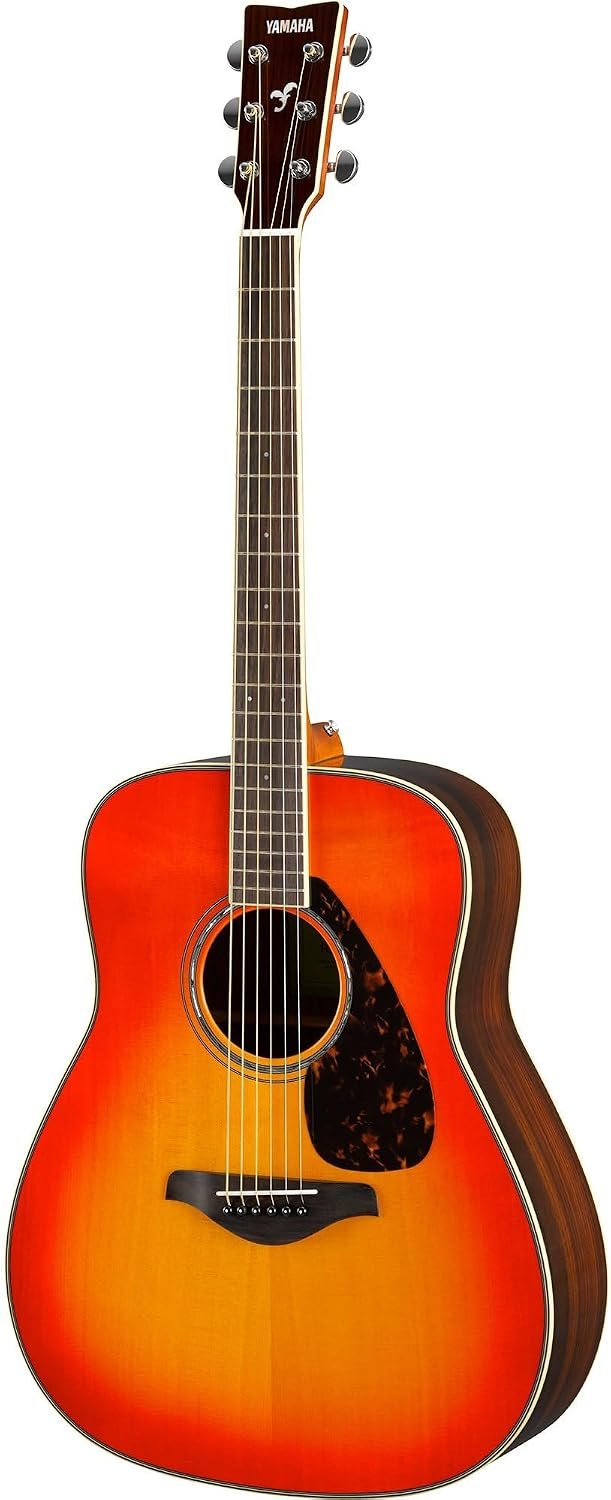
Yamaha FG830 Acoustic Guitar – Autumn Burst
As an Amazon Associate I earn from qualifying purchases.
There is something particularly satisfying about a traditional acoustic guitar that feels ready to play whenever inspiration strikes. No amplifier, no complicated controls and no need to connect anything before enjoying the sound.
The Yamaha FG830 Acoustic Guitar in Autumn Burst follows that straightforward approach, combining a solid spruce top, rosewood back and sides, and Yamaha’s scalloped bracing within a full-sized dreadnought body.
Its warm Autumn Burst finish gives the guitar a distinctive appearance without taking attention away from the familiar acoustic design.
For players who enjoy rich rhythm playing, clear individual notes and the natural resonance of a wooden instrument, the FG830 offers an appealing combination of traditional construction and everyday practicality.
Why it works as an everyday acoustic guitar
The Yamaha FG830 is built around the traditional Western dreadnought body shape.
This is one of the most recognisable acoustic guitar designs, offering a broad soundboard and substantial body depth.
That larger construction helps produce the strong acoustic projection associated with dreadnought guitars.
Whether accompanying vocals, playing open chords or working through familiar songs, the FG830 is designed to deliver a full acoustic sound without additional equipment.
The solid spruce top is an important feature.
Unlike a completely laminated soundboard, a solid top uses a single piece of wood through its thickness, allowing it to respond naturally to string vibration.
Spruce is widely used for acoustic guitar tops because of its balance between strength, weight and responsiveness.
Yamaha combines this with rosewood back and sides, giving the FG830 a different tonal character from the mahogany-based models elsewhere in the FG range.
The result is a guitar designed to offer a rich, resonant voice with clear individual notes and a satisfying foundation for rhythm playing.
For players considering a simpler model, our Yamaha FG800 Acoustic Guitar guide explores another traditional dreadnought with a solid spruce top.
The FG830 adds rosewood back and sides along with more decorative detailing, making it particularly appealing to players who want a slightly richer presentation.
What it feels like to play
The FG830 has the physical presence expected from a full-sized acoustic guitar.
Its body measures approximately 412mm across the widest point, with a depth ranging from 100mm to 118mm.
When seated, the rounded body rests firmly against the player, while the broad upper bout supports the picking arm.
That substantial shape can feel reassuring for someone accustomed to traditional acoustic guitars.
The 650mm scale length gives the strings the familiar tension and response associated with a full-scale steel-string instrument.
The 43mm nut width provides conventional string spacing suitable for general chord playing, rhythm work and many fingerstyle techniques.
Yamaha uses a nato neck with a matte finish, providing a smoother surface beneath the fretting hand than a heavily polished gloss neck.
That can be particularly welcome during longer practice sessions when the player’s hand becomes warm.
The rosewood fingerboard provides a traditional playing surface, while the die-cast chrome tuning machines offer straightforward tuning adjustment.
There are no onboard electronics or additional controls to interrupt the playing experience.
The FG830 is simply a guitar that can be picked up, tuned and played.
For musicians who enjoy sitting down with an acoustic for half an hour without preparing an entire setup, that simplicity is a meaningful advantage.
Solid spruce and rosewood construction
The combination of spruce and rosewood is a familiar one in acoustic guitar construction.
Spruce provides the vibrating soundboard, while the rosewood back and sides contribute to the instrument’s overall acoustic character.
The FG830 uses layered rosewood for the back and sides rather than an entirely solid-wood body.
This is an important distinction, but it doesn’t automatically reduce the usefulness of the instrument.
Layered construction offers additional dimensional stability while allowing Yamaha to concentrate on a solid spruce soundboard.
In practical terms, the guitar is designed to deliver a balanced acoustic response without requiring the more elaborate construction of an all-solid instrument.
The rosewood gives the back and sides a dark, attractive appearance, with grain patterns that contrast against the spruce top.
Yamaha also includes an abalone soundhole inlay, adding a decorative feature without making the instrument look excessively ornate.
The overall design remains traditional, with a tortoiseshell-pattern pickguard, cream binding and polished body finish.
These details give the FG830 a more refined appearance than a completely plain acoustic guitar.
Scalloped bracing and natural resonance
One feature that deserves particular attention is Yamaha’s scalloped internal bracing.
Acoustic guitar bracing supports the soundboard against string tension while influencing how freely the top can vibrate.
The shape, position and mass of the bracing can significantly affect the character of an acoustic guitar.
Yamaha’s scalloped design is intended to improve the response of the spruce top while maintaining the structural strength necessary for a steel-string instrument.
This contributes to the FG830’s ability to respond to different picking strengths.
Gentle fingerpicking allows individual notes to emerge clearly, while firmer strumming produces a fuller acoustic sound.
The dreadnought body provides enough physical volume for traditional rhythm playing, making the guitar particularly useful for accompanying vocals.
That doesn’t mean every FG830 will sound identical.
Natural variations in the wood, individual setup and string condition can influence the way an acoustic guitar responds.
Nevertheless, Yamaha’s established FG construction provides a sensible foundation for consistent everyday playing.
The character of the Autumn Burst finish
The Autumn Burst finish is one of the most immediately attractive features of this particular FG830.
Its warm shading creates a traditional appearance with more visual depth than a plain natural finish.
The darker edges contrast with the lighter central area of the spruce top, drawing attention towards the soundhole and the natural shape of the instrument.
The gloss finish gives the body a polished appearance, while the decorative rosette adds a restrained touch of detail.
There is something particularly appealing about a warm burst-finished acoustic guitar in a music room.
It looks equally comfortable resting on a suitable stand beside a sofa or sitting among other instruments in a dedicated practice space.
The finish doesn’t change the fundamental specifications of the FG830, but it gives this version a distinctive personality.
For players who appreciate traditional acoustic styling without wanting excessive decoration, Autumn Burst provides an attractive middle ground.
A guitar for strumming and fingerstyle
One of the strengths of a conventional dreadnought is its versatility.
The FG830 is particularly well suited to rhythm guitar playing, where a strong acoustic foundation helps support a singer or another instrument.
Open chords have room to resonate, while the larger body provides a substantial acoustic presence.
For songwriting, that can be particularly useful.
A guitarist can explore chord progressions, develop melodies and experiment with rhythms without needing additional equipment.
Fingerstyle players may also appreciate the FG830’s note definition and the clarity of its spruce-top construction.
However, the instrument retains conventional steel-string spacing rather than the wider fingerboard found on some dedicated fingerstyle guitars.
The FG830 is therefore best understood as an adaptable traditional acoustic rather than an instrument developed for one highly specialised technique.
For players who want a different body shape and the ability to connect directly to amplification, our Taylor 114ce Grand Auditorium guide explores another approach to acoustic guitar versatility.
The Yamaha concentrates on the natural unplugged playing experience.
The drawbacks
The Yamaha FG830 has many appealing qualities, but several important limitations deserve consideration before choosing it.
The first is its full-sized dreadnought body.
Although the larger soundboard helps create a substantial acoustic sound, the body can feel bulky for smaller players.
The guitar’s 412mm body width and 100–118mm depth mean there is a considerable amount of wood resting against the player’s torso.
For someone with a shorter reach, the picking arm may need to stretch farther across the upper bout than it would on a concert-sized acoustic.
That can become uncomfortable during extended seated practice sessions.
A smaller guitar may also feel easier to hold while relaxing on a sofa or playing in a restricted space.
The FG830’s size is part of its musical character, but it isn’t automatically the most comfortable shape for everyone.
There is no cutaway.
The traditional dreadnought body continues around the neck joint without the shaped access found on many electro-acoustic guitars.
That gives the FG830 its familiar appearance, but makes reaching the highest frets less convenient.
For rhythm players who spend most of their time playing chords lower down the neck, this may be unimportant.
Guitarists who regularly play melodic lines or lead parts high on the fingerboard may find the shape restrictive.
A cutaway acoustic would offer more room for the fretting hand in those situations.
The FG830 also lacks built-in electronics.
There is no onboard pickup, preamp, tuner or output socket.
For home playing, this is part of its appeal. The guitar remains entirely acoustic and doesn’t need batteries.
However, anyone planning to perform through an amplifier or PA system will need a separate solution.
An external microphone is one option, although that introduces microphone positioning and potential feedback considerations.
An aftermarket pickup is another possibility, but installation and compatibility need to be considered.
Players who regularly perform live may find it more convenient to choose a guitar with electronics already fitted.
Our Yamaha FGX800C Acoustic-Electric Guitar guide covers a model that combines a dreadnought body with a cutaway and built-in amplification.
The FG830 makes more sense when unplugged playing is the priority.
The back and sides are not solid rosewood.
Although the guitar features a solid spruce top, its rosewood back and sides use layered construction.
That is not necessarily a disadvantage for everyday ownership, and layered wood can offer practical stability.
Nevertheless, players specifically seeking an all-solid acoustic should understand the difference.
Some guitarists prefer the tonal response and construction of an instrument made entirely from solid tonewoods.
Others are perfectly happy with a solid top and layered back and sides, particularly when the guitar delivers the sound and playing comfort they enjoy.
The important point is to recognise what the FG830 actually offers rather than assume that every wooden component is solid.
The standard scale length creates relatively firm string tension.
At 650mm, the FG830 follows a familiar full-scale acoustic arrangement.
Players moving from shorter-scale electric guitars may notice that acoustic strings require more finger pressure.
This is particularly noticeable when forming barre chords or making repeated stretches across several frets.
String gauge and setup have a considerable influence on playing comfort, but the basic physical difference remains.
Someone with limited hand strength or a strong preference for low string tension may find a shorter-scale acoustic easier to manage.
The 43mm nut width may not satisfy every fingerstyle player.
The spacing is conventional and suitable for many styles.
However, guitarists who regularly play intricate fingerstyle arrangements may prefer a slightly wider neck.
More space between the strings can make certain picking and fretting techniques feel less crowded.
Conversely, some players with smaller hands may find the FG830’s dimensions comfortable.
There is no universally ideal neck width, which is why playing preference matters more than the specification alone.
The glossy body finish requires care.
Autumn Burst gives the guitar an attractive appearance, but polished surfaces can show fingerprints, dust and fine handling marks.
Regular contact from the player’s forearm and clothing may gradually leave signs of use.
The darker edges of the finish can also make certain scratches more noticeable under direct lighting.
A soft, suitable guitar cloth and sensible storage habits will help maintain its appearance.
However, anyone expecting a guitar to remain visually immaculate through years of regular use should be realistic.
A musical instrument is designed to be handled, and some signs of use are natural.
The solid spruce top is sensitive to environmental conditions.
Like other solid-top acoustic guitars, the FG830 should be protected from excessive dryness, high humidity and rapid temperature changes.
Very dry indoor heating can cause wooden components to shrink, potentially affecting the action and overall condition of the instrument.
Excessive humidity can create different problems, including changes in the way the guitar responds and feels.
An appropriate room environment and suitable storage are important, particularly when the guitar isn’t being played regularly.
A case and a reliable humidity-monitoring routine may be worthwhile for owners living in areas with significant seasonal changes.
The factory setup may not be ideal for every guitarist.
An acoustic guitar’s action height, neck relief and string condition have a major influence on comfort.
One player may prefer a slightly higher action for energetic strumming, while another wants a lower setup for lighter fingerstyle playing.
Even instruments of the same model can feel slightly different.
It would therefore be unwise to assume that the FG830 will arrive perfectly adjusted for every individual.
A professional setup can be valuable, especially for players who intend to use the guitar regularly.
The traditional bridge and tuning arrangement still require maintenance.
The FG830 uses conventional acoustic guitar hardware, including die-cast tuning machines and a pinned bridge.
Strings need replacing periodically, and the guitar should be checked for normal changes in tuning stability and setup.
The bridge pins need careful handling during string changes, while the nut and saddle should remain in good condition.
None of this is unusual for a steel-string acoustic guitar, but beginners should understand that an instrument requires occasional attention.
Finally, the FG830 isn’t the ideal guitar for every musical situation.
Its dreadnought body and traditional construction make it particularly appealing for strumming and everyday acoustic work.
However, a player interested mainly in amplified stage performance, very high fret access or compact travel use may benefit from another design.
A smaller concert guitar can be easier to handle, while an electro-acoustic offers greater convenience for amplified playing.
The FG830 is strongest when its traditional acoustic character matches the guitarist’s actual needs.
These limitations don’t diminish the instrument’s appeal. They simply explain why body size, playing style and intended use matter as much as the attractive finish and familiar Yamaha name.
Who it suits best
The Yamaha FG830 Autumn Burst is particularly well suited to guitarists who appreciate a traditional full-sized acoustic.
It makes sense for singer-songwriters, rhythm players and musicians who enjoy playing unplugged at home.
Its solid spruce top and scalloped bracing should also appeal to developing guitarists looking for an instrument that can remain useful as their technique improves.
The warm finish provides additional visual character without changing the familiar FG830 design.
It may also suit electric guitarists who want a straightforward acoustic for songwriting and occasional practice.
However, smaller players, frequent travellers and musicians who regularly require amplification should consider whether a different body style would be more practical.
For additional instruments with different shapes, construction and playing characteristics, explore our Acoustic Guitars guides.
Is it worth the guitar space?
The Yamaha FG830 Acoustic Guitar in Autumn Burst combines traditional styling with the practical features that make a good acoustic enjoyable to own.
Its solid spruce top, rosewood back and sides, scalloped bracing and substantial dreadnought body provide a strong foundation for everyday playing.
The warm burst finish and decorative detailing give it an attractive appearance without distracting from the instrument itself.
There are genuine compromises.
The full-sized body won’t suit everyone, the lack of electronics limits its immediate stage flexibility, and the absence of a cutaway makes higher-fret access more difficult.
Nevertheless, these characteristics are also part of the FG830’s traditional identity.
For players who enjoy the natural sound of a wooden guitar and want an instrument that encourages regular practice, songwriting and relaxed playing, the Yamaha FG830 Autumn Burst is a convincing choice.
Its greatest appeal is simple: a familiar acoustic guitar that keeps the focus where it belongs, on the music.
As an Amazon Associate I earn from qualifying purchases.