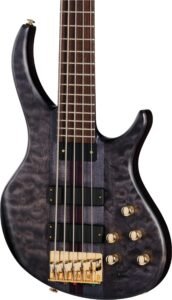
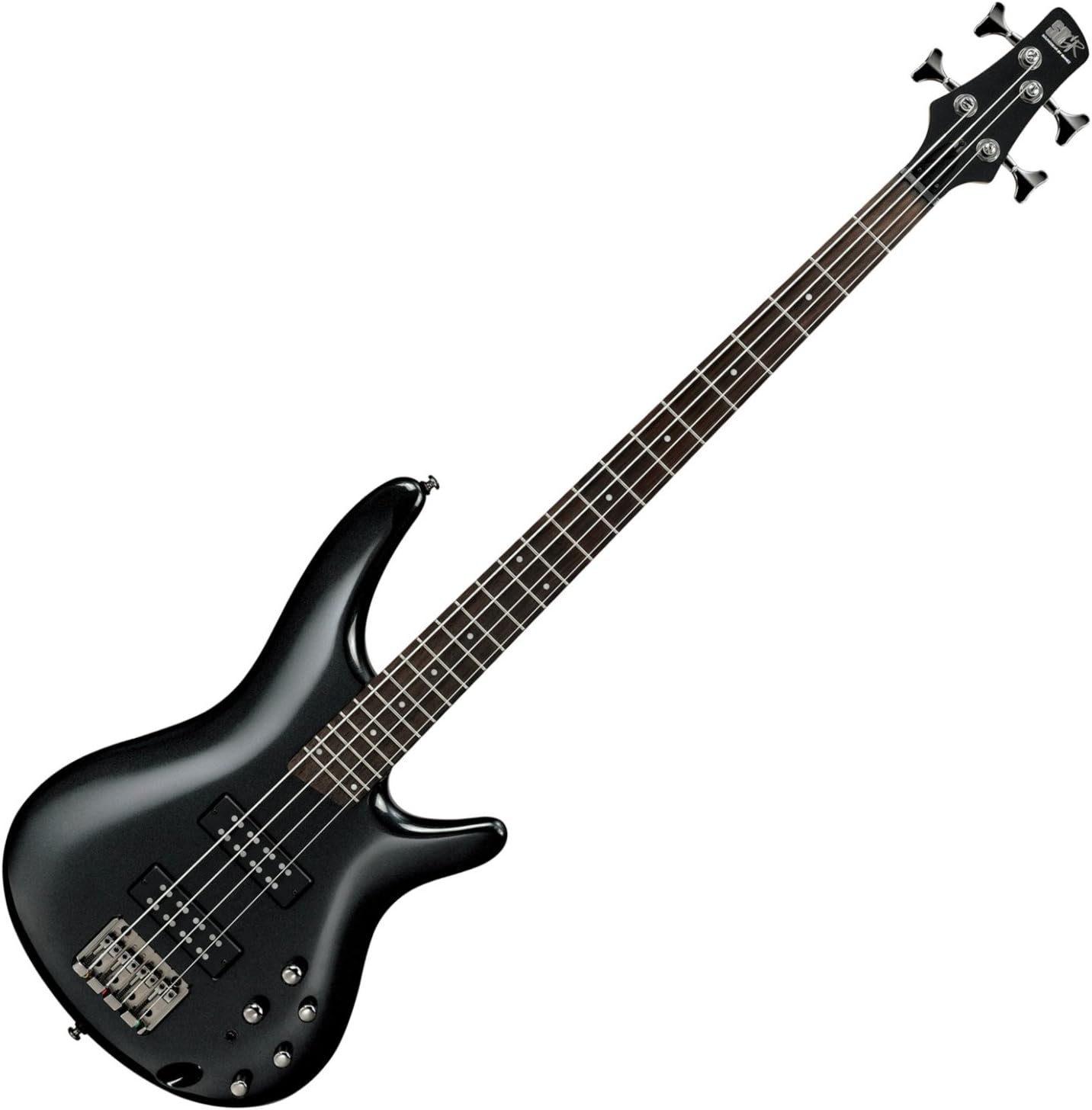
Ibanez SR300E Bass – Iron Pewter
As an Amazon Associate I earn from qualifying purchases.
The Ibanez SR300E Bass in Iron Pewter combines modern styling, a slim neck and unusually flexible electronics in a practical four-string instrument.
Part of Ibanez’s long-established Soundgear series, the SR300E is designed for bassists who want a comfortable playing experience without being restricted to one particular sound.
Its two PowerSpan Dual Coil pickups, active three-band equaliser and three-way Power Tap switch provide a wide selection of tonal possibilities, from warm and rounded bass lines to sharper, more articulate sounds.
The dark Iron Pewter finish gives the instrument a restrained, contemporary appearance, while its contoured body and 24-fret neck make it particularly interesting for players who prefer a modern bass design.
Why the Ibanez SR300E Works for Bass Players
The SR300E follows the familiar Ibanez Soundgear approach: a compact, smoothly contoured body, relatively slender neck and controls designed for versatility.
Unlike bass guitars built around a traditional Precision or Jazz Bass layout, the SR300E has a distinctly modern appearance.
Its rounded body edges and sculpted shape help create an instrument intended to sit comfortably against the player.
Ibanez’s current specifications list an okoume body, a five-piece maple and walnut neck and a jatoba fingerboard with white dot position markers.
These materials provide the foundation for an instrument designed around everyday practicality rather than elaborate decoration.
The Iron Pewter finish is particularly appealing.
Its dark metallic appearance gives the bass character without introducing an overly bright or ornamental colour scheme.
The Cosmo Black hardware complements the finish, creating a consistent appearance across the bridge, tuners and other fittings.
For musicians who prefer traditional bass styling and simpler electronics, our Squier Debut Precision Bass guide explores a very different approach to the four-string instrument.
The SR300E makes its case through flexibility and modern playability.
What the Ibanez SR300E Feels Like to Play
One of the most important features of the SR300E is its neck.
Ibanez uses a five-piece maple and walnut construction, with the company’s slim SR4 neck profile.
At the nut, the neck measures approximately 38mm wide.
That relatively narrow dimension can appeal to guitarists moving onto bass and existing bass players who prefer a less substantial neck beneath their fretting hand.
The neck has a 34-inch scale length, giving it the familiar string length and proportions of a conventional full-size electric bass.
This means the instrument retains normal full-scale fret spacing despite its slim neck profile.
The jatoba fingerboard has 24 medium frets, offering two complete octaves on each string.
That extended upper range can be useful for melodic bass lines, solo passages and players who enjoy moving beyond traditional low-register accompaniment.
The contoured body is another worthwhile detail.
Compared with instruments featuring more angular edges, the curved design is intended to sit naturally against the body.
The relatively compact Soundgear shape can also be appealing when practising seated or playing with a strap.
Comfort will still depend on individual preferences, setup and instrument weight, but the SR300E’s proportions are clearly designed with playability in mind.
For players accustomed to conventional bass guitars with broader necks and heavier-looking bodies, it offers a noticeably different design philosophy.
PowerSpan Pickups and Tonal Character
The SR300E uses two Ibanez PowerSpan Dual Coil pickups.
These are passive pickups connected to active tone-shaping electronics.
The dual-pickup arrangement allows players to adjust the balance between the neck and bridge positions, providing a useful starting point for different sounds.
Moving towards the neck pickup generally encourages a fuller, rounder character.
Increasing the bridge pickup contribution can introduce greater definition and emphasis on the attack of individual notes.
Blending the pickups allows the player to explore sounds between these two positions.
The PowerSpan design uses exposed pole pieces and is intended to deliver strong output with clear upper-frequency response while maintaining a substantial low end.
This makes the bass suitable for exploring several musical styles.
Fingerstyle playing can benefit from a full, controlled sound, while pick playing can emphasise attack and definition.
More percussive techniques, including slap bass, can take advantage of the available treble and midrange adjustment.
The final sound will depend on the amplifier, strings, playing technique and selected electronic settings.
Rather than promising one particular signature tone, the SR300E provides a flexible platform that can be adjusted to suit different musical requirements.
Three-Band EQ and Power Tap Switching
The active electronics are among the SR300E’s most distinctive features.
The instrument includes a three-band equaliser with separate bass, middle and treble controls.
These allow players to make practical adjustments without relying entirely on an amplifier.
The bass control affects low-frequency weight, while the treble control influences brightness and attack.
The middle control is particularly useful because midrange frequencies help determine how clearly a bass can be heard alongside guitars, drums and keyboards.
In addition to the equaliser, Ibanez includes a three-way Power Tap switch.
This provides three different pickup operating modes.
Tap Mode uses a single-coil-style configuration, intended to produce a more articulate and dynamic sound.
Series Mode provides a fuller humbucking character, suitable for players looking for warmth and body.
Power Tap Mode combines single-coil-style clarity with additional low-frequency weight.
The combination of pickup balance, equalisation and switching provides considerably more sound-shaping flexibility than a simple volume-and-tone arrangement.
However, it is worth remembering that more controls do not automatically produce better music.
The real benefit comes from finding a handful of useful settings and understanding how each responds to different playing techniques.
Hardware and Everyday Practicality
The SR300E includes an Ibanez Accu-cast B120 bridge with 19mm string spacing.
The bridge is designed to hold its saddles securely and allow normal adjustments for string height and intonation.
This is important because the playing experience of any bass depends heavily on its setup.
A comfortable action, suitable neck relief and correctly adjusted intonation can make a substantial difference to how easily an instrument plays.
The five-piece neck construction is another thoughtful feature.
Combining maple and walnut produces a visually distinctive laminated neck and is intended to provide strength and stability.
The 24 medium frets are suitable for a wide variety of playing styles without requiring unusually narrow upper-fret spacing.
Factory specifications include D’Addario EXL165 strings in .045–.105 gauges.
That is a familiar combination for standard four-string bass tuning.
Players who prefer heavier strings or alternative tunings may need appropriate setup changes.
The SR300E is therefore a conventional full-scale bass in its basic dimensions, even though its styling and electronics are more modern.
Practice, Recording and Playing With a Band
The SR300E’s flexibility makes it interesting for players working in several musical environments.
For home practice, the slim neck and body contours may help make longer sessions more comfortable.
The active equaliser allows adjustments when practising through headphones, a small amplifier or a larger bass combo.
For recording, the pickup balance and Power Tap settings provide different tonal starting points without requiring an immediate instrument change.
A more rounded sound might suit a restrained accompaniment, while a brighter setting can help articulate faster passages.
In rehearsal, midrange adjustment can be especially valuable.
Increasing low frequencies alone does not always help a bass remain audible in a busy band.
Careful midrange control can improve definition without simply increasing overall volume.
Accurate tuning remains important regardless of the chosen playing style.
Our Peterson StroboStomp HD Tuner guide explores a precision tuning pedal suitable for bass players who value careful pitch adjustment.
The SR300E’s overall versatility makes it a practical option for musicians who move between practice, recording and rehearsals.
The Drawbacks
The Ibanez SR300E offers plenty of useful features, but it is not necessarily the right instrument for every bassist.
Its modern design and extensive controls introduce several considerations that are worth understanding before choosing it.
The active electronics require a battery.
Although the PowerSpan pickups themselves are passive, the onboard three-band equaliser relies on battery-powered circuitry.
The bass uses a 9V battery, which adds a small but important maintenance requirement.
Players who rehearse or perform regularly should keep a spare battery available.
If the battery becomes exhausted, the active circuitry may stop functioning correctly.
This is less convenient than a completely passive instrument that requires no onboard power.
Anyone specifically looking for a simple, battery-free bass may prefer a more traditional passive design.
The controls take time to understand.
With pickup balance, three-band equalisation and three Power Tap settings, the SR300E offers a considerable number of possible combinations.
That is attractive to musicians who enjoy experimenting with tone.
However, a beginner may find it difficult to understand which adjustment is responsible for a particular change in sound.
Excessive bass boost can produce a muddy response, while too much treble can exaggerate finger movement and string noise.
Aggressive midrange adjustment may also make a sound less natural.
Starting with the equaliser near its neutral settings and making small changes is usually a more sensible approach.
Players who prefer straightforward volume-and-tone controls may find the SR300E unnecessarily complicated.
It remains a full-scale bass.
The slim neck can make the instrument feel approachable, but the 34-inch scale length does not change.
Players with smaller hands may still find the distance between lower frets demanding.
This is particularly relevant to complete beginners who have never played a full-size bass.
A comfortable neck width does not automatically reduce the stretch required when playing certain passages.
For someone who prioritises portability or a much shorter scale, our Kala Wanderer Acoustic-Electric U-Bass guide explores a distinctly different approach to bass playing.
The modern sound may not suit every musical preference.
The PowerSpan pickups and active equaliser provide a broad tonal range, but the instrument has its own underlying character.
A player who specifically wants the traditional sound and response of a vintage-style Precision Bass may not find an exact equivalent here.
The Power Tap settings offer useful variations, but switching between coil configurations does not physically change the pickup position or construction.
Likewise, active equalisation cannot reproduce every quality of a completely different instrument.
The SR300E is versatile, but it should not be expected to replace every classic bass design.
The large number of electronic options can become distracting.
Having several tonal choices available is useful, but it can encourage constant adjustment.
Players may spend considerable time searching for the perfect combination of pickups, switching and EQ.
In practice, the most useful approach is often to develop a few dependable settings for different playing situations.
The instrument rewards familiarity, but achieving that familiarity requires time.
Twenty-four frets are not essential for everyone.
The extended fingerboard provides useful upper-register access, especially for melodic and technical playing.
However, many traditional bass lines make little use of the highest frets.
Someone who concentrates on straightforward rhythm parts may gain little practical benefit from the additional range.
Upper-fret access also depends on playing technique and hand position.
A 24-fret instrument is not automatically more comfortable or more musically useful than a conventional 20- or 21-fret bass.
The pickup switching requires realistic expectations.
The three Power Tap modes are designed to provide different sound characteristics.
However, the difference between settings may be more noticeable through some amplification systems than others.
A small practice speaker may not reproduce the same low-frequency detail as a substantial bass cabinet.
Similarly, heavily processed recording sounds may reduce some of the subtler distinctions.
The switching is genuinely useful, but players should not expect every setting to sound dramatically different under all conditions.
Setup quality still matters.
The SR300E includes adjustable hardware, but that does not guarantee that every individual instrument will arrive with the ideal string action.
Neck relief, intonation and string height may need checking.
A poorly adjusted bass can feel more difficult to play than its neck design suggests.
Players who change string gauges or use lower tunings may also need additional adjustments.
These are normal ownership considerations rather than faults unique to Ibanez.
The body materials can vary between production years.
Ibanez’s current specification identifies okoume as the body material, but earlier SR300E production versions have used other woods.
The finish and model designation alone do not necessarily establish every construction detail of an older instrument.
Anyone comparing a current listing with an older example should check the precise specification rather than assuming the two are completely identical.
The essential Soundgear design remains recognisable, but production differences are worth understanding.
A suitable case may be needed separately.
Ibanez lists compatible cases and gig bags for the SR300E, but purchasers should check what their particular retailer includes.
A protective bag is important for regular travel, rehearsals and storage.
The compact body shape does not eliminate the need to check compatibility with a chosen case.
Finally, the SR300E may offer more flexibility than some players need.
A bassist who has already developed a preferred passive tone and rarely changes settings may find the extra electronics unnecessary.
Additional features have value only when they contribute to the way an instrument is actually used.
For some musicians, the simplicity of a conventional single-pickup bass will remain more appealing.
These limitations do not undermine the SR300E’s overall design. They simply show that it is best suited to players who appreciate modern ergonomics and genuinely intend to explore its tonal options.
Who the Ibanez SR300E Suits Best
The Ibanez SR300E is particularly appealing to players looking for a modern four-string bass with a slim neck and flexible electronics.
Guitarists moving onto bass may appreciate the relatively narrow nut width and smoothly contoured body.
Intermediate bassists can benefit from the three-band EQ and Power Tap switching when working across different musical styles.
It is also a useful option for home recording musicians who want several tonal starting points without relying entirely on external processing.
The 24-fret neck provides additional range for players interested in melodic passages and more technical techniques.
However, the SR300E is less suited to someone specifically seeking traditional passive electronics, a shorter scale length or the simplest possible control layout.
Is the Ibanez SR300E Worth the Guitar-Case Space?
The Ibanez SR300E in Iron Pewter brings together an appealing combination of modern playability, practical construction and versatile electronics.
Its five-piece neck, contoured body and 24 medium frets make it an interesting alternative to more traditional bass designs.
The two PowerSpan pickups, active three-band EQ and Power Tap switching provide plenty of opportunities to explore different sounds.
The Iron Pewter finish adds a restrained, contemporary appearance that suits the instrument’s practical character.
For other instruments offering different playing experiences and tonal approaches, explore our Bass Guitars guides.
The SR300E is particularly worth considering for bassists who want an instrument that can adapt to changing musical interests.
It may offer more controls than some players require, but for those willing to explore its capabilities, it provides a thoughtful balance of comfort, flexibility and modern Soundgear design.
As an Amazon Associate I earn from qualifying purchases.