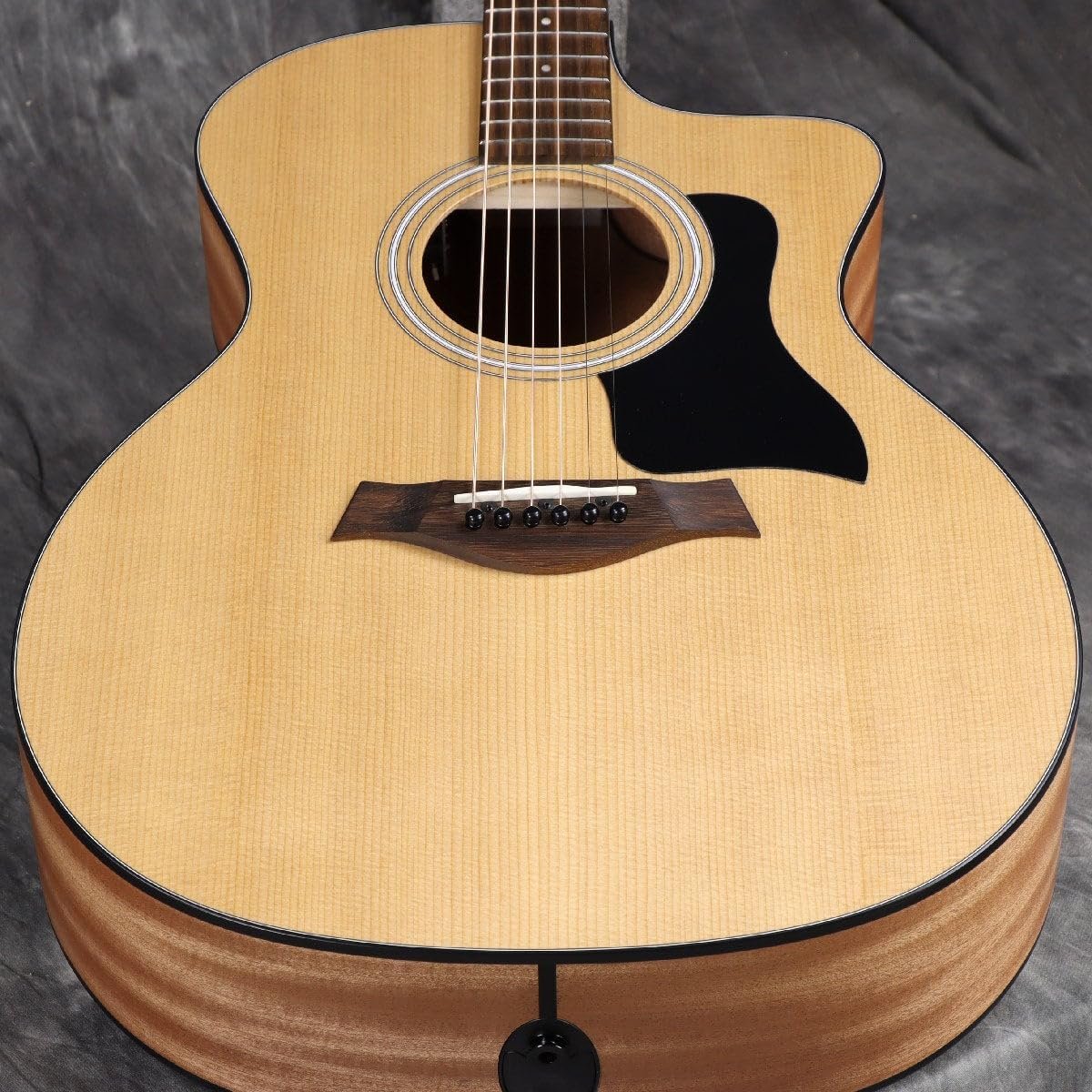
Taylor 114ce Grand Auditorium
As an Amazon Associate I earn from qualifying purchases.
The Taylor 114ce Grand Auditorium is built for players who want one acoustic-electric guitar that can handle a broad mix of strumming, fingerstyle work, practice, songwriting and plugged-in playing without feeling overly specialised.
Taylor’s current 114ce uses a solid torrefied spruce top, layered sapele back and sides, a Grand Auditorium body and a Venetian cutaway. It also includes Taylor’s Expression System 2 electronics, so it is ready to plug into an acoustic amplifier, PA or recording setup without adding an external pickup later.
Why the Grand Auditorium shape works
The Grand Auditorium is one of Taylor’s most versatile body shapes.
It sits between the compact feel of a smaller acoustic and the bigger physical presence of a dreadnought. That makes it easier to live with for long sessions while still providing enough body volume for strong strumming.
Taylor describes the shape as suitable for both fingerstyle and strumming, which is exactly why the 114ce works well as an all-purpose acoustic rather than a guitar aimed at one narrow style.
The Venetian cutaway also matters in practical use. It gives the fretting hand easier access to the upper part of the neck, which is useful for higher-register chords, melodic lines and lead playing.
Visually, the Natural finish keeps everything simple. The spruce top, black binding and understated three-ring rosette give the guitar a clean appearance without loading it with decorative details that distract from the wood.
What it feels like to play
Taylor uses a 25½-inch scale length and a 1 11/16-inch nut width on the current 114ce. The neck has the company’s Standard Carve profile with a matte finish.
That matte neck finish is an important physical detail. It should feel smoother and less glossy under the palm than a heavily polished neck, particularly when your hand warms up during a longer playing session.
Taylor also builds the guitar around its familiar slender-neck approach. The idea is to make fretting feel relaxed rather than forcing the player to wrestle with a bulky neck profile.
For someone moving from an electric guitar to acoustic, that can make the transition feel less abrupt.
The full-scale length still gives the strings a proper acoustic firmness, though. This is not a short-scale instrument with an especially loose feel, so bends and stretches will still have the resistance expected from a conventional steel-string acoustic.
Solid torrefied spruce on top
The top is one of the more interesting parts of the 114ce.
Taylor uses solid torrefied spruce, which has been heat treated through a controlled roasting process. Taylor says this treatment is intended to add warmth and a more played-in character while retaining the clarity, projection and balance associated with spruce.
Physically, spruce is light and responsive, which is one reason it appears on so many acoustic guitars. A solid top also matters because it forms one of the main vibrating surfaces of the instrument.
The back and sides are layered sapele rather than solid wood. That construction helps keep the guitar more stable and predictable while still giving the instrument the appearance and general character associated with sapele.
The combination makes sense for a guitar designed to be used rather than treated as something too precious to leave the house.
C-Class bracing and response
Taylor specifies C-Class bracing inside the current 114ce. The company says this bracing is intended to increase response, sustain, low-end presence and overall volume.
Bracing is easy to overlook because you cannot see most of it while playing, but it has a major influence on how an acoustic top moves.
A good acoustic should not feel as though you have to force sound out of it. The appeal of this design is that it aims to respond clearly whether the guitar is being picked lightly or driven harder with a plectrum.
That balance is useful for someone who moves between softer playing and full strumming within the same session.
Taylor Expression System 2 electronics
The Expression System 2, or ES2, is Taylor’s onboard pickup system.
Rather than placing the pickup directly underneath the saddle in the conventional way, Taylor positions the ES2 sensors behind the saddle. The aim is to capture more of the guitar’s movement and dynamics when it is amplified.
For practical use, the main advantage is convenience.
The 114ce can move from unplugged practice to an amplifier, PA or recording interface without adding an external microphone or separate pickup system.
That makes it particularly useful for singer-songwriters, church players, small gig performers and anyone who wants the same guitar to work at home and on stage.
The controls are kept discreet rather than dominating the body with a large digital panel, which preserves the clean acoustic appearance.
A guitar that can cover several jobs
The strongest case for the 114ce is versatility.
Its body is not so large that it feels cumbersome for fingerstyle playing, but it still has enough physical presence for strong rhythm work.
The cutaway supports higher-neck access, the ES2 electronics make amplification straightforward, and the gig bag means the guitar is already set up for transport.
Taylor currently includes a structured gig bag with the 114ce rather than leaving the buyer to source protection separately.
That makes the guitar particularly sensible for someone who wants one instrument to move between home, lessons, rehearsals and occasional performances.
The drawbacks
The first drawback is the layered back and sides.
The top is solid torrefied spruce, but the back and sides are layered sapele rather than solid wood.
That is not inherently a problem, and layered construction can be very practical, but players specifically looking for an all-solid acoustic should be aware of the distinction.
An all-solid instrument may appeal more to someone who places a high priority on traditional construction and long-term tonal development throughout the entire body.
The second consideration is the 25½-inch scale.
That full scale contributes to a firm, familiar acoustic response, but it also means the strings can feel noticeably tighter than on a shorter-scale guitar. Players with smaller hands or anyone who strongly prefers a softer, looser feel may need a little adjustment.
String gauge matters here too. Taylor supplies the guitar with .012–.053 light-gauge phosphor bronze strings, which is a sensible acoustic starting point, but even light acoustic strings generally feel more substantial than typical electric-guitar strings.
The Grand Auditorium body is versatile, but it is still a full-sized acoustic.
Someone who wants something extremely compact for travel, sofa playing or a very small frame may prefer a smaller Grand Concert or GS Mini-style instrument.
The matte finish is another preference issue.
It gives the guitar a clean, understated appearance and keeps the neck from feeling overly glossy, but players who love a deep, highly polished acoustic finish may find the visual presentation too restrained.
There is also the cutaway itself.
The Venetian cutaway is useful if you regularly play higher up the neck, but players who never venture beyond the lower and middle frets may simply not need it. A non-cutaway acoustic can offer a more traditional appearance and may appeal more to players who want the most conventional body shape possible.
The ES2 electronics are convenient, but plugged-in acoustic tone remains a matter of taste.
No pickup system sounds exactly like standing in front of the guitar and hearing the full acoustic body in the room. Players who record primarily in controlled studio conditions may still prefer microphones, either instead of the onboard system or alongside it.
There is also the question of simplicity.
The 114ce is built to cover a lot of situations, but that very versatility means it does not have the extreme personality of a highly specialised acoustic.
A player chasing a very deep dreadnought thump, a tiny parlour feel or a distinctly dry vintage voice may prefer an instrument designed more narrowly around that sound.
The structured gig bag is useful, but it is still a bag rather than a hard case.
For routine transport that may be perfectly adequate, but someone travelling frequently, flying with the guitar or carrying it around crowded venues may prefer the additional protection of a proper hard case.
Natural wood variation is another consideration.
The spruce top and layered sapele construction mean grain pattern and shade can vary slightly from one instrument to another. That is normal with wood, but someone expecting every example to look absolutely identical should keep that in mind.
And finally, setup remains important.
Even a well-built acoustic can arrive with action or neck relief that is not ideal for every player. Playing style, hand strength and preferred string gauge all affect what feels comfortable.
A professional setup can make a noticeable difference, particularly if the guitar is going to be used regularly rather than occasionally.
Those are not major faults, but they are the sort of practical details worth knowing before buying rather than after.
Who it suits best
The Taylor 114ce makes sense for someone who wants one dependable acoustic-electric to cover several roles.
It suits singer-songwriters, players who move between fingerpicking and strumming, guitarists who occasionally plug into a PA, and anyone who wants an acoustic that feels approachable without being stripped down.
It may also suit an electric guitarist looking for a first serious acoustic because the slender neck profile and cutaway make the transition less intimidating than some bulkier traditional designs.
Players who specifically want an all-solid body, a very small acoustic or a highly traditional non-cutaway guitar may prefer to look elsewhere.
Is it worth the acoustic guitar space?
The Taylor 114ce Grand Auditorium works because it is not trying too hard to be unusual.
The solid torrefied spruce top, layered sapele back and sides, Grand Auditorium body, C-Class bracing, Venetian cutaway and ES2 electronics all point towards versatility rather than one narrowly defined sound.
It is comfortable enough for everyday playing, practical enough for amplification and portable enough to move around in the included structured gig bag.
The trade-offs are clear: layered back and sides will not satisfy someone who insists on all-solid construction, the full scale can feel firm, and the gig bag is less protective than a hard case.
For a player who wants a clean, well-rounded acoustic-electric that can move between home, rehearsal and performance without becoming complicated, the Taylor 114ce has a very sensible balance of feel, construction and practicality.
For more acoustic guitars with different body styles and playing characteristics, explore our Acoustic Guitars guides on SwapStrings.
As an Amazon Associate I earn from qualifying purchases.