BOSS IR-2 Amp & Cabinet Pedal
As an Amazon Associate I earn from qualifying purchases.
The BOSS IR-2 Amp & Cabinet Pedal puts an entire selection of guitar amplifier sounds into a compact stompbox, giving guitarists a practical way to practise, record and perform without always relying on a conventional amplifier.
With 11 amplifier types, Celestion Digital cabinet simulations, stereo outputs and USB-C connectivity, the IR-2 offers considerably more flexibility than its modest dimensions suggest.
Its appeal is particularly clear for guitarists who already have a pedalboard but want the freedom to send their sound directly to a recording system, headphones or suitable live sound equipment.
Rather than replacing the experience of standing beside a loud guitar amplifier, the IR-2 provides an alternative approach built around convenience, consistent signal routing and detailed tone shaping.
For home musicians, recording enthusiasts and players working on quieter stages, that combination makes it an interesting piece of guitar equipment.
Why It Works for Modern Guitarists
Traditional guitar amplifiers remain an important part of making music, but they are not always practical.
A valve amplifier may produce its most satisfying sound at a volume unsuitable for a small home. Carrying a substantial combo to rehearsals can also become tiring, while recording a microphone in front of a speaker introduces additional complications.
The BOSS IR-2 addresses these situations by combining digital amplifier modelling with speaker cabinet simulation.
Instead of depending on a physical guitar speaker to shape the sound, the pedal uses digital processing to recreate the tonal characteristics of different amplifier and cabinet combinations.
This allows a guitarist to connect directly to compatible recording equipment or a live mixing system while retaining the character of an amplified guitar signal.
The compact design also means it can become part of an existing pedalboard rather than requiring an entirely new setup.
For players who want to travel with fewer pieces of equipment, or simply practise without disturbing the household, this approach has considerable appeal.
What It Feels Like to Use
One of the attractive qualities of the IR-2 is its familiar BOSS compact-pedal format.
The enclosure measures approximately 73mm wide, 129mm deep and 59mm high, making it easy to accommodate on most pedalboards.
At around 450g with its battery installed, it has a reassuringly substantial weight for such a small unit.
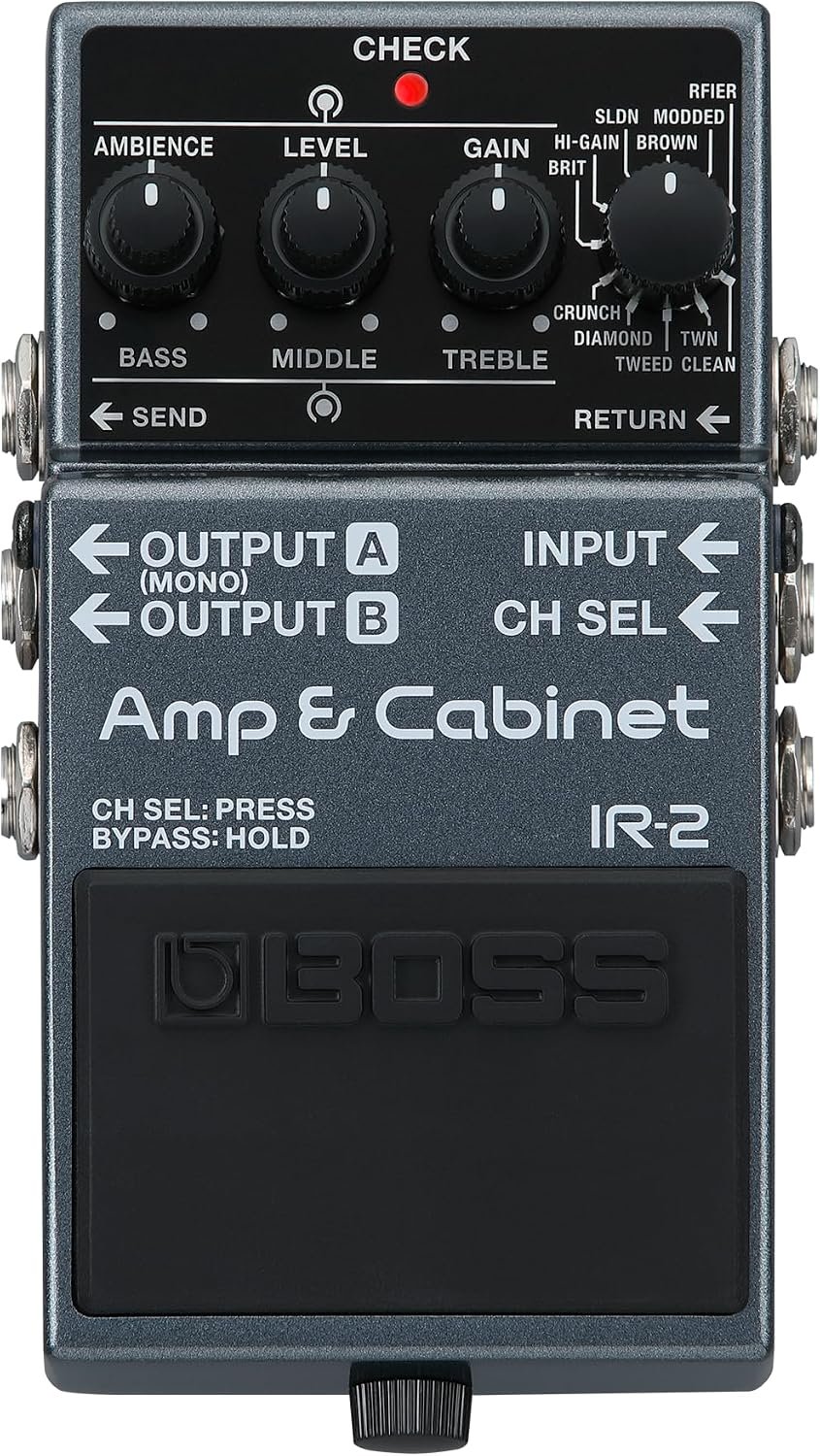
The familiar BOSS-style footswitch occupies the lower section, while the upper panel contains controls for Gain, Level, Bass, Middle, Treble and Ambience.
There is also a rotary selector for choosing the amplifier type.
Unlike many larger digital processors, the IR-2 does not require navigating through several menu screens to make ordinary tone adjustments.
Want more drive? Adjust the Gain control.
Need a brighter sound? Turn the Treble knob.
The controls follow the familiar layout of a traditional guitar amplifier, making the basic operation approachable for players accustomed to conventional equipment.
However, the IR-2 has two stored channels, and switching between them recalls saved settings. Consequently, the physical knob positions do not always represent the currently recalled sound.
That is worth understanding before using it onstage.
Eleven Amplifier Types for Different Playing Styles
The IR-2 includes 11 amplifier types, covering everything from clean sounds to heavily distorted modern guitar tones.
The CLEAN setting provides a straightforward starting point for players who want clarity and definition.
The TWN and TWEED models draw inspiration from familiar American amplifier designs, offering contrasting approaches to clean and overdriven sounds.
DIAMOND introduces British-style chime, while BRIT offers the character associated with classic British rock amplification.
For heavier playing, the HI-GAIN, BROWN, MODDED and RFIER selections provide progressively more aggressive possibilities.
There is also a CRUNCH setting designed for clear, driven guitar sounds and an SLDN model inspired by a well-known high-gain amplifier design.
This selection gives guitarists considerable scope without requiring an enormous preset library.
A player working on blues, classic rock, indie music or heavier styles can explore different amplifier characters from one pedal.
Importantly, the IR-2 is not limited to high-gain sounds. Its clean and moderately driven options make it useful for musicians who rely on subtle dynamics and the character of their guitar.
Celestion Cabinet Simulation and Impulse Responses
A guitar amplifier’s speaker cabinet contributes enormously to its finished sound.
The speaker’s frequency response, cabinet construction and microphone characteristics all influence what eventually reaches the listener.
The IR-2 uses cabinet impulse responses, commonly called IRs, to simulate these characteristics.
BOSS includes 11 Celestion Digital cabinet IRs, each paired with a corresponding amplifier type.
These provide ready-to-use combinations without requiring the player to understand the technical details of impulse response files.
For guitarists who enjoy creating their own sounds, the IR-2 also supports loading compatible third-party cabinet IRs using the dedicated BOSS IR Loader software for Mac and Windows.
The pedal has 11 user-loadable cabinet positions, corresponding to its factory cabinet slots.
This allows considerable experimentation, although loading custom IRs replaces the cabinet responses occupying those positions rather than adding an unlimited library.
The important benefit is flexibility.
A familiar amplifier model can take on a noticeably different tonal character when combined with another cabinet response.
For players interested in recording and tone development, this is one of the IR-2’s most useful features.
Quiet Practice Without a Traditional Amplifier
Not every guitar session needs to involve a loud speaker.
The IR-2 includes a dedicated headphone connection, allowing players to practise using its amplifier and cabinet simulations without running a conventional guitar amplifier.
This makes it particularly useful for late-night playing, shared accommodation and home environments where volume needs to remain controlled.
The built-in Ambience control adds a sense of space to the sound.
Instead of listening to an excessively dry, close-up guitar signal, players can introduce a more spacious character that may make headphone practice more enjoyable.
USB-C connectivity also supports audio playback from compatible computers and mobile devices.
This allows players to practise alongside backing tracks, recorded songs or instructional material while monitoring through the pedal.
For someone learning songs or developing new musical ideas, the ability to keep the same amplifier sounds available for both practice and recording is particularly convenient.
Home Recording and Direct Performance
The IR-2 can operate as a USB audio interface, sending its processed guitar sound directly to compatible recording software.
This reduces the need for a separate guitar amplifier, microphone and associated recording setup.
Its digital processing operates at a 96kHz sampling rate with 32-bit floating-point internal processing.
These specifications support BOSS’s approach to detailed amplifier and cabinet simulation, although the finished sound still depends on the chosen settings and monitoring equipment.
The pedal also includes conventional stereo outputs for connecting to appropriate external audio equipment.
For live performance, this makes it possible to send a consistent amplifier-and-cabinet signal to a suitable mixing system.
However, the sound heard through stage monitors or a PA system will still depend on their quality and the overall sound setup.
The IR-2 is therefore especially appealing to guitarists who want a compact direct-performance arrangement rather than transporting a conventional amplifier to every engagement.
Integrating the IR-2 With Other Pedals
The IR-2 is designed to work alongside existing guitar effects.
Overdrive, boost and similar pedals can be connected before its input, allowing them to influence the simulated amplifier in a familiar way.
A dedicated send-and-return effects loop provides another connection option.
This is particularly useful for placing modulation, delay and reverb effects after the amplifier simulation rather than before it.
The return connection also supports stereo effects, allowing compatible pedals to feed the IR-2’s stereo outputs.
The amplifier and cabinet sections can be switched off independently, adding flexibility when integrating the unit with other equipment.
For guitarists who already have a collection of pedals, these connections make the IR-2 more adaptable than a basic cabinet simulator.
The Drawbacks
The BOSS IR-2 offers an impressive selection of features, but its compact size and straightforward control layout introduce several limitations.
These are particularly important for guitarists considering it as their main amplification solution.
Only Two Immediately Available Channels
Despite offering 11 amplifier types, the IR-2 provides just two stored channels for immediate switching during a performance.
Each channel can hold its own settings, making it convenient to prepare a clean sound and a driven alternative.
However, guitarists who regularly switch between several distinct sounds may find this restrictive.
A player needing separate clean, crunch, rhythm and lead settings cannot recall all four through dedicated onboard presets.
The IR-2 is therefore less flexible for complex live arrangements than a larger multi-effects processor with extensive patch storage.
Its two-channel arrangement works best when the guitarist can organise a performance around a relatively small number of core sounds.
The Footswitch Works Differently From a Conventional Pedal
Many guitarists expect pressing a compact pedal’s main switch to engage or bypass an effect.
The IR-2 uses its primary footswitch to change between the green and red channels.
This is convenient when moving between two prepared amplifier sounds, but it requires a different approach from a traditional distortion or modulation pedal.
Additional control options are available through compatible external footswitches, although these require extra equipment and pedalboard space.
For players accustomed to simple on/off operation, learning the channel arrangement is important.
No Built-In Speaker or Power Amplifier
Although the IR-2 reproduces amplifier sounds, it is not a conventional guitar amplifier.
It cannot produce audible sound independently.
The pedal needs headphones or suitable external amplification and monitoring equipment.
Connecting it directly to an ordinary passive speaker cabinet will not provide the power required to drive that speaker.
This distinction matters for anyone expecting to replace a complete guitar combo with a single compact pedal.
The IR-2 provides the signal processing, but the appropriate listening or amplification equipment remains essential.
For headphone users and musicians with existing recording monitors, that may be perfectly acceptable.
For others, it means additional equipment will be necessary.
Digital Modelling Will Not Suit Every Player
The IR-2 offers amplifier sounds inspired by traditional valve equipment, but digital modelling does not automatically reproduce every physical characteristic of a conventional valve amplifier and loudspeaker.
Some guitarists particularly enjoy the interaction between a valve amplifier, its speaker and the surrounding room.
The movement of air from a substantial guitar cabinet and the response of an amplifier being driven hard are part of that experience.
Listening through headphones or studio monitors creates a different playing environment.
The IR-2 provides considerable flexibility, but players specifically seeking the physical response of a traditional amplifier may prefer to retain their existing equipment.
Custom Cabinet IRs Require a Computer
The included Celestion cabinet simulations make the IR-2 usable immediately.
However, loading custom impulse responses requires the dedicated BOSS IR Loader software on a compatible Mac or Windows computer.
This is less convenient than equipment that allows extensive cabinet editing directly from its front panel.
There is also a limit of 11 cabinet IR slots, meaning players who enjoy maintaining large libraries of cabinet responses must manage their selections.
For someone who prefers straightforward equipment, the factory cabinet simulations may provide more than enough variety.
Players who constantly experiment with different impulse responses may prefer a processor with greater onboard storage and editing flexibility.
Battery Operation Is Limited
The IR-2 accepts a conventional 9V alkaline battery, but BOSS estimates approximately 3.5 hours of continuous operation under specified conditions.
Using the headphone connection or USB interface can increase battery consumption.
For occasional use, this provides a convenient option.
However, it is not particularly attractive for extended recording sessions, rehearsals or regular performances.
A compatible BOSS PSA-series power adapter is available separately.
For a permanent pedalboard arrangement, an appropriate external power supply is the more practical solution.
Buyers should also remember that the USB-C connection is provided for audio and data functions, not as a substitute for the specified pedal power supply.
Small Controls Can Be Awkward onstage
The familiar amplifier-style controls are an advantage when setting up sounds at home.
However, the compact dimensions mean the knobs are relatively close together.
Making precise adjustments while standing on a dark stage is unlikely to be as convenient as changing settings on a larger amplifier.
There is also no large display showing the active preset’s complete settings.
Because each channel recalls its saved configuration, the visible knob positions may not match the sound currently being heard.
This is manageable once understood, but it can create confusion when making quick adjustments during a performance.
More Equipment May Still Be Needed
The IR-2 can simplify a guitar rig, but the final arrangement depends on the intended use.
Live performers may still require suitable monitoring, cabling and external sound equipment.
Home recording users need compatible software and a suitable computer or mobile device.
Guitarists wanting multiple instant sounds may also need external switching equipment.
The pedal is best understood as a versatile component within a complete guitar setup rather than a replacement for every piece of equipment normally associated with amplification.
Its greatest advantage comes when the guitarist already has, or intends to build, a system that benefits from direct amplifier and cabinet simulation.
Who It Suits Best
The BOSS IR-2 is particularly well suited to guitarists who want a compact solution for practising, recording and performing with consistent amplifier sounds.
Home musicians using headphones or recording software will appreciate the direct connection options.
Players with existing pedalboards can use its amplifier and cabinet simulations without abandoning their favourite overdrive, modulation or delay pedals.
It also makes sense for guitarists working in environments where conventional amplifier volume is impractical.
However, musicians who need numerous instantly accessible presets may prefer a more comprehensive processor.
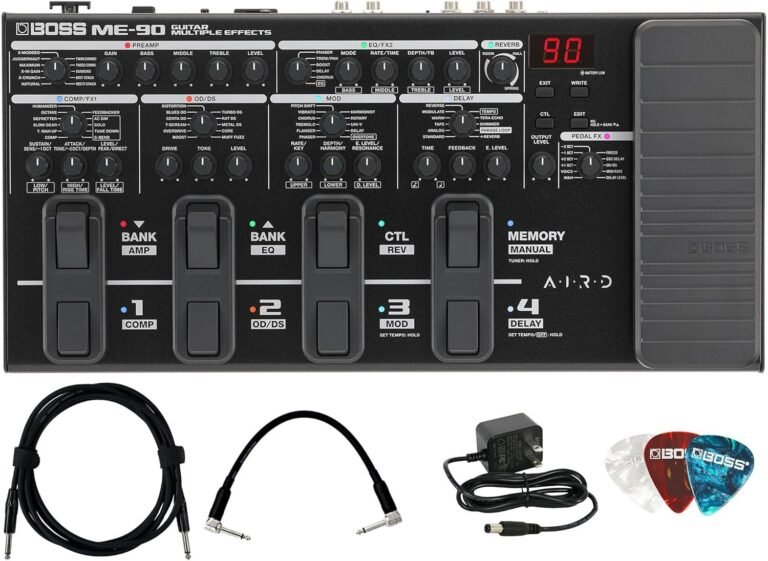
For example, our BOSS ME-90 Multi-Effects Pedal article explores a larger unit with extensive effects and more direct foot control.
The IR-2 is most appealing when compact dimensions, straightforward amplifier controls and flexible connections matter more than an enormous library of switching options.
Is the BOSS IR-2 Worth the Pedalboard Space?
The BOSS IR-2 offers a thoughtful approach to modern guitar amplification.
Its combination of 11 amplifier types, Celestion cabinet simulations, stereo connectivity and USB-C recording provides useful flexibility within a familiar compact-pedal design.
The hands-on controls make ordinary sound adjustments straightforward, while the effects loop allows it to integrate with existing guitar equipment.
Its two-channel limitation, relatively short battery life and dependence on suitable external monitoring equipment are genuine compromises.
Nevertheless, for guitarists who want their amplifier sounds available at home, in the recording room or through a suitable live sound system, the IR-2 offers a practical and well-considered solution.
It does not need to replace every traditional amplifier to earn its place.
For many players, its value lies in making good guitar sounds accessible in situations where carrying or using a conventional amplifier is inconvenient.
Explore more carefully selected equipment in our Effects & Pedals collection.
As an Amazon Associate I earn from qualifying purchases.