D’Addario XPND 1 Expandable Pedalboard
As an Amazon Associate I earn from qualifying purchases.
A guitarist’s pedal collection rarely stays exactly the same. One new overdrive leads to a delay, perhaps a tuner, and before long the carefully arranged effects setup has run out of space.
The D’Addario XPND 1 Expandable Pedalboard offers a practical alternative to replacing your board whenever your collection grows.
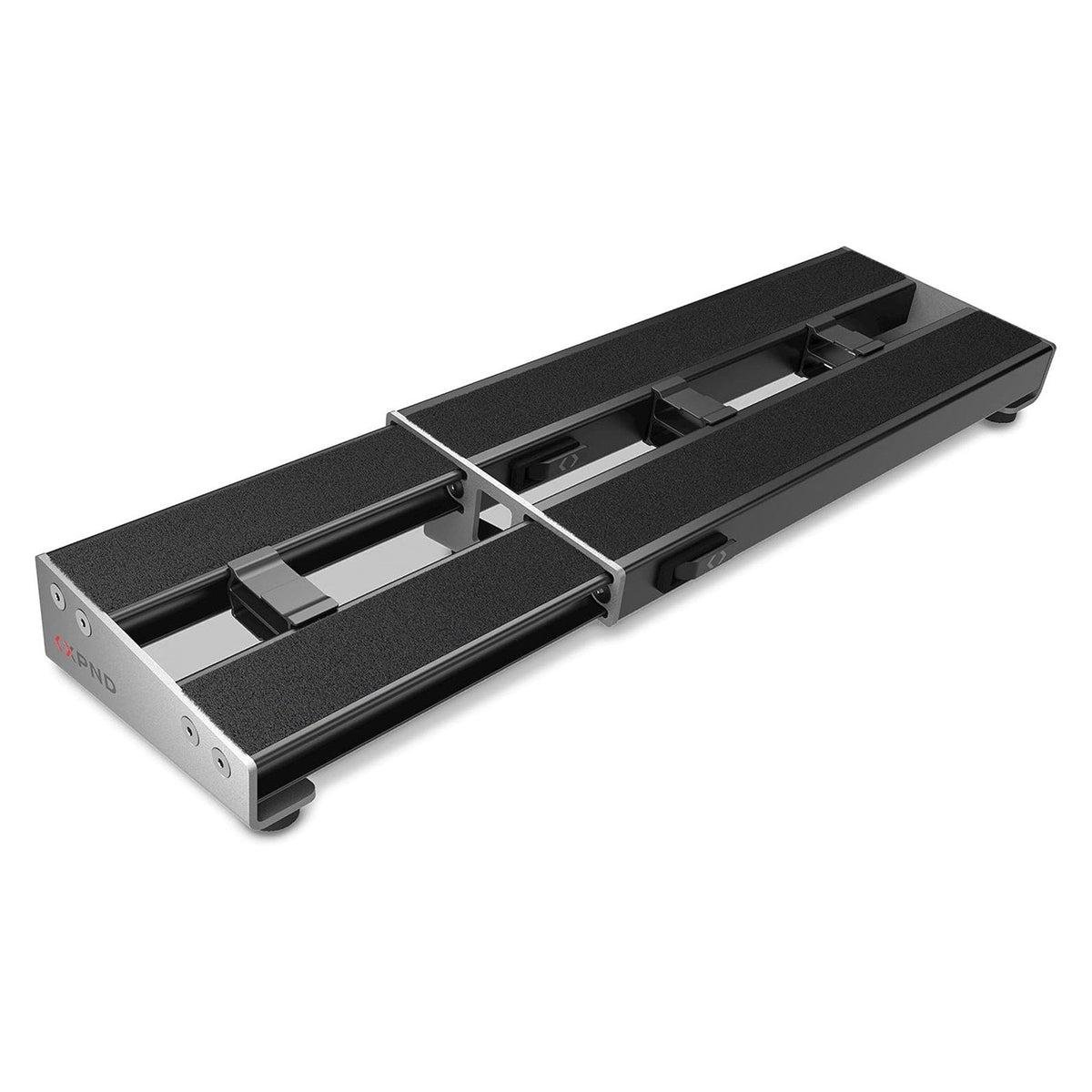
Its clever telescoping aluminium frame expands from approximately 14 to 24 inches, allowing you to adjust the available space around the pedals you actually use.
With integrated cable management, pre-applied hook-and-loop material and a compact single-row layout, the XPND 1 is designed for guitarists who appreciate an organised setup without unnecessary bulk.
A Pedalboard That Grows With Your Music
The defining attraction of the D’Addario XPND 1 is its patented telescoping construction.
Most traditional pedalboards have fixed dimensions. Once the available space is filled, accommodating another pedal can mean rearranging everything or purchasing a larger board.
The XPND 1 approaches the problem differently.
Its adjustable frame allows the playing surface to extend or retract according to the amount of equipment required.
At its smallest setting, the board provides a compact platform for a modest collection of essential effects.
Extend it towards its maximum length, and there is room for a more substantial selection of conventional stompboxes.
This flexibility is particularly useful for players whose equipment changes between rehearsals, recording sessions and live performances.
Rather than carrying a large, partly empty pedalboard everywhere, you can arrange the XPND 1 around the equipment needed for a particular setup.
The result is a design that accommodates changing musical requirements without demanding a completely new foundation.
Strong Aluminium Construction
D’Addario builds the XPND 1 around an aluminium frame intended to withstand the demands of regular musical use.
Aluminium offers a practical combination of strength and manageable weight, making it especially appropriate for equipment that may travel between home, rehearsals and performances.
The frame has a purposeful, understated appearance, with dark metal rails that allow the pedals themselves to remain the visual focus.
Its single-row design measures approximately 5.85 inches from front to back, helping keep the overall arrangement relatively compact.
The board weighs around 1.5kg before pedals and accessories are added.
For guitarists who appreciate a straightforward physical layout, the XPND 1 has considerable appeal.
There are no unnecessary electronics or complicated control systems built into the board itself. It provides a sturdy platform on which the guitarist can develop a personal effects arrangement.
Keeping Your Pedals Secure and Organised
A good pedalboard needs to do more than provide somewhere to place effects.
Pedals should remain appropriately secured during use, while their connections need to be arranged so that cables do not become unnecessarily tangled.
The XPND 1 arrives with loop Velcro already fitted to its rails.
Compatible hook material can then be attached to the underside of the pedals, allowing them to be positioned and rearranged.
This saves some of the preparation normally involved in building a pedalboard from scratch.
D’Addario also incorporates a cable management arrangement, including clips that help guide cables between the rails.
Keeping patch leads organised can make a pedalboard easier to maintain and more convenient to transport.
It can also reduce the likelihood of loose cables interfering with footswitches or neighbouring controls.
For example, a precision tuner such as the Peterson StroboStomp HD Tuner can occupy a permanent position within the signal chain, while other effects are rearranged around it as musical requirements change.
Build a Pedal Collection Around Your Sound
The XPND 1 is particularly appealing because it does not dictate which effects a guitarist should use.
A blues player might prefer a tuner, overdrive, delay and boost.
Someone exploring ambient music might choose reverb, modulation and several delay effects instead.
The adjustable platform allows these different approaches to share the same basic pedalboard design.
Consider a traditional analogue effect such as the MXR M169 Carbon Copy Analog Delay Pedal.
Its compact stompbox enclosure makes it a natural candidate for an organised single-row setup.
As new effects are introduced, the XPND 1 can provide additional room without requiring an entirely different board.
The arrangement also encourages players to think carefully about pedal order, power connections and how frequently each effect is used.
A well-organised pedalboard is not necessarily the one containing the greatest number of pedals. It is the one that makes the sounds you want readily accessible.
Practical for Home, Studio and Stage
One of the advantages of a compact pedalboard is having a consistent arrangement wherever the guitar is played.
At home, pedals can remain connected and organised instead of being scattered across the floor.
For rehearsals, the same board can be transported and positioned near the amplifier.
In a recording environment, having the signal chain prepared makes it easier to concentrate on playing rather than reconnecting equipment.
The XPND 1’s adjustable construction is particularly interesting for musicians who use different pedal combinations for different projects.
A modest effects selection may require little space, while a more elaborate live arrangement can take advantage of the extended frame.
The board can also accommodate suitable pedal-format equipment beyond conventional sound effects.
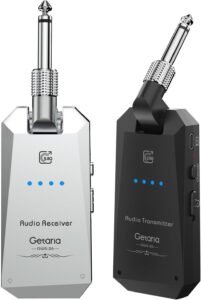
For instance, the Shure GLXD16+ Digital Wireless Guitar Pedal System illustrates how wireless receivers and tuning equipment can become part of an organised floor-based guitar setup.
The XPND 1 gives players the flexibility to plan around that equipment rather than relying on loose components scattered beside an amplifier.
The Drawbacks
Although the D’Addario XPND 1 offers an appealing solution to expanding pedal collections, its single-row construction creates some important limitations.
The single-row design restricts pedal arrangements.
The XPND 1 is built around one row of effects.
This makes it compact, but it also means that pedals must generally sit alongside one another rather than occupying multiple rows.
Guitarists with large collections may discover that even the fully extended board cannot accommodate everything comfortably.
Pedals with unusually wide enclosures, expression controls or awkward connector positions can consume more space than their appearance initially suggests.
Players who already own a substantial collection should measure their equipment before deciding that the XPND 1 provides enough room.
D’Addario’s larger XPND 2 may be more appropriate for those requiring two rows.
Expansion does not create unlimited space.
The telescoping mechanism allows the board to grow from approximately 14 to 24 inches, but that remains a defined maximum.
A guitarist who continually adds effects may eventually exceed the available capacity.
The XPND 1 therefore postpones the need for a larger pedalboard rather than eliminating that possibility altogether.
It makes the most sense for players expecting a relatively compact collection.
Power supply placement requires planning.
This is one of the more significant practical considerations.
There is limited clearance beneath the XPND 1, so not every pedalboard power supply will fit underneath.
D’Addario identifies certain compact models as compatible, but larger power units may require alternative positioning.
Mounting a power supply on top of the board uses space that would otherwise accommodate another pedal.
Before purchasing, guitarists should check the dimensions of their existing power equipment and decide how everything will connect.
The pedalboard does not include a power supply.
A carrying bag is another consideration.
The aluminium frame is designed for portability, but a protective transport bag is not included with the standard board.
Musicians regularly travelling to rehearsals or performances should consider how they intend to carry it.
D’Addario offers compatible transport accessories separately.
Without appropriate protection, the pedals, knobs and cables remain exposed to accidental knocks during transportation.
The compact format is convenient, but it does not remove the need for sensible equipment protection.
The adjustable frame still needs arranging.
Although the telescoping construction provides flexibility, changing the board’s length does not automatically reorganise the attached pedals.
Patch cables and power leads must still have sufficient slack to accommodate the intended arrangement.
If everything is wired tightly together, extending the board may require additional cable adjustments.
Pedals may also need repositioning as the available space changes.
For players who use one fixed setup every day, these adjustments may provide little practical benefit over a conventional board.
Large expression pedals can be awkward.
Wah pedals and full-sized expression pedals often occupy substantially more space than conventional effects.
Their physical dimensions and operating movements can make them less convenient on a narrow single-row platform.
The guitarist must also consider whether adjacent pedals interfere with comfortable foot movement.
Anyone relying heavily on larger control pedals should check the available dimensions carefully.
A wider board may provide a more natural arrangement.
Velcro attachment requires preparation.
The pre-applied loop material is convenient, but the pedals still need compatible hook fastening material fitted to their undersides.
Some pedal finishes, labels, rubber feet and battery compartments can complicate attachment.
Guitarists who frequently change equipment may also prefer removable mounting solutions that leave fewer adhesive residues.
The supplied system offers flexibility, but it is not completely preparation-free.
The board adds weight to your complete rig.
At approximately 1.5kg before accessories, the aluminium frame is reasonably manageable.
However, the finished pedalboard’s weight depends heavily on the pedals, power supply and cables installed.
A collection of substantial metal stompboxes can quickly create a heavier arrangement than expected.
The XPND 1 should therefore be considered as part of the complete equipment load rather than judged by its empty weight alone.
Not everyone needs an expandable board.
Finally, some guitarists know exactly which pedals they want and rarely change their setup.
For those players, a fixed pedalboard of appropriate dimensions may be perfectly sufficient.
The XPND 1’s distinctive advantage is adaptability.
If that feature will rarely be used, its adjustable construction may offer less practical value.
These drawbacks are worth understanding because the XPND 1 is designed around a particular type of guitarist: someone who values compact organisation and expects their effects collection to change over time.
Who Will Appreciate the D’Addario XPND 1?
The XPND 1 is especially well suited to guitarists building their first serious pedalboard.
Starting with a few essential effects and gradually adding others becomes easier when the board can accommodate modest growth.
It should also appeal to experienced musicians who maintain a compact collection but change their arrangements depending on the music they are playing.
Home players may appreciate the tidier floor space, while rehearsing and performing musicians can benefit from having their equipment organised on one portable platform.
Bass guitarists using conventional effects pedals can also make use of the design.
For other equipment ideas, explore our Guitar Gear guides, where we look at useful accessories that help musicians build more practical setups.
Is the D’Addario XPND 1 Worth Buying?
The D’Addario XPND 1 Expandable Pedalboard offers a thoughtful answer to a familiar problem: a pedal collection that gradually outgrows its available space.
Its telescoping aluminium frame, integrated cable management and pre-applied mounting material provide a flexible foundation for an organised effects setup.
The adjustable design is particularly appealing to musicians who prefer a compact board but want room for additional pedals in the future.
It is not the ideal choice for everyone. The narrow single-row layout, limited power-supply clearance and need for separate transport protection are genuine considerations.
However, for guitarists who want a tidy, adaptable pedalboard without immediately committing to a large two-row system, the XPND 1 deserves serious consideration.
It provides something that many conventional boards cannot: the freedom to adapt your equipment arrangement as your musical interests develop.
As an Amazon Associate I earn from qualifying purchases.