Squier Classic Vibe Bass VI
As an Amazon Associate I earn from qualifying purchases.
Imagine an instrument that looks remarkably like an offset electric guitar, uses six strings and familiar guitar chord shapes, yet produces notes an entire octave lower than standard guitar tuning.
That’s the unusual appeal of the Squier Classic Vibe Bass VI.
With its 30-inch scale, three single-coil pickups and vintage-style vibrato bridge, the Bass VI occupies a fascinating space between conventional electric guitars and basses.
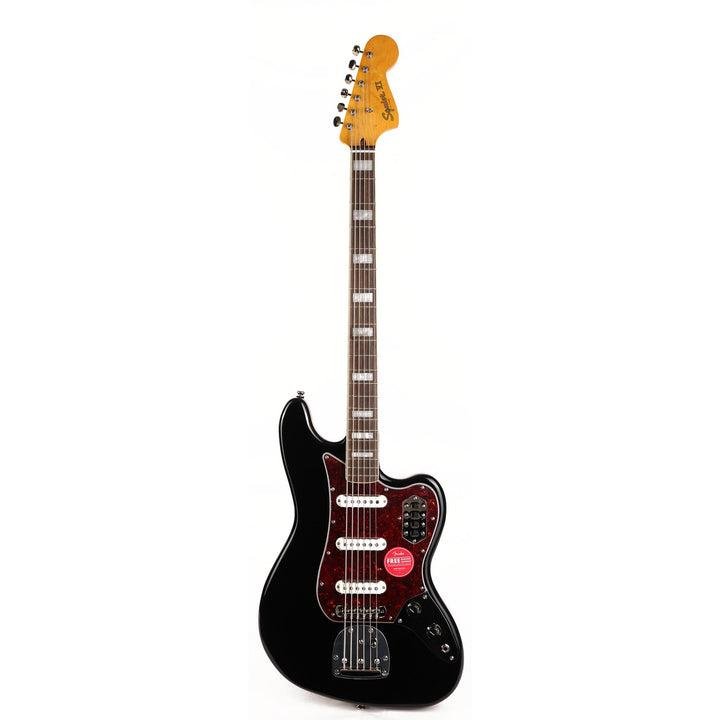
Finished in black with a tortoiseshell pickguard and laurel fingerboard, it has unmistakable 1960s-inspired styling. More importantly, it provides a different approach to songwriting, low-register melodies and recording.
However, its specialised tuning, longer scale and distinctive hardware require careful consideration.
Six Strings With a Different Musical Purpose
The Bass VI uses the same basic E–A–D–G–B–E string arrangement as a standard guitar, but every string is tuned one octave lower.
This allows guitarists to transfer familiar chord shapes and scale patterns into a much deeper register.
Unlike a conventional four-string bass, the instrument also provides two additional high strings, opening possibilities for chords, melodic passages and unusual layered arrangements.
The 30-inch scale is shorter than many standard electric basses but substantially longer than an ordinary electric guitar.
Its slim C-shaped maple neck, 9.5-inch-radius Indian laurel fingerboard and 21 narrow-tall frets provide a familiar Fender-style foundation.
The black gloss body, pearloid block inlays and vintage-tinted neck create a distinctive appearance without excessive decoration.
It’s an instrument designed for musicians interested in exploring different musical roles rather than simply replacing a traditional bass.
Three Pickups and Unusual Switching
The Bass VI features three Fender-designed alnico single-coil pickups.
Each pickup has an individual on/off slide switch, allowing several combinations rather than the usual three- or five-position selector arrangement.
There are also master volume and tone controls.
A fourth slide switch activates the bass-cut circuit, traditionally known as the Strangle switch.
This reduces low-frequency content, providing a thinner, more guitar-like response that can help melodic lines stand out.
The combination of three pickups and bass-cut switching offers a wide variety of tonal starting points.
For comparison, our Ibanez SR300E Bass guide explores a more conventional four-string instrument with active equalisation and dual pickups.
The Bass VI offers a different form of flexibility, emphasising pickup combinations and musical register rather than extensive onboard EQ.
What You Should Know Before Buying
It isn’t a conventional electric bass
Although its tuning reaches the familiar low E of a standard bass, the Bass VI feels and responds differently.
Its six-string layout encourages guitar-like fingering, while the closer string spacing can make traditional fingerstyle bass techniques less comfortable for some musicians.
Players accustomed to widely spaced four-string basses may initially struggle with accuracy.
The additional strings also require more careful muting, particularly when playing low-register single-note lines.
A conventional four-string bass remains a more straightforward choice for many rhythm-section duties.
For players who prefer that simplicity, the Squier Debut Precision Bass offers a familiar passive pickup arrangement and uncomplicated controls.
The 30-inch scale takes adjustment
Guitarists moving to the Bass VI will immediately notice the longer neck.
The distance between frets is greater than on a conventional electric guitar, particularly towards the lower positions.
Chords involving wide stretches may feel demanding, even though the string arrangement is familiar.
The instrument also occupies more physical space when played seated or standing.
Its slim C-shaped neck helps keep the playing experience approachable, but it cannot eliminate the extra reach required by the longer scale.
For musicians specifically seeking compact proportions, our Kala Wanderer U-Bass guide covers a dramatically shorter alternative.
Low-register chords need careful voicing
One of the Bass VI’s attractions is the ability to play familiar guitar chord shapes an octave lower.
However, simply moving ordinary six-string chords into the bass register can produce a muddy or indistinct result.
Low-frequency notes occupy considerable sonic space, and closely grouped intervals may compete with one another.
Open chord shapes that sound clear on a standard guitar can become overwhelming through bass amplification.
Players may obtain more useful results by choosing smaller chord voicings, omitting certain notes or concentrating on melodic arrangements.
The Bass VI rewards experimentation, but it doesn’t automatically make every familiar guitar technique effective in its lower register.
The vintage-style bridge requires attention
The Classic Vibe Bass VI uses a six-saddle floating bridge with a non-locking vibrato system.
This contributes to the instrument’s traditional appearance and allows subtle pitch movement.
However, it introduces additional setup considerations compared with a simple fixed bridge.
Bridge positioning, string height, intonation and vibrato adjustment all affect playing stability.
Changes to string gauge or tuning may require further adjustments.
Players who prefer uncomplicated string changes and minimal hardware maintenance may find a fixed-bridge instrument more convenient.
String selection is specialised
Fender supplies the Bass VI with a .024–.084 string set.
These strings are specifically suited to its longer scale and unusually low six-string tuning.
Ordinary electric guitar strings are not appropriate replacements, while standard four-string bass sets cannot provide the required six-string arrangement.
Replacement strings must be suitable for the instrument’s scale length, bridge and tuning.
The lowest string’s tension and clarity are particularly important.
Some players may prefer a different gauge to achieve their desired response, but changing gauges can affect nut clearance, intonation and overall setup.
This is worth considering before experimenting with alternative tunings.
The pickups can introduce noise
The three alnico pickups are conventional single-coil designs.
They provide familiar clarity and a distinctive vintage-style response, but single-coil pickups can pick up electromagnetic interference.
Electrical equipment, certain lighting systems and unsuitable recording environments may introduce unwanted hum.
Pickup combinations can affect noise behaviour, but buyers should not assume that every setting is completely silent.
The Bass VI doesn’t provide the same inherent noise rejection as a conventional humbucking pickup arrangement.
Musicians recording in electrically noisy environments may need to consider shielding, equipment positioning and appropriate noise-management techniques.
Amplification needs careful consideration
The Bass VI operates in a much lower frequency range than a standard guitar.
Although guitar amplifiers may produce interesting creative sounds, they aren’t necessarily designed to reproduce powerful bass frequencies at high volume.
Using unsuitable speakers with excessive low-frequency output can create distortion or potentially damage equipment.
A capable bass amplifier or appropriate recording system is generally the more sensible starting point for clean low-register reproduction.
The bass-cut switch can help reduce low-frequency weight for selected sounds, but it doesn’t transform the instrument into an ordinary six-string guitar.
The gloss neck finish may not suit everyone
Squier uses a vintage-tinted gloss urethane finish on the maple neck.
This gives the instrument its traditional appearance, but some players prefer the drier sensation of satin-finished necks.
A gloss finish can feel noticeably different beneath the fretting hand, particularly during warm or humid playing conditions.
Fingerboard comfort, neck shape and playing technique remain personal considerations.
The published dimensions provide useful guidance, but they cannot guarantee that every musician will enjoy the physical feel.
Protective transport equipment is separate
Fender’s published specification does not include a case or gig bag with this model.
Its longer neck and unusual dimensions make case compatibility particularly important.
Buyers should check the recommended Bass VI-compatible carrying options rather than assume that an ordinary electric guitar bag will fit.
Anyone planning rehearsals, lessons or regular transport should account for suitable protection.
Who Should Probably Avoid This Product?
Beginners seeking a straightforward first bass may find a conventional four-string easier to understand and maintain.
Guitarists who want to play familiar chords without changing their technique should recognise that low-register voicing requires adjustment.
Players who dislike floating bridges, specialised strings or more involved setup work may prefer simpler hardware.
The Bass VI is also less appropriate for musicians who require the exact string spacing, physical response and established playing conventions of a standard electric bass.
Its appeal comes from being different, not from replacing every other instrument.
Who Will Benefit Most?
The Classic Vibe Bass VI is particularly interesting for songwriters, experimental guitarists and musicians working in home studios.
Its extended low register can create distinctive melodies, layered arrangements and unusual rhythmic textures.
Guitarists exploring bass parts may appreciate the familiar six-string layout, while experienced bassists can investigate chord voicings and melodic approaches unavailable on their usual instruments.
The pickup combinations and bass-cut circuit provide additional creative choices.
For musicians curious about different bass formats, our Bass Guitars guides explore instruments with a variety of scales, electronics and playing characteristics.
A Different Way to Explore the Low End
The Squier Classic Vibe Bass VI combines vintage styling with an unusual musical purpose.
Its octave-down tuning, six-string arrangement and flexible pickup switching make it particularly attractive for creative recording and experimental playing.
The longer scale, specialised strings, floating bridge and need for careful low-register technique are meaningful compromises.
For musicians willing to explore those differences, however, the Bass VI offers a distinctive instrument capable of adding an entirely different character to guitar and bass arrangements.
As an Amazon Associate I earn from qualifying purchases.
Opens Amazon (paid link)