Sterling StingRay RAY4 Bass
As an Amazon Associate I earn from qualifying purchases.
Few bass designs are as instantly recognisable as the StingRay. Its distinctive body, large humbucking pickup and punchy tonal character have made it a familiar sight in everything from rock and funk to pop and alternative music.
The Sterling by Music Man StingRay RAY4 brings that classic approach to a straightforward four-string instrument, combining a solid basswood body, hard maple neck and active electronics.
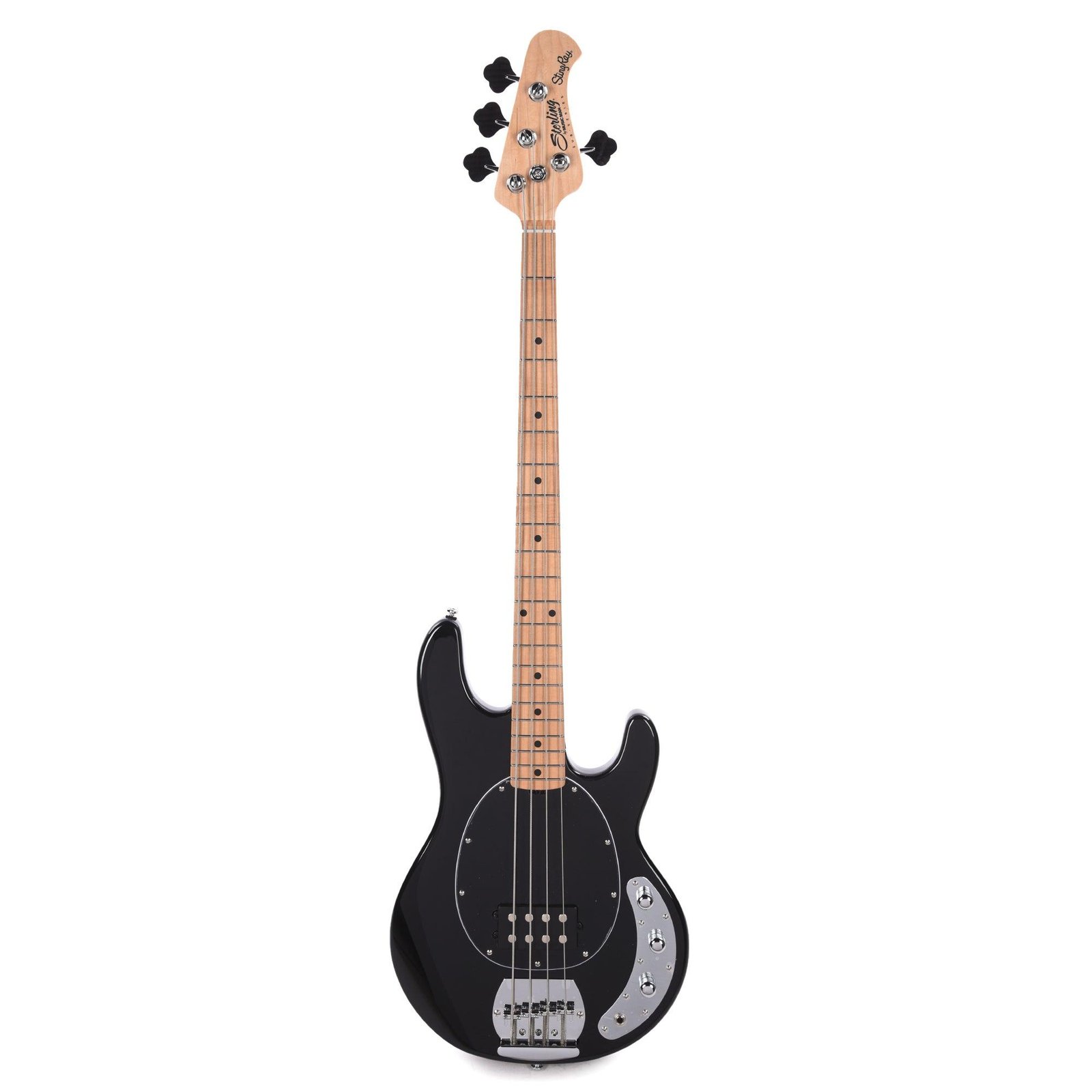
Finished in black with a matching pickguard and maple fingerboard, the RAY4 has a clean, purposeful appearance. More importantly, it offers the characteristic single-humbucker StingRay layout without overwhelming players with complicated controls.
There are compromises, particularly concerning tonal flexibility, battery dependence and the full-size neck. Understanding those details is essential when choosing a bass intended to be played for years rather than purchased on impulse.
The Familiar StingRay Character
The RAY4 uses a single ceramic humbucking pickup positioned towards the bridge, providing a distinctive tonal foundation.
This configuration is associated with a firm attack, pronounced note definition and substantial low-frequency presence.
The ceramic pickup feeds a two-band active preamp, allowing players to adjust bass and treble directly from the instrument.
For fingerstyle playing, the controls can help produce a rounded foundation with enough definition for individual notes to remain clear.
Players using a pick may appreciate the more pronounced attack and focused character.
The RAY4 can also suit slap techniques, where the combination of low-frequency weight and upper-frequency detail helps emphasise rhythmic playing.
Its actual sound will depend on the amplifier, strings, technique and equaliser settings. The important attraction is a recognisable tonal identity rather than an endless selection of pickup combinations.
For musicians wanting considerably more onboard flexibility, our Ibanez SR300E Bass guide explores an instrument with two pickups, three-band EQ and additional switching options.
A Traditional Full-Scale Playing Experience
The RAY4 has a 34-inch scale length, the familiar standard for many conventional electric basses.
Its hard maple neck attaches to the basswood body using a six-bolt arrangement. The maple fingerboard carries 21 medium frets, while the neck features a 9.5-inch radius.
At the nut, the neck measures approximately 38mm wide.
That relatively narrow measurement may appeal to guitarists moving onto bass or existing players who prefer a less substantial neck beneath their fretting hand.
The full-scale design retains conventional fret spacing and string tension, making the instrument familiar to bassists accustomed to traditional four-string instruments.
Its black finish, black pickguard and maple neck create an understated contrast without distracting from the instrument’s classic proportions.
The fixed bridge includes adjustable saddles for setting string height and intonation, while open-gear tuning machines provide a traditional appearance.
These are practical features, but the quality of the final setup remains important.
What You Should Know Before Buying
The single pickup limits tonal variety
The RAY4’s signature pickup arrangement is both its main attraction and one of its limitations.
A single humbucker provides a focused starting point, but it cannot reproduce every sound available from a bass with separate neck and bridge pickups.
There is no pickup selector or blending control for moving between different pickup positions.
The active EQ can increase or reduce bass and treble, but it cannot change the physical location of the pickup.
Players seeking particularly rounded neck-pickup sounds or the characteristic combinations available from a Jazz-style bass may find the arrangement restrictive.
The RAY4 is better understood as an instrument with a distinctive voice that can be adjusted, rather than a bass designed to imitate every other pickup configuration.
Active electronics require a battery
Unlike a fully passive bass, the RAY4 uses a 9V-powered active preamp.
The onboard EQ provides convenient tonal adjustment, particularly when moving between amplifiers or musical situations.
However, it introduces a continuing battery requirement.
A depleted battery can affect the electronics and potentially interrupt a rehearsal or performance.
Keeping a suitable spare battery available is sensible, especially for musicians who play regularly.
It is also good practice to unplug the instrument cable when the bass is not being used, since the output jack commonly forms part of the active circuit’s battery switching arrangement.
The RAY4 does not offer the same battery-free simplicity as a conventional passive instrument.
For those who prefer uncomplicated volume and tone controls, our Squier Debut Precision Bass guide covers a more traditional alternative.
The EQ isn’t infinitely flexible
The two-band preamp provides separate bass and treble adjustment, which is useful for making immediate changes.
However, there is no dedicated midrange control.
This matters because midrange frequencies often determine how clearly a bass remains audible when guitars, keyboards and drums occupy the surrounding frequency range.
Boosting bass excessively can make the sound less defined, especially through smaller amplifiers.
Similarly, aggressive treble settings may emphasise finger noise, pick attack and string movement.
The best results are likely to come from moderate adjustments alongside careful amplifier settings.
Players who depend heavily on precise midrange shaping may prefer an instrument with three-band EQ.
Full-size proportions won’t suit everyone
The RAY4’s 38mm nut width may feel approachable, but its 34-inch scale remains substantial.
Beginners with smaller hands may find stretches across the lower frets demanding.
The neck length and overall dimensions also require more storage and transport space than a short-scale instrument.
Comfort depends on more than neck width. Body balance, strap position, individual instrument weight and playing posture all contribute to the experience.
A player who enjoys a compact guitar might initially underestimate the physical difference involved in handling a full-size bass.
For musicians prioritising portability, our Kala Wanderer U-Bass guide explores a dramatically shorter instrument with a different playing character.
Setup quality makes a difference
Even a well-designed bass can feel uncomfortable if its setup is unsuitable.
The RAY4 has an adjustable bridge and truss rod, allowing appropriate changes to string height, neck relief and intonation.
However, adjustments may still be necessary after delivery.
String action that is too high can make fretting unnecessarily tiring. An action that is too low may produce unwanted fret buzz.
Incorrect intonation can also cause notes to sound increasingly out of tune higher up the fingerboard.
These issues are not unique to Sterling instruments, but buyers should not assume that every factory setup will match their preferences.
A professional setup may be worthwhile, particularly for a first-time bassist unfamiliar with adjusting an instrument.
String choice affects the response
The manufacturer’s standard specification identifies .045–.105 gauge strings.
This is a familiar range for four-string basses in standard tuning.
Players experimenting with heavier gauges, lighter strings or alternative tunings should consider the potential effects on string tension and setup.
Changing string gauges may require adjustments to the bridge, neck relief or nut.
The ceramic humbucker and active electronics will also respond differently depending on string construction, age and playing technique.
No onboard EQ can completely compensate for worn strings or an unsuitable setup.
A gig bag isn’t included
Sterling’s published specification does not list a gig bag with this RAY4 configuration.
That is worth knowing before delivery.
Anyone planning lessons, rehearsals or regular transport should budget for suitable protection.
A properly fitting padded gig bag is convenient for local journeys, while a suitable hard case may offer better protection during demanding transport.
Because the RAY4 is a conventional full-scale instrument, buyers should check internal case dimensions rather than assuming every bass case will fit perfectly.
It isn’t the premium Music Man StingRay
The Sterling RAY4 takes inspiration from the established Music Man StingRay design, but it should not be confused with the considerably more elaborate instruments in the premium Ernie Ball Music Man range.
Construction details, electronics, hardware and finishing specifications differ between the ranges.
The RAY4 uses basswood, a ceramic humbucker and a straightforward two-band preamp.
Those components provide a credible platform for everyday playing, but buyers should not expect identical specifications or construction standards to premium StingRay models.
The appeal lies in its recognisable design and practical functionality, not in pretending that two differently specified instruments are interchangeable.
Who Should Probably Avoid This Product?
Bassists who need the widest possible selection of pickup sounds may prefer a dual-pickup instrument.
Players who specifically want passive electronics should consider a battery-free alternative.
Those seeking a compact travel bass or a shorter scale may find the RAY4 unnecessarily large.
It may also be less suitable for musicians who require advanced onboard EQ or frequent switching between substantially different tones during performances.
The RAY4 makes the most sense when its fundamental StingRay character is something the player actively wants.
Who Will Benefit Most?
The RAY4 is particularly appealing to players who enjoy a direct, punchy bass sound with straightforward onboard adjustment.
Rock, funk, pop and alternative musicians may appreciate its combination of humbucking pickup, active electronics and conventional full-scale proportions.
Beginners who want a distinctive instrument rather than a completely traditional Precision-style bass may also find it attractive, provided the scale length feels comfortable.
For home recording, its focused pickup character can provide a useful starting point that responds to further adjustment through suitable recording equipment.
More experienced players may appreciate having a relatively uncomplicated bass with a recognisable tonal personality.
Anyone comparing it with other instruments can explore our Bass Guitars guides for different pickup arrangements, neck designs and playing styles.
An Instrument With Its Own Identity
The Sterling StingRay RAY4 succeeds in offering the essential character of a familiar bass design without unnecessary complexity.
Its ceramic humbucker, active two-band EQ and conventional full-scale construction provide a practical foundation for a wide range of music.
The single-pickup arrangement, battery requirement and potential need for a setup are important considerations, but they do not undermine the instrument’s fundamental appeal.
For bassists who appreciate a focused sound, traditional StingRay styling and straightforward controls, the RAY4 offers an interesting instrument to learn, practise and develop with over time.
As an Amazon Associate I earn from qualifying purchases.
Opens Amazon (paid link)