Traveler Guitar Ultra-Light Electric
As an Amazon Associate I earn from qualifying purchases.
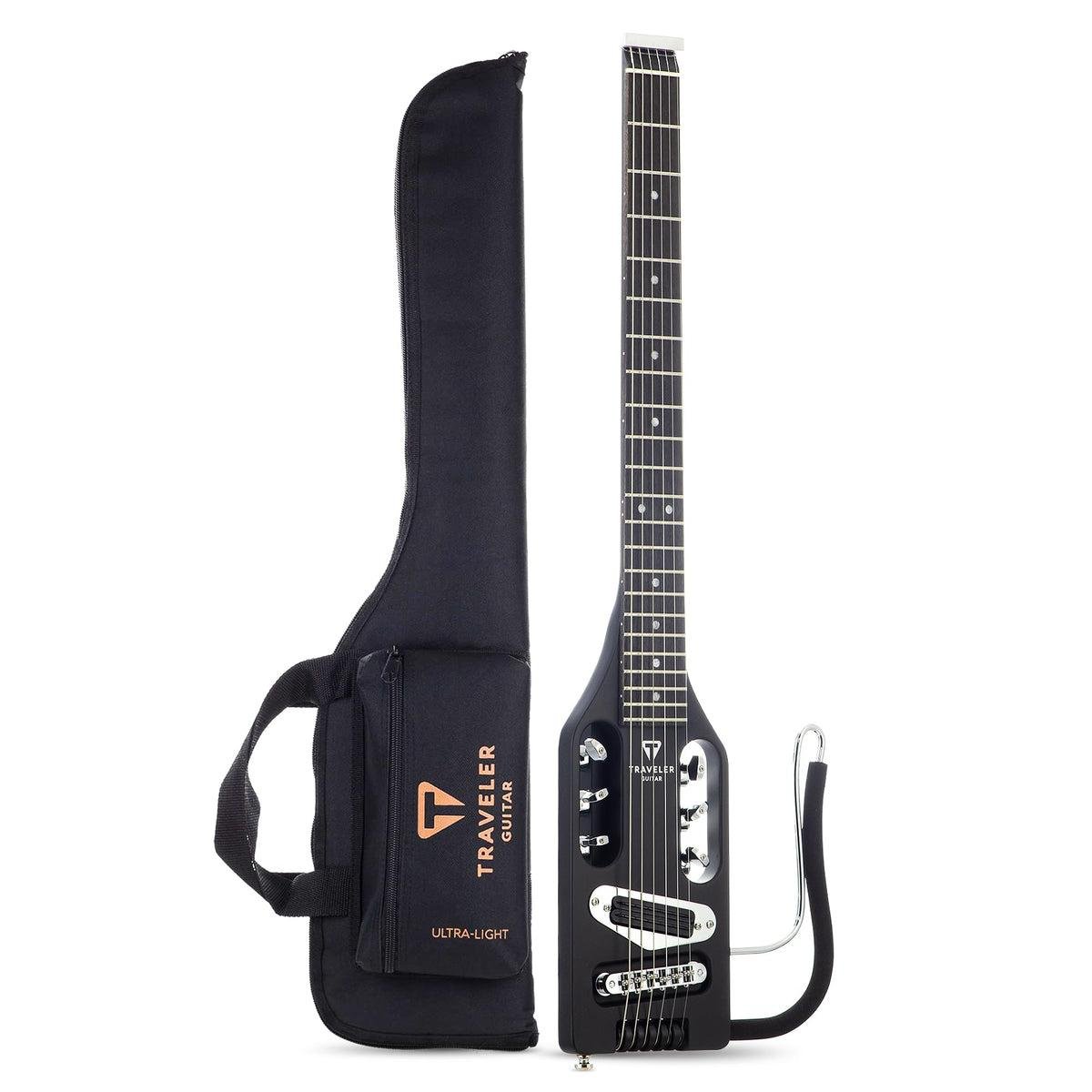
A guitar that is only 28 inches long usually comes with a catch: shortened frets, toy-like proportions or a playing feel that has little in common with your everyday instrument. The Traveler Guitar Ultra-Light Electric takes a cleverer route. It keeps a proper 24¾-inch scale and six steel strings, then removes almost everything that makes a conventional electric guitar bulky.
In Matte Black, the result looks more like an exposed guitar neck with a pickup and a curved metal support than a traditional solid-body. That purposeful minimalism is appealing, but there are some important surprises behind the tiny outline.
What You Should Know Before Buying
Full scale does not mean conventional handling. The Ultra-Light has 22 medium frets, a 15.75-inch fingerboard radius and a 1¾-inch nut width. Chord spacing and string tension therefore feel much closer to a normal 24¾-inch electric than to a children’s short-scale instrument. The slim body, however, offers almost none of the familiar surface against which your forearm rests. Picking-hand position and the angle of the neck can take adjustment, especially when switching between this and a conventional guitar.
Traveler includes a removable lap rest: a curved metal frame that presses into holes along the instrument’s side. It helps support the guitar while sitting, but does not recreate the reassuring width and weight of a Stratocaster or Les Paul. Remove it for packing and the guitar becomes smaller still. Standing players can fit a conventional guitar strap using the provided buttons, although balancing such a narrow instrument may still feel unfamiliar.
You cannot simply plug headphones into the guitar. Its dual-rail humbucker is passive, and the instrument has a standard quarter-inch output jack. There is no onboard headphone amplifier, speaker, rechargeable battery, Bluetooth connection or effects processor. Played unplugged, the strings are relatively quiet, which is convenient for finger exercises, but you will not hear a satisfying amplified electric tone without extra equipment.
That might be an existing amplifier, a suitable audio interface or a portable unit such as the BOSS Katana Headphone Amplifier. Remember to include the required cable or headphones in your travel kit. A compact guitar does not necessarily mean a complete, self-contained practice system.
One pickup means a narrower palette. The single dual-rail humbucker provides a useful foundation for clean practice, overdriven riffs and direct recording through appropriate equipment. However, there is no neck-pickup option, five-way selector or familiar bank of volume and tone knobs to shape the signal at the instrument. Most tonal adjustment happens at the amplifier, pedal or software end. Players who continually ride the guitar’s volume control during a performance may miss that immediate access.
The tuners are ordinary machines in an extraordinary location. Instead of a headstock, the strings pass through an endcap, around rollers and back towards tuning machines mounted within the body. You tune from the front while holding the instrument normally. This saves a remarkable amount of length, yet restringing is less intuitive than on a regular guitar. Traveler’s manual recommends replacing three strings at a time because string tension helps hold certain components in position. The new string must follow the correct roller route and be wound with sufficient slack; careless winding can cause tuning problems.
The welcome detail is that special proprietary strings are not required. It ships with D’Addario EXL110 strings, and standard compatible electric guitar sets can be used. Still, allow extra time for your first string change rather than attempting it just before a rehearsal.
Travel-ready is not indestructible. The one-piece Eastern American hard maple neck-through construction feels like a serious design decision rather than a novelty shortcut. The matte finish is understated, and the black instrument looks particularly striking without a large body or pickguard. Yet this remains a wooden guitar with metal hardware, frets, strings and a jack socket. Temperature swings, dry air, knocks and poor storage can affect it just as they can a larger instrument.
The included soft gig bag is shaped for the 28-inch guitar and makes carrying convenient. It is not a rigid flight case. Airline overhead storage also depends on the carrier’s rules, available space and staff decisions; the guitar’s dimensions are an advantage, not a guarantee that it will always travel in the cabin.
Small size does not automatically mean a small learning curve. If you’re completely new to guitar, a conventional body can offer more stable reference points for your picking arm and seated posture. The unusual tuning route and exposed compact construction also introduce details that a beginner may find distracting. For travelling musicians who mainly want an acoustic instrument they can play without electronics, the Enya Nova Go Travel Guitar takes a different approach, offering a compact resonant body and no need for amplification.
Who Should Probably Avoid This Product?
Players who expect headphone-ready sound straight from the instrument should look elsewhere or budget for a separate amplifier. The same applies to anyone who needs several pickup combinations, onboard tone adjustment or the physical support of a full-size guitar body.
It may also frustrate a player who dislikes unfamiliar stringing systems, wants a guitar that can take rough treatment in unprotected luggage or needs the natural volume of an acoustic for playing outdoors. A tiny electric guitar is still an electric guitar: the portability does not remove its dependence on appropriate sound equipment.
If your main guitar rarely leaves the house and storage space is plentiful, the compromises may offer little practical benefit. And beginners may find a regular electric more comfortable for establishing consistent posture and technique.
Who Will Benefit Most?
For an established guitarist who travels frequently, the Ultra-Light offers something genuinely valuable: familiar fret spacing in a package that is far easier to fit beside clothes, luggage and work equipment. Its roughly three-pound weight and narrow body make it a plausible companion for hotel-room exercises, backstage warmups and quiet sessions in a small apartment.
Its standard output means it can join an existing pedalboard, practice amp or recording interface without proprietary adapters. Guitarists who already carry compact amplification are especially well positioned to appreciate it.
The choice becomes clearer alongside the Donner HUSH-I PRO Travel Guitar, which uses a slim travel-oriented design but provides integrated headphone-focused electronics. The Traveler is deliberately simpler on the instrument side, leaving the amplified sound to your chosen external rig.
For other instruments with distinct playing personalities, browse our Electric Guitars guides. Portability is one reason to choose a guitar; feel, sound and the way you actually practise matter just as much.
The Ultra-Light Electric does not pretend that removing the body is free of compromises. What it preserves is the part that matters most for practising chords, scales and techniques away from home: a genuinely full-scale neck. If your playing life involves regular travel and you already have a way to amplify it, that unusual balance of familiarity and minimal bulk has a clear purpose.
As an Amazon Associate I earn from qualifying purchases.
Opens Amazon (paid link)