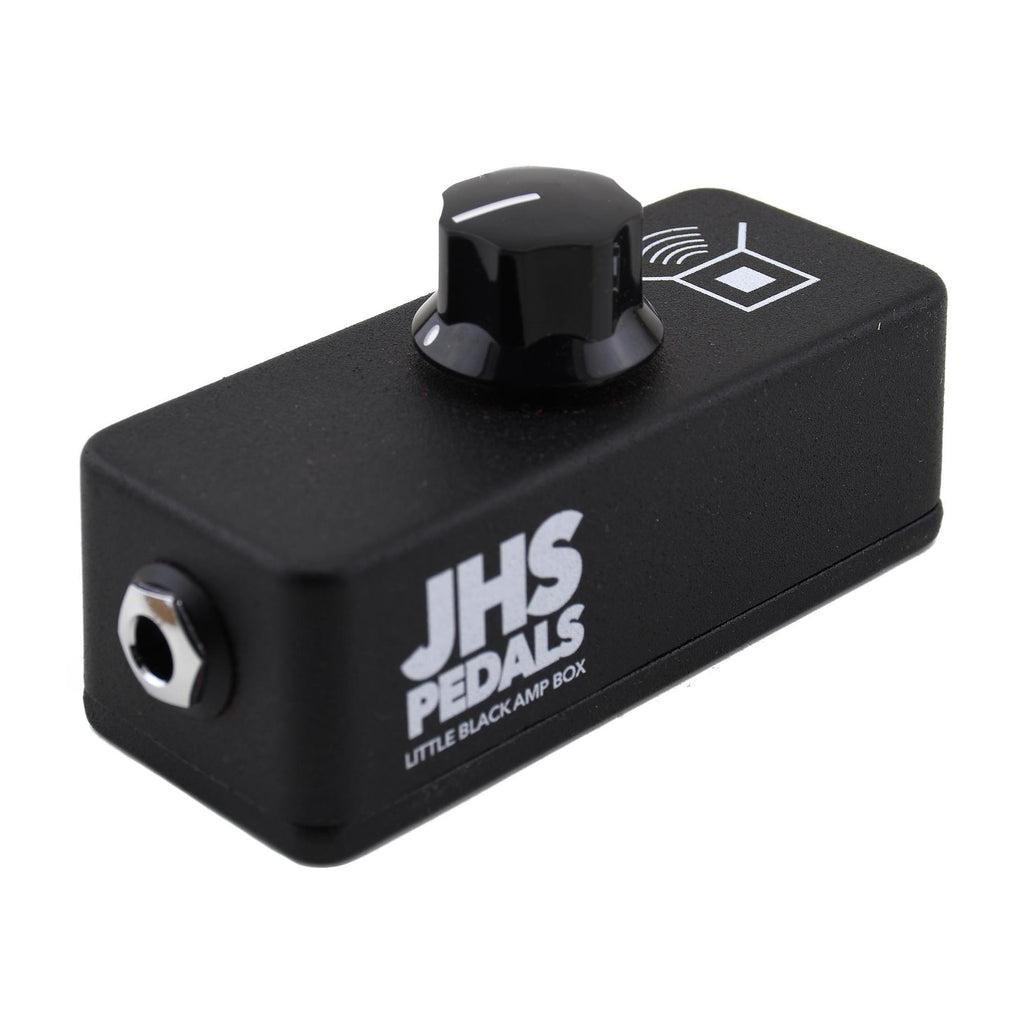
JHS Little Black Amp Box
As an Amazon Associate I earn from qualifying purchases.
There’s something wonderful about a guitar amplifier when it reaches the point where the tone starts to come alive. Unfortunately, the volume that produces that sound isn’t always welcome in a bedroom, apartment or shared home.
The JHS Little Black Amp Box offers a simple way to manage that problem, provided your amplifier has the correct type of effects loop.
It’s a tiny black box with one control knob, two audio connections and no need for batteries or external power.
But there’s an important catch: this isn’t a conventional speaker attenuator, and using it incorrectly could damage your equipment.
A Small Box With a Very Specific Purpose
The Little Black Amp Box is a passive volume control designed to operate inside a guitar amplifier’s series effects loop.
It sits between the amplifier’s preamp and power amplifier sections, allowing you to reduce the signal reaching the power stage.
This means you can turn up the amplifier’s preamp to develop more of its driven character while controlling the overall output level.
It’s a particularly interesting option for guitarists who enjoy the sound of preamp distortion but find the resulting volume difficult to manage.
Unlike an elaborate multi-effects processor, the Little Black Amp Box doesn’t attempt to introduce different amplifier models, digital effects or presets.
Its purpose is simply to control signal level in the correct location.
For players interested in a completely different approach to amplifier sounds, our Universal Audio UAFX Dream ’65 Reverb Amplifier guide explores a dedicated amplifier-modelling pedal.
Compact and Completely Passive
JHS has kept the design deliberately uncomplicated.
The enclosure measures approximately 3.6 × 1.5 × 1 inches, making it small enough to fit on a crowded pedalboard or sit near an amplifier.
The black powder-coated housing is understated, with a single knob providing volume adjustment.
There’s no display, menu, battery compartment or power socket to worry about.
Because the circuitry is passive, the device doesn’t require an external power supply.
That makes it appealing to players who want one specific function without introducing another powered component into their setup.
However, its simplicity doesn’t mean it’s compatible with every amplifier.
What You Should Know Before Buying
This is where the details really matter. The Little Black Amp Box can be useful in the right setup, but several misunderstandings could lead to disappointment or even damaged equipment.
Your Amplifier Must Have a Series Effects Loop
This is the most important requirement.
The Little Black Amp Box must be connected through a compatible series effects loop, normally using the amplifier’s effects send and return connections.
If your amplifier doesn’t have an effects loop, this product isn’t suitable for its intended purpose.
JHS also specifically warns against using it with a parallel effects loop because it won’t produce the intended result.
Before purchasing, check your amplifier’s manual to establish how its effects loop operates.
Don’t assume that every amplifier with send and return sockets has the correct loop configuration.
Never Connect It to a Speaker Output
This point deserves particular attention.
The Little Black Amp Box must never be connected between an amplifier’s speaker output and its speaker cabinet.
JHS explicitly warns that doing so will damage equipment.
Speaker connections carry a completely different type of signal from the line-level connections found in an effects loop.
The Little Black Amp Box isn’t designed to handle speaker-level power.
It must not be used as a substitute for a speaker attenuator or load box.
If you’re uncertain which sockets are which, consult the amplifier manufacturer’s instructions before connecting anything.
It Doesn’t Reproduce Full Power-Amp Saturation
The marketing appeal of lowering volume while retaining a driven amplifier sound is understandable.
However, there’s an important technical distinction.
The Little Black Amp Box reduces the signal entering the power amplifier. It doesn’t reduce the power after the amplifier’s output stage.
That means it can help you retain preamp distortion at lower listening levels, but it cannot reproduce the complete behaviour of a power amplifier and output transformer operating at high volume.
Players whose favourite sound depends heavily on power-stage saturation may not achieve what they’re expecting.
For that particular requirement, a suitable speaker attenuator or reactive load system may be more appropriate.
Results Depend on Your Amplifier
Two amplifiers can respond quite differently to the same volume-control arrangement.
An amplifier with substantial preamp gain may benefit considerably from the ability to reduce the signal entering its power stage.
A cleaner amplifier that develops most of its distortion only when the power section is pushed may show less benefit.
This is why the Little Black Amp Box shouldn’t be viewed as a universal solution for achieving cranked amplifier tones at whisper-quiet volume.
Its usefulness depends on your amplifier’s actual circuit design.
Other Effects-Loop Pedals May Behave Differently
JHS advises against routinely combining other effects pedals in the loop alongside the Little Black Amp Box because their sound can be affected.
Delay, reverb and modulation pedals may behave differently depending on where they sit relative to the volume control.
Although experimenting with compatible effects-loop pedals is not inherently damaging, you may need to reconsider their order or settings.
This matters particularly for guitarists who already rely on a carefully arranged effects loop.
The Little Black Amp Box isn’t guaranteed to slot into every existing rig without changing anything else.
You’ll Need Suitable Instrument Cables
The device has quarter-inch audio connections, so you’ll need appropriate cables to connect it between the amplifier’s effects send and return.
Check what cables you already own before purchasing.
Long cable runs can also be inconvenient if you intend to place the box on a pedalboard some distance from the amplifier.
Keeping the arrangement tidy may require additional planning.
It Won’t Make Every Amplifier Suitable for Silent Practice
Reducing the signal level can make an amplifier more manageable, but that doesn’t make it a headphone amplifier.
The Little Black Amp Box has no headphone socket, speaker simulation or built-in recording connection.
It also doesn’t eliminate the need for a speaker or suitable load where the amplifier requires one.
For genuinely private headphone practice, our BOSS Katana Headphone Amplifier guide covers equipment designed for that purpose.
It’s Not a Footswitchable Volume Pedal
Although it resembles a miniature guitar pedal, the Little Black Amp Box has no footswitch.
It’s intended to provide a manually adjusted volume setting rather than instant changes during a performance.
Players wanting to switch between different output levels mid-song may need another solution.
The design is best suited to setting an appropriate amplifier level before playing.
Who Should Probably Avoid This Product?
Players whose amplifiers lack a series effects loop should avoid it because it cannot perform its intended function.
Guitarists seeking genuine power-stage attenuation need equipment designed to operate safely at the appropriate point in the amplifier system.
Musicians using parallel effects loops should follow JHS’s compatibility warning.
Players who require headphone output or silent recording won’t find those features here.
Performers wanting footswitchable volume changes may prefer a conventional volume pedal or another suitable control system.
And anyone unfamiliar with amplifier connections should establish compatibility before purchasing rather than relying on the appearance of the sockets.
Who Will Benefit Most?
The Little Black Amp Box is best suited to electric guitarists who already own a compatible amplifier with a series effects loop.
It’s especially relevant to players who enjoy pushing their amplifier’s preamp but need better control over the resulting volume.
Home musicians, rehearsal-room players and anyone working in a smaller space may appreciate its simple operation.
It can also suit experienced guitarists who want a compact, passive utility device without adding software or another power connection.
If you’re exploring alternative practice equipment, our JOYO JAM Buddy II portable amplifier article covers another way to manage guitar sounds in smaller spaces.
You can discover more equipment for different playing environments in our Amplifiers collection where the focus is on finding the right setup for the way you actually play.
The most important thing is choosing a solution that matches your amplifier and the sound you’re trying to achieve.
Simple Volume Control, When Used Correctly
The JHS Little Black Amp Box is an appealing example of a product designed to solve one specific problem without unnecessary complexity.
Its compact enclosure, passive operation and single control make it straightforward to incorporate into a suitable setup.
However, understanding what it doesn’t do is essential. It isn’t a speaker attenuator, it won’t recreate full power-stage saturation at reduced volume, and it requires a compatible series effects loop.
For guitarists with the right amplifier and realistic expectations, this little box offers a practical way to enjoy more preamp drive without always turning the room into a rehearsal studio.
As an Amazon Associate I earn from qualifying purchases.
Opens Amazon (paid link)