Tone That Travels Wherever You Play
As an Amazon Associate, we may earn from qualifying purchases. This comes at no extra cost to you and helps support our website.
Guitar Playing Doesn’t Always Happen Where You Planned
There’s a version of practicing that most guitarists imagine — sitting in a dedicated space, amp warmed up, everything plugged in and ready. And then there’s the version that actually happens most weeks: fifteen minutes on a lunch break, a half hour at a friend’s place with no amp in sight, or an evening where the only quiet spot in the house is a bedroom corner with nothing but a set of headphones nearby.
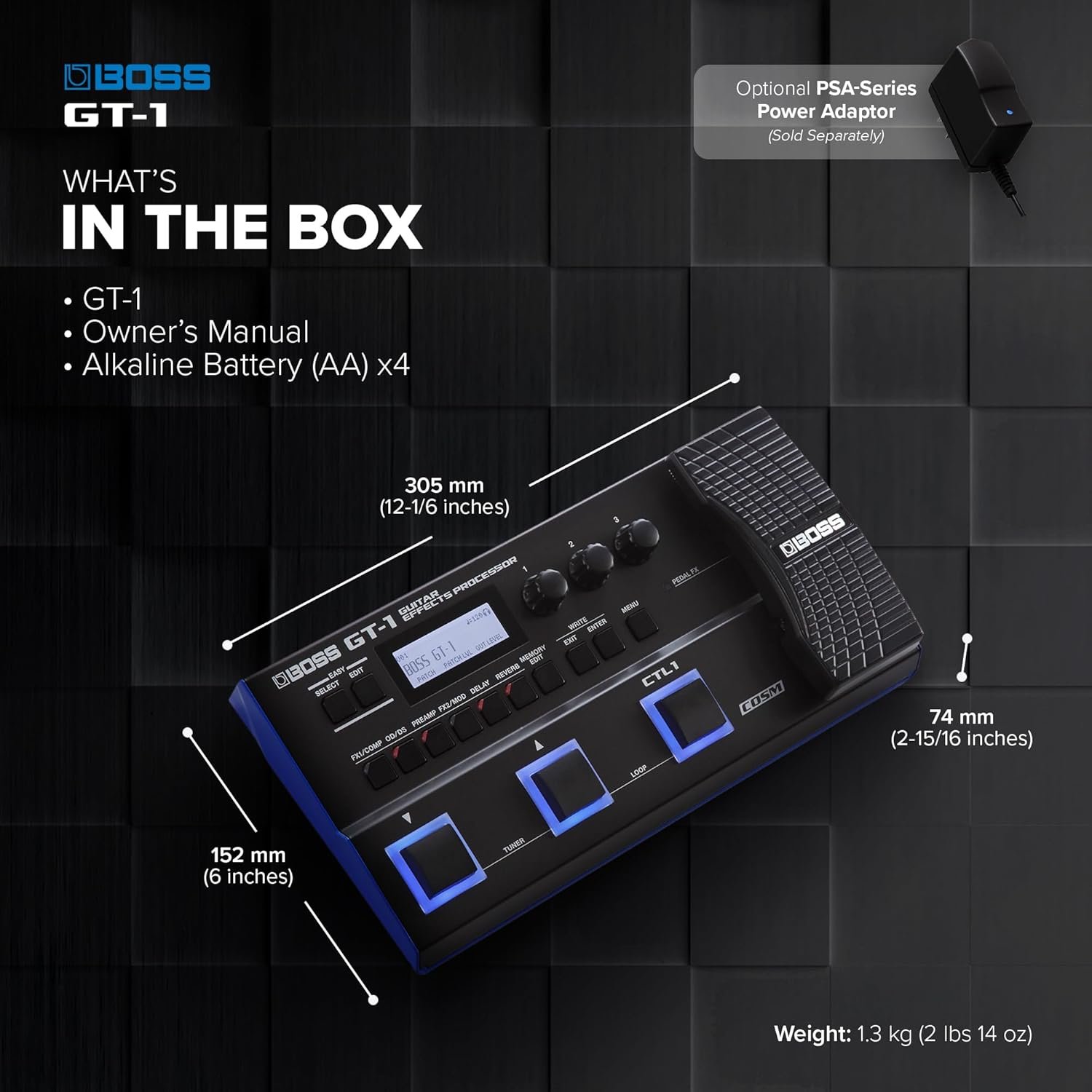
A portable guitar effects processor tends to earn its place in exactly those in-between moments. Something like the BOSS GT-1 isn’t built around the idea of a permanent setup in one room. It’s built for the reality that a lot of playing time happens somewhere else entirely — on a couch, in a rehearsal space you’re borrowing for the hour, or on a sidewalk with a case open for tips.
Small Enough to Actually Bring With You
Gear that’s genuinely enjoyable to use tends to be gear that doesn’t add friction to picking it up in the first place. A rig that requires setup time, cable routing, and a dedicated corner of a room is a rig that quietly gets used less often than intended, simply because getting everything ready feels like its own small project.
This is where the compact size and rounded, no-hard-edges design start to matter more than they might sound like on a spec sheet. Being able to toss the unit into a guitar bag without worrying about sharp corners digging into other gear makes it something you’re more likely to actually grab on your way out the door, rather than leaving it behind because packing it feels like a hassle.
Practicing Without Needing an Amp Nearby
One of the more underrated shifts that comes with a compact multi-effects pedal like this is how much it changes where practice can happen. Plugging in headphones and running through amp models and effects means a full range of tones is available without needing an actual amplifier turned up in the room — useful for apartment living, late-night sessions, or simply not wanting to disturb whoever else is in the house.
For a lot of players, that alone opens up practice time that wouldn’t have existed otherwise. Instead of waiting for a window where an amp can be cranked without annoying anyone, a quiet late-night session becomes just as viable as an afternoon rehearsal.
Built With Busking and Mobile Gigs in Mind
Street performing and casual mobile gigs come with a specific set of practical demands that a lot of gear simply isn’t designed around. Reliable power without an outlet nearby is one of the biggest. Running on four AA batteries with up to seven hours of playing time means a busker or traveling musician isn’t tied to finding a power source before they can even start playing — they can set up wherever there’s foot traffic and simply go.
That kind of self-contained reliability tends to matter just as much for casual mobile gigs — a backyard party, a small outdoor event, a friend’s acoustic set that suddenly needs a bit of tone shaping. Not needing to hunt for an extension cord or worry about outlet access removes one more variable from an already unpredictable setting.
Getting to a Usable Sound Quickly
Nobody wants to spend twenty minutes digging through menus when they’ve got a limited window to actually play. Easy Select and Easy Edit functions are aimed specifically at that problem — getting to a patch that sounds right, and making small adjustments to it, without needing to understand every parameter in the underlying signal chain first.
This matters especially for players who are still building confidence with effects in general. Rather than being confronted with an overwhelming number of settings, a streamlined interface makes it realistic to find a workable tone in a couple of minutes and get back to actually playing, which tends to keep practice sessions feeling productive instead of fiddly.
Room to Grow Into, Not Just Grow Out Of
A common concern with beginner-friendly gear is that it gets outgrown quickly, leaving a player needing to replace it within a year or two. The GT-1 runs on the same underlying BOSS GT-series engine found in the brand’s more advanced processors, which means the range of amps and effects available goes well beyond what a newer player might initially explore.
That range becomes more relevant as playing style develops. A beginner might start with a handful of go-to patches for practicing. Months later, that same player might be experimenting with layered modulation effects or dialing in a specific amp voicing for a song they’re learning. The unit doesn’t need to be replaced for that progression to happen — it just gets used differently as skills develop.
Expanding Sounds Through BOSS Tone Central
For players who want to keep exploring beyond the onboard presets, connecting to BOSS Tone Central opens up free downloadable patches and editing software. This turns the unit into something that can keep evolving alongside a player’s taste, rather than staying limited to whatever came loaded on it out of the box. Trying a patch built around a completely different genre than what you usually play is a low-effort way to shake up a practice routine that’s started to feel repetitive.
A Practical Fit for Everyday Playing Situations
Picture a typical week for a lot of guitarists: some solo practice at home, maybe a rehearsal with a band, occasionally bringing an instrument along on a trip just in case there’s a quiet moment to play. A single compact unit that handles tone shaping across all of those situations — without needing a pedalboard, a separate amp, or a stack of individual pedals — simplifies things considerably.
The onboard expression pedal and assignable control switch add a layer of real-time control that’s genuinely useful in a live or rehearsal setting, letting a player adjust a wah or volume-style effect on the fly without reaching down to twist a knob mid-song. And with a USB connection available, the unit can also tie into a computer setup for recording ideas, which extends its usefulness beyond live playing into home recording as well.
Where This Settles Into a Musician’s Routine
For someone just starting to explore effects and looking for a way in without getting overwhelmed, for a traveling player who needs gear that works without relying on an outlet, or for a band member who wants a compact solution for both rehearsals and the occasional gig, a portable guitar effects processor like this tends to adapt to the situation rather than demanding the situation adapt to it.
It won’t replace a full pedalboard for a player chasing a very specific, curated live tone, and it isn’t trying to. What it offers instead is flexibility — a way to keep playing, practicing, and experimenting with tone regardless of where that happens to take place, whether that’s a bedroom at midnight, a rehearsal space on a Tuesday, or a sidewalk corner on a Saturday afternoon.
Check It Out!